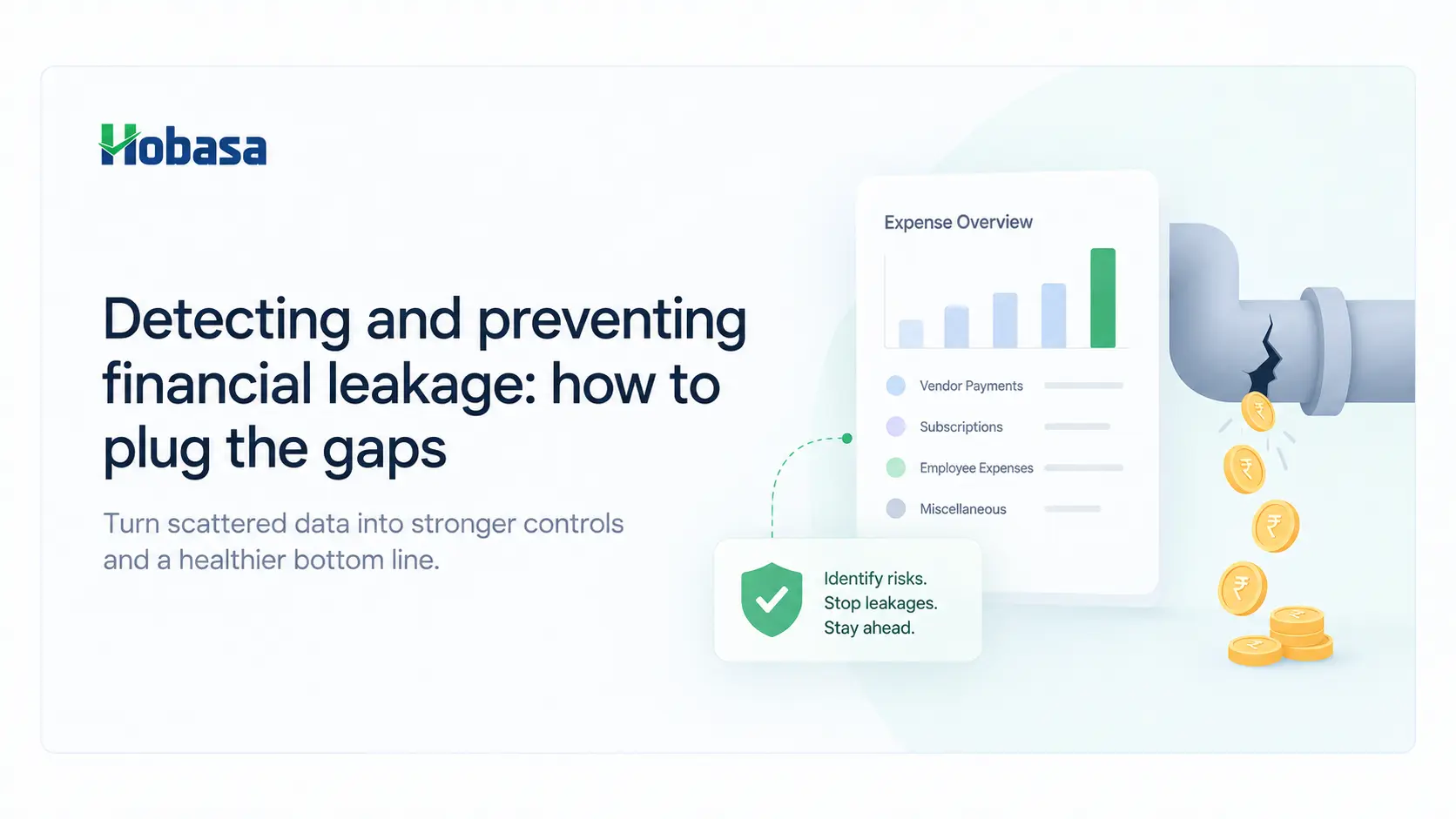
- Financial leakages are often a result of process inefficiencies, invoice errors, supplier overpayments, payroll inaccuracies, and weak controls.
- Common leakage areas include expenses, procurement, payables and receivables, and payroll, among others.
- Financial leakages go undetected because of fragmented systems, high transaction volumes, periodic reporting cycles, and excessive focus on fixing issues rather than preventing them.
- CFOs can identify leakages earlier by improving visibility across finance operations, monitoring anomalies continuously, and focusing on recurring patterns rather than isolated incidents.
- Preventing financial leakages requires stronger controls, standardized processes, better data quality, reduced reliance on manual workarounds, and clear ownership across functions.
- The most effective organizations focus on prevention and continuous visibility rather than relying solely on audits and month-end reviews.
When it comes to profitability, managing major costs and making sound strategic investments are only one part of the equation. As a CFO, you also need visibility into the operational inefficiencies and process gaps that tend to deteriorate financial performance over time.
A duplicate payment that slips through. A supplier overcharge that goes unnoticed. A manual workaround that introduces recurring errors into a process.
Individually, these issues may seem immaterial. Collectively, they can create significant financial leakage across the organization.
The challenge is that these errors are often scattered across finance operations, hidden within transaction volumes, and difficult to detect through traditional reporting alone. As organizations grow and processes become more complex, even well-run finance teams can struggle to identify where value is being lost.
In this blog, we explore where financial leakages typically occur, why they often remain undetected, and how CFOs can build stronger processes to identify and prevent them before they affect profitability.
Where financial leakage commonly occurs
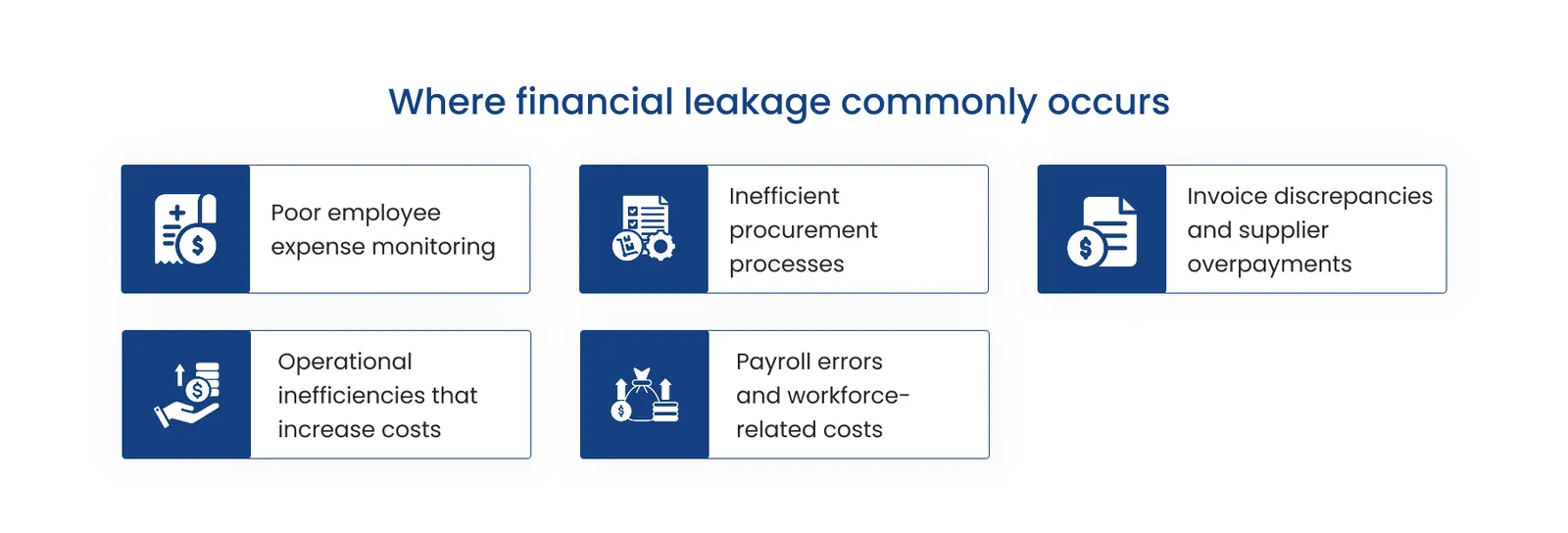
Financial leakage typically emerges at process intersections, where volume, complexity, and manual work create room for small but persistent losses.
Understanding where to look is the first step toward detecting leakage early.
1. Poor employee expense monitoring
Employee and business expenses can become a source of financial leakage when spending is not monitored consistently or expense policies are not enforced properly.
Common issues include duplicate reimbursement claims, expenses submitted without receipts or supporting documents, spending that falls outside company policies, and unnecessary purchases that are approved without sufficient review.
Individually, these expenses may seem minor. But across hundreds or thousands of transactions, they can add up quickly and create significant costs.
Regular reviews, clear expense policies, and stronger approval processes can help you control spending and reduce financial leakage.
2. Inefficient procurement processes
Procurement-related financial leakages often occur long before invoices reach your finance team. Purchases made outside approved procurement channels, poor contract management, and limited visibility into vendor spending can all lead to unnecessary costs.
For example, different departments may purchase similar products from multiple suppliers at different price points, negotiated discounts may go unused, or contracts may renew automatically without review. Over time, these inefficiencies can increase procurement costs and reduce your ability to manage spend strategically.
Because procurement data is often distributed across purchasing systems, contracts, and finance platforms, these leakages can be difficult to identify without a consolidated view of spending patterns and supplier relationships.
3. Invoice discrepancies and supplier overpayments
Invoice-related mistakes are one of the most common sources of financial leakage.
These issues can include duplicate invoices, incorrect billing amounts, payments made twice for the same invoice, or invoices that do not match agreed pricing terms.
In organizations processing large volumes of transactions, these errors can easily blend into day-to-day finance activities and remain unnoticed for months.
Recurring invoice errors can gradually increase costs, create unnecessary cash outflows, and affect the accuracy of financial reporting.
With regular invoice reviews, automated validation checks, and continuous monitoring, you can identify these issues earlier and prevent small errors from turning into larger financial losses.
4. Operational inefficiencies that increase costs
Not all financial leakages stem from accounting errors. Many arise from inefficient processes that consume time, resources, and budget unnecessarily. Manual workarounds, duplicated effort across teams, delayed approvals, fragmented workflows, and excessive reliance on spreadsheets can all contribute to hidden costs.
These inefficiencies rarely appear as line items in financial statements, yet they can significantly impact productivity and profitability.
5. Payroll errors and workforce-related costs
Payroll is typically one of the largest expenses for most organizations, making even small inaccuracies financially significant. Errors in compensation calculations, overtime payments, benefits administration, employee classification, or payments to inactive employees can create unnecessary costs while exposing your organization to compliance risks.
Without regular validation and monitoring, these issues can persist for long periods before being identified.
Leakage hiding in process gaps and handoffs?
Hobasa helps CFOs detect invoice, payroll, and vendor discrepancies while they are still small.
Talk to our teamWhy financial leakages often go undetected
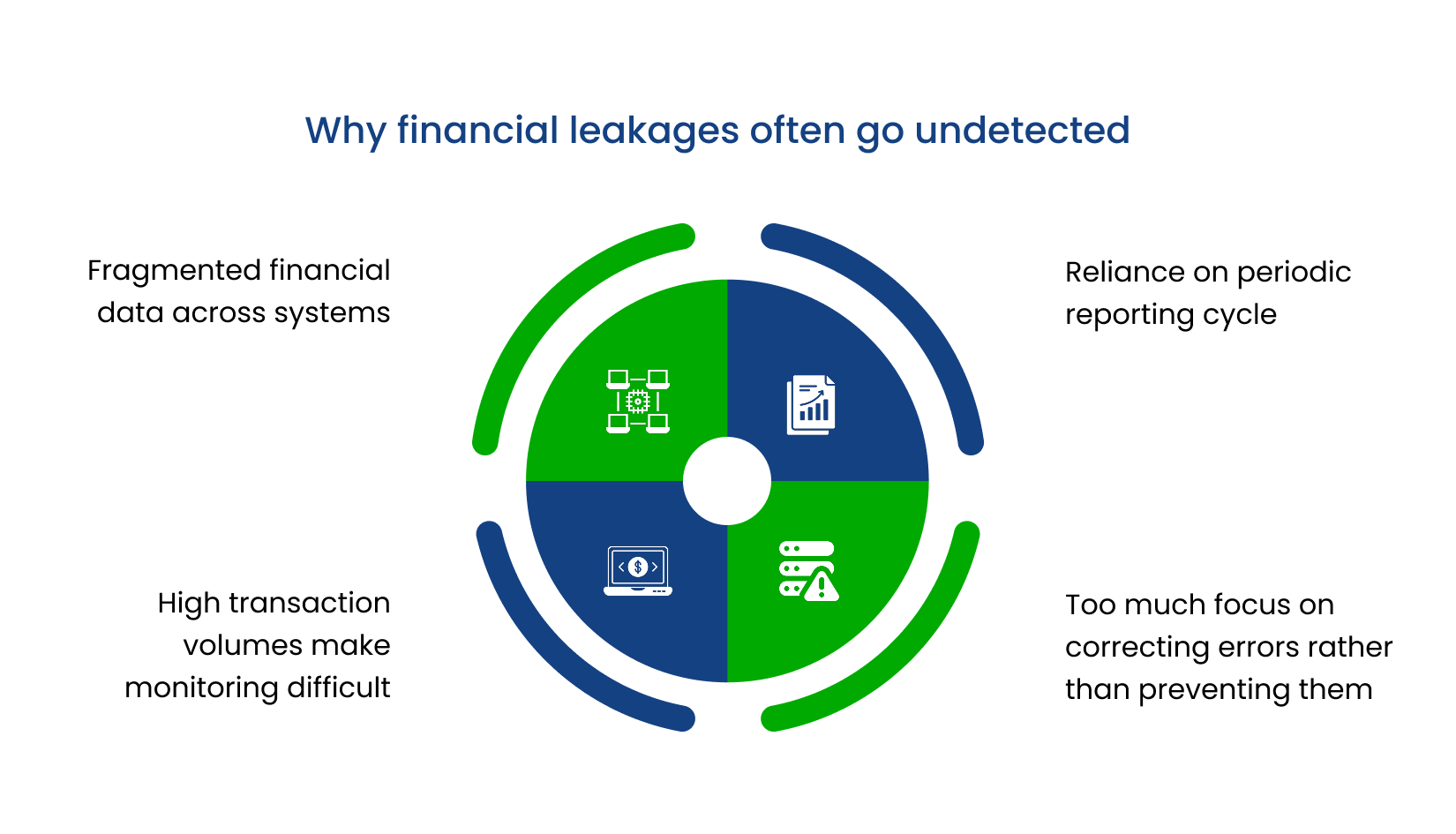
Most organizations already have financial controls and reporting processes in place. Yet leakages still occur.
The issue is often not a lack of oversight but limited visibility into emerging exceptions and process breakdowns.
1. Fragmented financial data across systems
When financial data is spread across ERP systems, accounting platforms, payroll software, procurement systems, and expense management tools, tracking issues and monitoring trends becomes a challenge. More so because these systems often operate independently which makes it difficult to identify connection between transactions.
Small discrepancies that appear harmless in one system may represent a broader issue when viewed end-to-end - but fragmentation makes that connection difficult to see.
2. Reliance on periodic reporting cycle
Many organizations still rely heavily on month-end reviews, quarterly audits, or annual compliance checks to identify issues.
While these reviews remain important, they often identify problems after financial impact has already occurred.
By the time issues are discovered, corrective options may be more limited and costly.
3. High transaction volumes make monitoring difficult
Modern finance functions process thousands - or even millions - of transactions annually.
With traditional controls and manual reviews, it's neither practical nor scalable to review transactions and identify risks as they emerge.
As transaction volumes grow, small discrepancies can easily be overlooked and escalate into bigger issues if not corrected in time.
4. Too much focus on correcting errors rather than preventing them
Many finance teams operate in environments where immediate issues naturally take priority. When discrepancies, payment errors, or reporting issues arise, the focus is often on resolving them quickly so that operations can continue without disruption.
While corrective action is important, this approach can create a cycle where the same issues repeatedly resurface. Teams spend significant time fixing individual transactions or exceptions without fully examining the underlying process gaps, control weaknesses, or data quality issues that caused them.
How CFOs can detect financial leakages earlier
Financial leakages often emerge through small inconsistencies, process deviations, and operational inefficiencies that accumulate over time. The challenge for CFOs is not simply identifying these issues once they become visible - it is creating the conditions to detect them before they begin affecting profitability, cash flow, or operational performance.
1. Improve visibility across finance operations
The first step toward identifying financial leakages earlier is gaining a connected view of finance operations.
In many organizations, critical financial data is spread across ERP systems, procurement platforms, payroll applications, expense management tools, and spreadsheets. While each system provides valuable data independently, they often fail to provide the broader context needed to identify emerging risks.
This is where Hobasa can help. By bringing together data from your existing financial systems, Hobasa provides connected visibility across finance operations, surfacing anomalies, process gaps, and potential risks in real time.
When finance data is connected and viewed holistically, it becomes easier to spot unusual spending patterns, recurring discrepancies, process bottlenecks, and cost drivers that may otherwise remain hidden.
2. Monitor financial exceptions and anomalies continuously
Financial leakages are frequently preceded by anomalies that appear insignificant when viewed individually but become meaningful when observed collectively.
Examples may include recurring invoice discrepancies, unusual vendor payment activity, unexpected payroll variances, repeated expense policy violations, or unexplained write-offs. These exceptions often indicate weak internal controls or process inefficiencies.
Organizations that continuously monitor financial exceptions are often able to identify issues much earlier than those relying solely on periodic reviews or audits.
3. Focus on patterns, not just individual incidents
Many financial leakages persist because they are treated as isolated events rather than symptoms of a broader issue.
A duplicate payment may be written off as a one-time error. A supplier overcharge may be corrected and forgotten. A payroll discrepancy may be resolved without further investigation. However, when similar issues occur repeatedly, they often point to weaknesses in processes, controls, or system integrations.
By analyzing trends across transactions, vendors, departments, and finance processes, you can identify recurring sources of leakage and address them proactively.
4. Shift from periodic reviews to real-time financial monitoring
Traditional finance reviews remain important, but they are often retrospective by nature. By the time an issue appears in a monthly report or audit review, the financial impact may have already occurred.
This is why an approach where you can continuously monitor your company's cash flow, operating expenses, payables, and receivables is extremely important. With always-on monitoring, your team can quickly identify risks closer to the point of occurrence, reducing both the impact and cost of remediation.
The objective is not to review more data. It is to ensure that the right signals reach decision-makers while there is still time to act.
5. Use technology to surface risks that are difficult to detect manually
As transaction volumes continue to increase, identifying financial leakages through manual reviews alone becomes increasingly difficult.
With data streaming from all directions, modern finance functions need analytics, automation, and AI-powered monitoring tools to identify anomalies, mismatches, unusual patterns, across transactions. These technologies can help surface risks that might otherwise remain buried within routine finance activity.
What's important to note is that technology does not replace financial judgment. Its value lies in helping you focus your attention on the transactions, patterns, and exceptions that need deeper investigation, so that potential leakages can be addressed before they turn into huge losses.
Find leakage earlier than the month-end review.
See how Hobasa monitors cross-system gaps so finance can plug them at the source.
Get in touchHow to prevent financial leakages: 7 practical tips for CFOs
Detecting financial leakages is important, but long-term value comes from preventing them from occurring in the first place.
While no organization can eliminate every exception or error, you can significantly reduce leakage exposure by strengthening processes, improving visibility, and creating greater accountability across finance operations.
1. Standardize processes across finance functions
Inconsistent processes are one of the most common sources of financial losses.
When departments follow different procedures for invoice approvals, expense reporting, procurement, or reconciliations, the likelihood of errors increases. Standardized workflows help improve consistency and make it easier to identify unusual transactions when they occur.
Areas that often benefit from standardization include:
• Invoice processing and approvals
• Expense reimbursement procedures
• Vendor onboarding and maintenance
• Reconciliation workflows
Consistent processes not only reduce errors but also create a stronger foundation for automation and reporting.
2. Strengthen internal controls
Financial leakages often expose weaknesses in your internal controls.
Effective controls help ensure that transactions are reviewed appropriately, responsibilities are clearly defined, and unusual activities are investigated before they create larger problems.
Strong control frameworks typically include clear approval hierarchies, vendor validation procedures, and properly documented policies and compliance requirements.
The objective is not to introduce unnecessary complexity, but to create safeguards that support accuracy and accountability.
3. Improve data quality across systems
Poor data quality can undermine even well-designed finance processes.
Duplicate vendor records, inconsistent account classifications, incomplete financial information, and disconnected systems all increase the risk of reporting inaccuracies and operational inefficiencies.
Improving data consistency across finance systems helps create more reliable reporting, supports better analysis, and reduces the effort required to reconcile data manually.
More importantly, high-quality data improves the accuracy of insights generated and conclusions drawn.
4. Reduce dependency on manual workarounds
Heavy reliance on spreadsheets, email-based approvals, and manual reconciliations increases the likelihood of errors, inconsistencies, and process breakdowns. In addition, these workarounds make it more difficult to maintain audit trails, enforce controls, and scale operations efficiently.
Common examples include:
• Exporting data from multiple systems and consolidating it manually.
• Tracking approvals through email chains.
• Maintaining separate spreadsheets to supplement core finance systems.
• Performing repetitive data validations outside existing workflows.
By automating repetitive activities, you can reduce dependence on these workarounds. This can help you improve consistency, strengthen controls, and free your teams from administrative activities that consume valuable time. More importantly, it allows you to focus on addressing the root causes behind process inefficiencies rather than continuously compensating for them.
5. Create clear ownership for leakage prevention
Preventing financial leakages should not rest solely with a single team.
Procurement, payroll, operations – all influence spending decisions and process execution. Without clear ownership, recurring issues can persist because no single team is responsible for addressing root causes.
To prevent financial leakages, it's crucial to define accountability for key finance processes, review recurring exceptions regularly, and use data-driven insights to strengthen processes over time.
When ownership is distributed appropriately, leakage prevention becomes an ongoing discipline rather than a one-off initiative.
6. Embed controls into everyday workflows
Internal controls are most effective when they operate as part of normal business activity - not as separate checkpoints applied after the fact. When controls sit outside day-to-day workflows, issues are often detected late, and corrective action becomes reactive and costly.
Embedding controls directly into financial workflows helps surface issues closer to their source.
For example, validating pricing at the point of order creation or flagging exceptions during invoice processing reduces the need for downstream corrections. This approach shifts control from retrospective review to real-time guidance.
When controls are built into workflows, they also become easier to follow and harder to bypass.
7. Close the loop between detection and action
Early detection only creates value if it leads to timely and consistent action. In many finance environments, leakage signals are identified - but not always translated into structural change. Issues are flagged, corrected once, and then reappear in later cycles because the underlying process remains unchanged.
Closing the loop means ensuring that every identified risk signal has a clear owner, response path, and follow-through. When anomalies - such as invoice discrepancies or supplier overpayments - are detected, they should trigger not only correction but also review of the process, control, or data gap that allowed the issue to occur.
This requires tighter alignment between insight and execution. Your finance teams need clear escalation thresholds, defined decision rights, and mechanisms to fix the underlying process.
Plug financial gaps with Hobasa
Financial leakages are the cumulative result of disconnected systems, manual workarounds, and process inefficiencies, that remain unnoticed until they begin affecting profitability.
For CFOs looking to stay ahead of these risks, Hobasa provides a more connected view of finance operations.
Hobasa works with your current financial systems and spreadsheets that are loaded with data. This data is processed and analyzed collectively to surface financial trends, risks, and leakages in real-time. As the underlying data changes, insights are continuously refreshed - giving you timely visibility into the issues that matter most.
With always-on AI-driven monitoring and proactive alerts, Hobasa helps you and your teams identify emerging risks, uncover the root causes behind recurring inefficiencies, and take corrective action before small leakages turn into larger financial losses.
Plug financial gaps with Hobasa.
Hobasa works alongside your existing finance systems and spreadsheets to surface trends, risks, and leakages in real time - so you can act before small issues turn into larger losses.
FAQs
Financial leakage commonly occurs in expense management, procurement processes, invoice handling, supplier payments, payroll, and billing processes.
Leakages are often missed because financial data is fragmented across systems, monitoring relies on periodic reviews, transaction volumes are too high for manual oversight, and corrective actions address symptoms without fixing root causes.
Common examples of financial leakage include duplicate supplier payments, invoice discrepancies, unauthorized expenses, and payroll errors.
CFOs can detect leakage earlier by connecting financial data across processes, monitoring exceptions continuously, focusing on patterns rather than one-off errors, and shifting from retrospective reviews to real-time financial awareness.
CFOs can identify financial leakages earlier by improving visibility across finance systems, monitoring anomalies and exceptions continuously, analyzing recurring patterns across transactions, moving from periodic reviews to real-time monitoring, and using analytics and AI-powered finance tools.