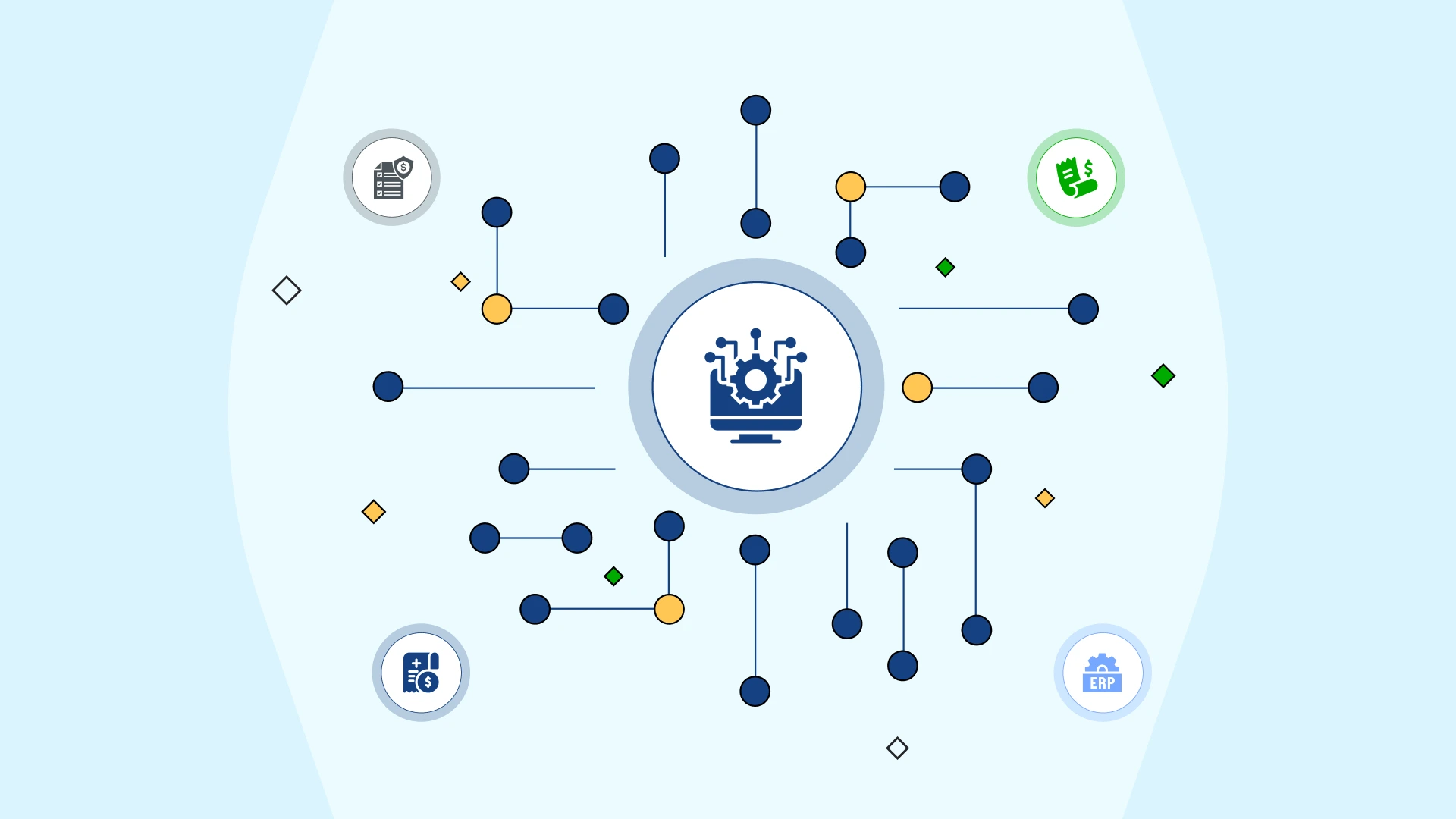
- Disconnected finance systems operate in silos, forcing teams to stitch together insights and reports manually.
- Fragmentation impairs operations, financial outcomes, and strategic response capability.
- The real-world cost shows up as slower decisions, weak forecasting, compliance risk, missed AI opportunities, productivity loss, longer close cycles, higher tech cost, and security vulnerabilities.
- Integrated finance systems provide a single source of truth - faster close cycles, embedded controls, reliable forecasts, and a stable foundation for AI.
- CFOs should treat fragmentation as a finance issue (not IT), prioritize integration over workarounds, and adopt a long-term modernization strategy.
- The shift from fragmentation to integration is a strategic transformation that positions finance leaders to guide decisions in a fast-changing environment.
Your finance team keeps switching between multiple tabs to monitor costs, expenses, and bills.
Yet the insights that emerge are often disconnected - spread across systems that don't talk to each other, making it harder for you to gain a true and timely financial picture.
While the financial systems might be brilliant at what they do, a lack of sync between them creates a fragmented data landscape - where critical data remains siloed, forcing finance teams to stitch together insights and reports manually.
*Over time, this fragmentation impairs visibility, slows analysis, and weakens decision-making.*
This blog throws light on the real-world cost you may incur when finance systems operate in silos. It also explores how fragmented and integrated finance environments differ and outlines what you can do to move toward a more connected data foundation.
What are disconnected financial systems?
Disconnected financial systems are platforms that operate independently, in silos, without sharing data with each other. This typically happens when the finance function relies on too many specialized tools separately for planning, analyzing, and reporting to meet growing business needs. Even if each platform is brilliant on its own, the lack of unified functioning creates a fragmented finance function.
This often manifests as:
• Multiple versions of financial data across systems
• Increased reliance on spreadsheets to reconcile differences
• Manual workarounds to fill system gaps
• Delayed access to financial insights
Finance systems that do not talk are already costing you.
Hobasa connects fragmented finance data so CFOs trust the numbers and move faster.
Talk to our teamWhat is at stake when financial systems don't work in sync?
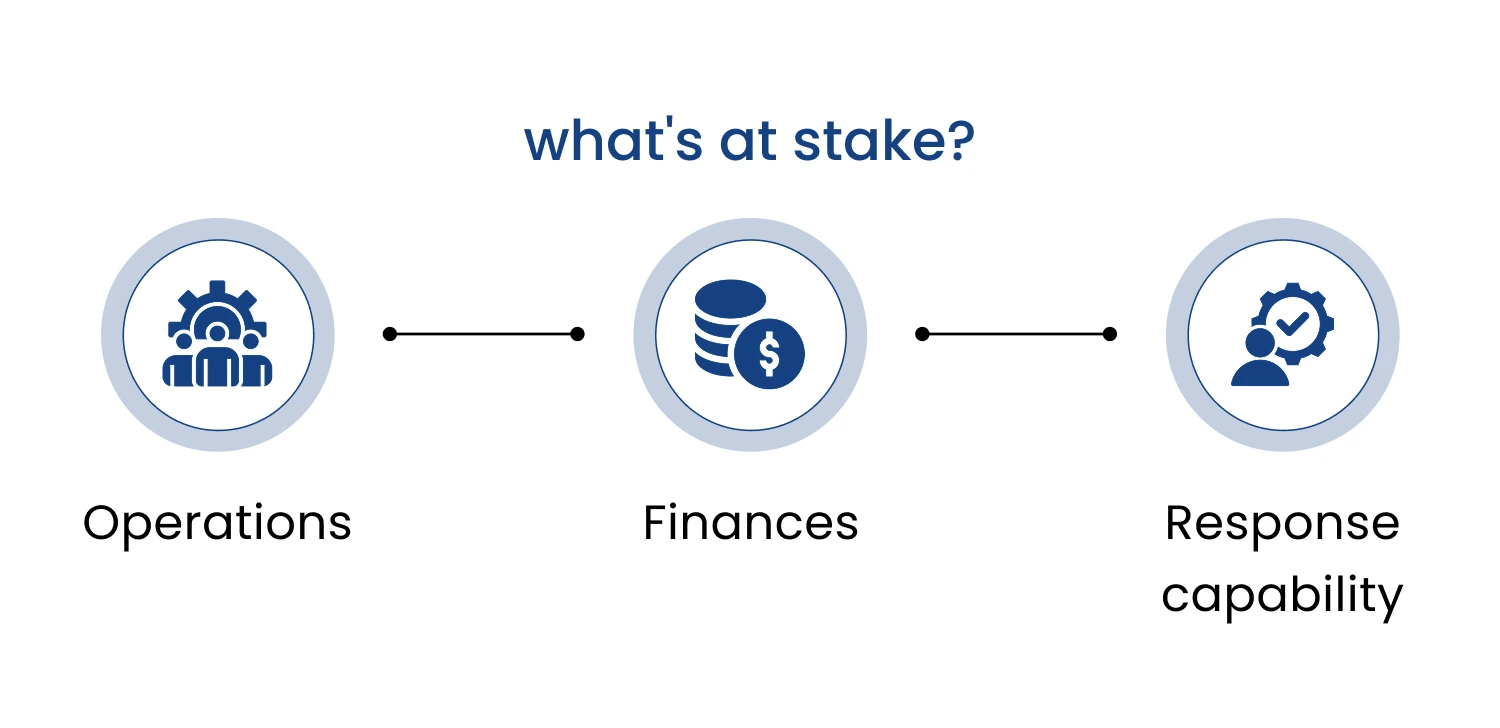
When financial systems work in silos, the consequences extend well beyond efficiency. There are 3 areas that are most significantly impacted - operations, finances, and strategic responsiveness.
1. Operations
Zoho reveals that 50% of businesses analyze data collected from fragmented sources and silos.
Note: This information was collected from a permissible source.
From an operational standpoint, fragmented systems require teams to compensate for gaps through manual effort. This means teams end up spending considerable time reconciling reports rather than analyzing the numbers.
Low-value activities like validating numbers, correcting inconsistencies, and resolving exceptions take precedence over insight-driven work - slowing down core operational processes.
2. Finances
Disconnected systems directly affect financial outcomes. Manual reconciliations and corrections increase operating cost by consuming skilled finance resources that should rather be focusing on high-value, strategic activities.
Disconnected systems also make it impossible to provide a transparent, end-to-end audit trail, significantly increasing the risk of reporting errors, wrong decisions, and subsequent financial losses.
3. Response capability
Perhaps the most significant risk lies in reduced strategic agility. In a world that's changing constantly, the speed of your data determines the speed of your pivot.
Today, finance leaders are expected to make quick decisions and provide timely insights to guide organizational strategy. However, when financial data is scattered across systems and must be manually consolidated and validated, insights arrive too late.
You end up making decisions based on incomplete or outdated data - limiting your ability to forecast accurately, respond quickly or manage risk proactively.
The real-world cost of disconnected finance systems
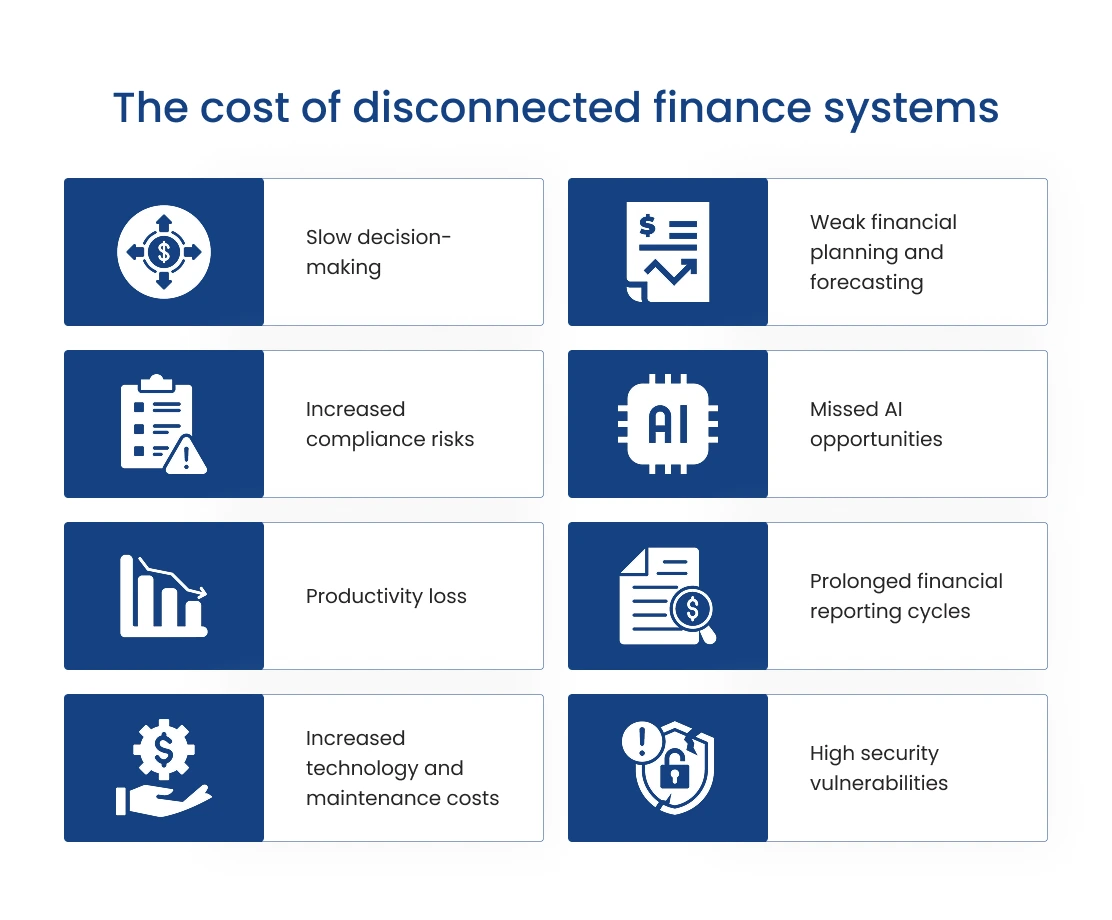
The cost of fragmented finance systems manifests in different forms - such as ineffective planning, wrong decisions, increased compliance risk, and much more.
The cost keeps accumulating and compounding, directly affecting profitability and strategic effectiveness.
1. Slower financial decision-making
With financial data spread across systems and no access to consolidated insights, confidence in the numbers slowly decline. There's an increased reliance on outdated data and simplified assumptions, rather than robust, in-depth and high-level analysis of facts.
As a result, even routine decisions require additional validation and explanation before they can be acted upon.
*In a recent survey by the Economist Impact, over half of the CFO respondents revealed data fragmentation and limited visibility as significant barriers to decision-making.*
This lack of confidence has a compounding effect - forecasts take longer to finalize and even small decisions face delays. Over time, finance becomes a function where acting quickly could mean taking big risks. In a fast-moving business environment, this becomes a competitive disadvantage.
2. Impaired financial planning and forecasting
The basis of accurate financial planning and forecasting is timely, dependable, and integrated data. An environment where financial systems operate in silos, consolidating the data streaming in from right, left, and center is a tedious task.
When inputs come from multiple systems, it's a struggle to maintain a consistent and up-to-date view of company revenue, expenses, cash flow, and operational performance, impacting financial analysis and planning. Forecasts are also largely driven by outdated data and sometimes, based on assumptions rather than real-time activities - decreasing their reliability.
This puts a major limitation on your finance team's ability to model scenarios accurately, respond to market changes, or provide forward-looking guidance.
3. Heightened compliance risks
Financial data distributed across systems that don't communicate with each other makes it super challenging to maintain consistent historical records and audit trails - which is the very basis of effective compliance.
In an environment where financial data is scattered, there is a lot of manual reconciliation and validation involved that increases both workload and the risk of reporting errors.
Since audit trails are hard to maintain, internal audits are often delayed and fail to catch inconsistencies - thus increasing the risk of compliance violations.
4. Missed AI opportunities
AI is shifting the way organizations work, simplifying complex workflows and automating tasks that once seemed implausible.
However, for AI to adapt to your organization it needs a well-connected environment where data can be easily accessed across touchpoints from a single place - a condition that disconnected systems rarely provide. This makes it challenging for AI to gain a good understanding of your finance workflows, expense patterns, or cost trends.
This prevents you from realizing the full potential of AI for real-time analysis or predictive forecasting.
On the contrary, when data is consolidated already, AI can easily go deep into the numbers, identify the root causes of financial issues, and address challenges instantly.
5. Productivity loss
Handling multiple systems that don't speak with each other eats up a substantial amount of your team's time, that could otherwise be spent on strategic analysis and decision support.
Skilled finance professionals doing repetitive administrative tasks such as validating data and reconciling figures takes the focus away from work that really matters, reducing their productivity in the long run. This also limits the capacity of the finance function to take on higher-value work without increasing headcount.
Over time, siloed systems create a persistent drag on the overall performance of the finance function.
6. Prolonged financial close and reporting cycles
Finalizing reports becomes a tedious, time-consuming process when financial data doesn't automatically move between systems.
Different systems means a huge number of discrepancies to resolve before reporting can be finalized. All this manual reconciliation extends the close cycle, ultimately impacting your ability to assess financial performance and make timely decisions, especially during periods of volatility.
7. Escalating technology and maintenance costs
More is not always better - because when your finance function hinges on multiple systems working in silos, it can drive up technology costs over time.
Maintaining multiple software platforms with similar capabilities and managing custom integrations increases IT complexity and operational costs. You also need additional resources to manage security, upgrades, and system administration.
This often happens when finance is run by legacy systems that are difficult and expensive to maintain as they age - and also fail to add value or adapt to new ways of work.
8. Increased security vulnerabilities
In a fragmented environment, monitoring financial activities and maintaining clear audit trails is significantly more difficult. With finance systems working separately, there is a high likelihood of unauthorized access, data leakage, and control failures. This happens because when financial data resides in disparate systems, hackers have multiple doorways to break through the security walls.
This would not be the case if you have a single comprehensive system that's constantly updated and has features like single sign-on, ensuring maximum security and minimum vulnerabilities.
Still paying the tax of manual finance reconciliation?
See how Hobasa reduces the time, risk, and second-guessing that disconnected systems create.
Get in touchFragmented vs. integrated finance systems: how the reality differs in practice
The difference in fragmented and integrated finance setups is prominently visible in how finance operates every day, how decisions are made, and how effectively risk is managed. While both environments help produce reports, the quality, speed, and confidence in the outcome differs significantly.
Data flow and visibility
Fragmented: Financial data is scattered across multiple systems, requiring manual consolidation and reconciliation to gain a complete view. Integrated: Data flows seamlessly across core systems, providing a single, consistent source of financial truth.
Financial close and reporting cycles
Fragmented: Close and reporting processes are extended due to manual validation, rework, and dependency on spreadsheets. Integrated: Automated data synchronization enables faster, more predictable close and reporting cycles.
Productivity and effort
Fragmented: Finance teams spend significant time fixing data issues and coordinating across systems instead of analyzing results. Integrated: Teams focus on value-adding analysis and decision support rather than data preparation.
Financial planning and forecasting
Fragmented: Planning relies on delayed and inconsistent inputs, limiting accuracy and responsiveness to change. Integrated: Forecasts and scenarios are continuously updated using timely, reliable data across the organization.
Controls and compliance
Fragmented: Controls depend heavily on manual checks and compensating processes, increasing compliance risk. Integrated: Controls are embedded into workflows, improving auditability and reducing reliance on manual oversight.
Technology and maintenance costs
Fragmented: Overlapping systems, custom integrations, and technical debt drive rising maintenance and support costs. Integrated: A rationalized system landscape lowers total cost of ownership and simplifies ongoing maintenance.
Security risk exposure
Fragmented: Multiple access points and data handoffs increase security vulnerabilities and control gaps. Integrated: Centralized access controls and monitored data flows reduce security and operational risk.
AI and advanced analytics enablement
Fragmented: Fragmented data prevents AI solutions from scaling beyond pilots or delivering reliable insights. Integrated: Integrated data provides a stable foundation for scalable AI, automation, and advanced analytics.
Strategic responsiveness
Fragmented: Decision-making is slower and more conservative due to low confidence in financial data. Integrated: Finance delivers timely, forward-looking insights that support faster and more confident decisions.
What CFOs can do next
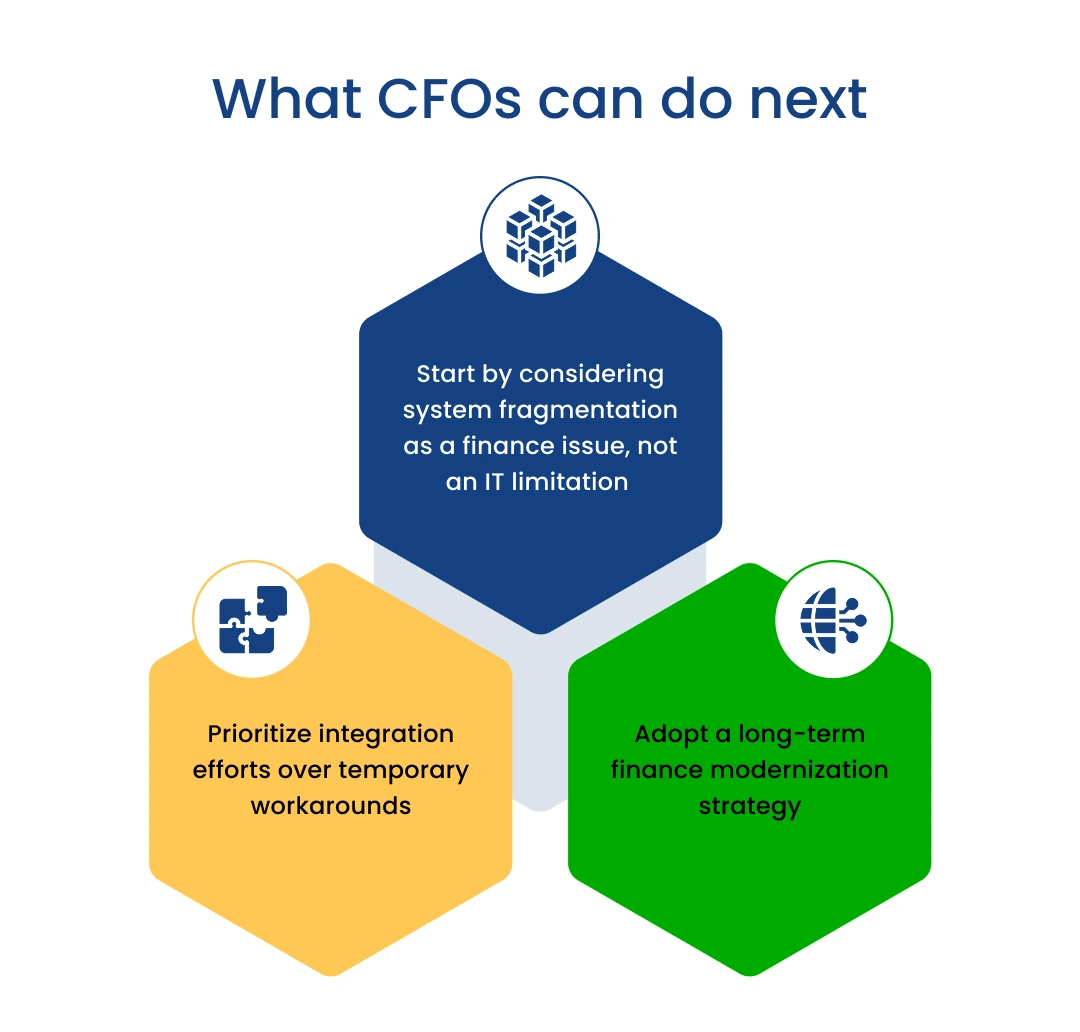
Now that it's clear how fragmented systems can drain your cost and resources, the question for you is no longer whether change is needed, but how deliberately change is embraced. It's not immediate transformation that we are trying to focus here.
The focal point now is to help you change your direction and adopt the right posture.
1. Start by considering system fragmentation as a finance issue, not an IT limitation
An environment where finance systems work in silos directly affects reporting accuracy, planning effectiveness, and decision quality - areas for which finance is single-handedly accountable.
When you treat fragmentation as a technical inconvenience, it can delay action.
2. Prioritize integration efforts over temporary workarounds
If you aim to build a connected environment with seamless data flow, integration is where your focus should be. Check for overlapping systems and remove the ones you don't really need.
For the rest, explore how they can work together in sync to create a single source of truth.
AI analytics platforms like Hobasa support this approach by working alongside the financial systems you already use. Rather than requiring system replacements, Hobasa connects data across your finance ecosystem, providing a more cohesive view of business performance.
3. Adopt a long-term finance modernization strategy
Isolated technology upgrades are going to do no good as far as data fragmentation is concerned. Instead pursue a broader modernization roadmap that aligns financial systems with future business needs. Ensure that every platform you adopt supports AI, real-time reporting, and advanced analytics.
Move toward a more connected finance foundation.
Hobasa helps CFOs act on what fragmented ERP, billing, and reporting stacks hide today.
Talk to our teamBring your finance data together with Hobasa
There's a sense of comfort when work keeps happening the way it has always - using the same old methods and tools. Disconnected financial systems are often tolerated because they are familiar and already embedded into the workflows.
However, as we discussed in the blog, fragmentation carries a cost that extends far beyond inefficiency. It weakens financial control, inflates overall business cost and impairs your decision making.
On the contrary, a well-integrated finance environment can do so much more than just improve the finance process. It creates conditions favorable for in-depth analysis, reliable reporting, and increased resilience in the face of change.
This is where Hobasa comes in. Hobasa doesn't replace your existing systems. It works together with the finance platforms, creating a connected view of your financial performance - so you can track metrics, monitor trends, and identify risks in real time.
The shift from fragmentation to integration is more of a strategic transformation. Leaders who address fragmentation today will be better positioned to provide forward-looking insights, inform business decisions, and navigate rapidly changing market scenarios.
Bring your finance data together with Hobasa.
Hobasa connects data across your existing finance ecosystem - no rip-and-replace required - so you can track metrics, monitor trends, and surface risks in real time.
FAQs
Disconnected finance systems are platforms that operate independently, without sharing data. They typically emerge when finance relies on many specialized tools for planning, analysis, and reporting that were never designed to work together - forcing manual reconciliation and workarounds.
Fragmentation quietly drives up cost through slower decisions, weak forecasting, higher compliance risk, missed AI opportunities, productivity loss, longer close cycles, escalating technology spend, and security vulnerabilities.
Integrated systems provide a single source of truth with seamless data flow, faster close and reporting, embedded controls, reliable forecasts, and a stable foundation for AI - so finance teams can focus on analysis rather than data preparation.
Treat fragmentation as a finance issue rather than an IT limitation, prioritize integration over temporary workarounds, and adopt a long-term modernization strategy that ensures every platform supports real-time reporting, AI, and advanced analytics.
Not necessarily. Platforms like Hobasa work alongside the finance systems you already use, connecting data across your ecosystem to provide a cohesive view of performance without requiring rip-and-replace.