- Traditional workflows - manual processes, fragmented systems, and fixed reporting cycles - limit the finance function's ability to respond quickly and strategically.
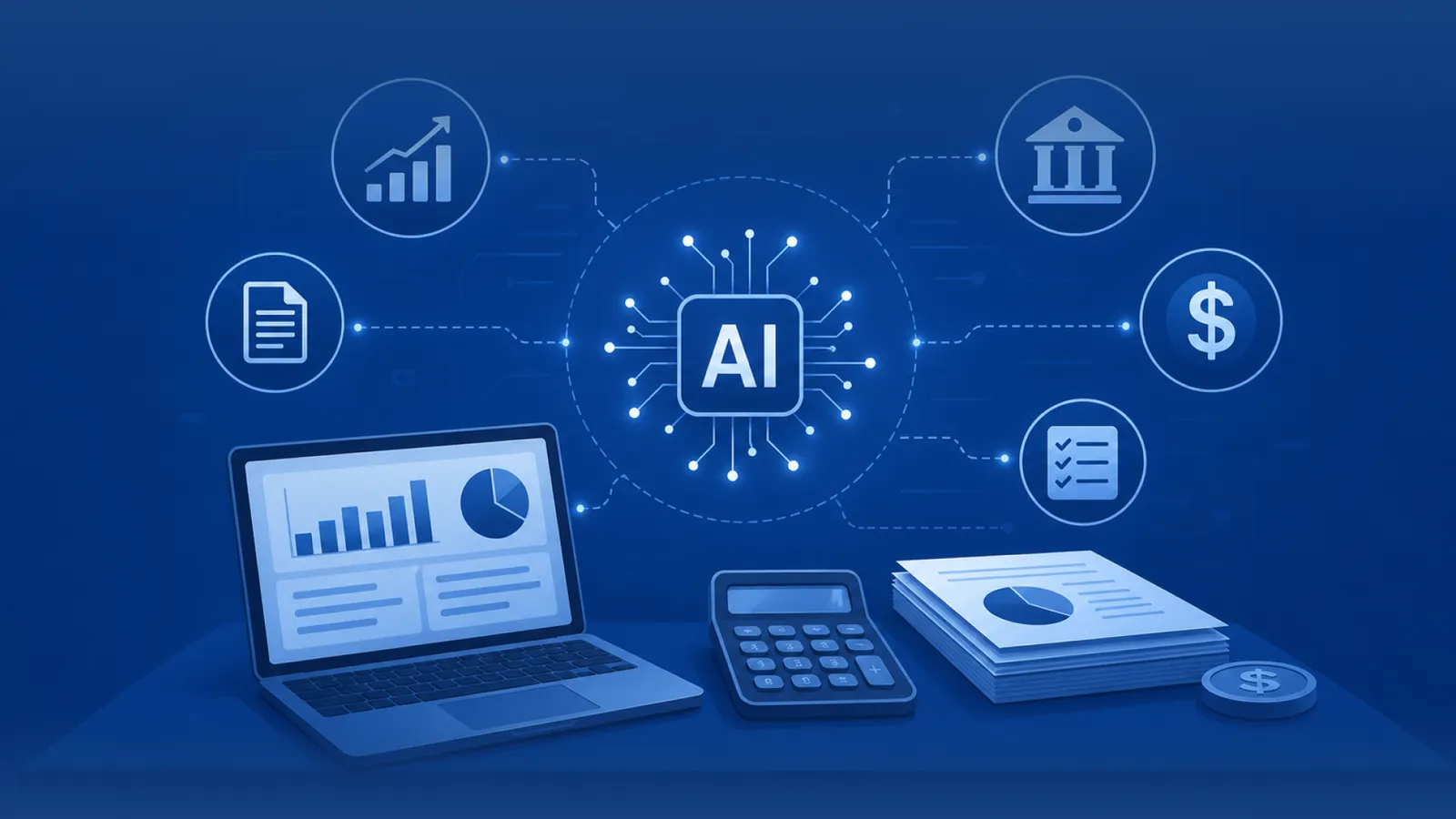
- AI is reshaping finance operations by automating repetitive work, connecting fragmented data, improving forecasting, and surfacing risks earlier.
- The real value of AI lies not just in efficiency, but in improving financial visibility, decision support, and risk management across the organization.
- As AI becomes embedded in finance operations, the CFO role becomes more strategic - focused on judgment, governance, and guiding enterprise decisions.
- AI supports analysis and insight, but accountability, context, and decision-making remain firmly human responsibilities.
- AI combined with strong leadership ensures clear decision ownership and sound financial judgment.
Finance and accounting functions today operate under growing pressure. Data volumes are rising, reporting expectations are expanding, and leadership teams are expected to provide faster insights and clearer guidance - often while managing uncertainty and risk at the same time.
AI has entered this environment as a powerful enabler. It is changing how financial data is processed, reconciled, analyzed, and monitored across the organization. But while access to data has improved significantly, the real challenge for finance leaders remains the same: turning information into timely, decision-ready insight that supports the business.
This shift has important implications for how finance and accounting operations are structured. Traditional workflows - built around manual effort, fragmented systems, and fixed reporting cycles - were not designed for today's pace or complexity. Therefore, it's vital to assess not just individual processes, but the broader operating model of finance.
In this blog, we examine why traditional workflows are increasingly limiting, how AI is reshaping finance and accounting operations, and what this transformation means for CFOs who are leading finance teams.
Why traditional finance workflows are becoming less effective
Traditional finance and accounting workflows involve manual processing, periodic reporting cycles, and siloed systems. While this approach supported operational stability for many years, it's not that effective in modern business environments where organizations require faster insights, stronger visibility, and more agile decision-making.
1. Growing data volume and operational complexity
Organizations today manage far more transactions, data sources, and regulatory requirements than in the past. As businesses scale, manual reconciliations, spreadsheet-driven analysis, and labor-intensive reviews become harder to sustain.
In today's environment, they struggle to keep pace - absorbing time and attention that finance leaders increasingly need for analysis, interpretation, and decision support.
2. Fragmented systems limit financial visibility
Financial data distributed across ERP systems, accounting software, and payroll platforms that don't work in sync with each other makes it difficult to get a consistent, real-time view of financial performance.
As a result, teams spend considerable effort reconciling data, validating reports, and resolving discrepancies. This not only slows reporting cycles but also undermines confidence in forecasts and limits the ability to respond quickly to emerging issues.
3. Expectations are shifting from reporting to insights
Leadership no longer wants to know only what happened last month. They expect forward-looking visibility, early warning signals, and decision-ready context. This shift places new demands on finance operations. Producing accurate reports remains essential, but it is no longer sufficient. What leaders value most is insight that clarifies priorities, highlights trade-offs, and informs action.
4. Static reporting cycles no longer support real-time decision-making
Traditional finance operations often rely heavily on monthly or quarterly reporting cycles. While these reporting structures remain important, they are no longer sufficient on their own in environments where business conditions can shift rapidly.
Modern finance organizations increasingly need more continuous visibility to support faster, more informed, and real-time responses.
5. Finance leaders are expected to contribute more strategically
The expectations placed on finance functions have expanded well beyond oversight and reporting. Today, CFOs are increasingly expected to support enterprise decision-making, guide strategic planning, improve operational efficiency, and help organizations respond more effectively to uncertainty. This shift requires finance to operate at a different level of speed and insight.
Traditional workflows and manual processes are not designed to support this kind of strategic contribution.
Finance workflows still built for last decade’s volume?
Hobasa helps CFOs use AI where it connects fragmented data and surfaces risk earlier.
Talk to our teamUnderstanding AI's role in modern finance operations
AI's role in modern finance is often misunderstood. It is neither a replacement for finance expertise nor a shortcut to better decisions on its own. Instead, AI functions as an enabler - changing how information is processed, surfaced, and made available to finance leaders.
At its core, AI excels at handling volume and pattern recognition. It can process large datasets quickly, identify anomalies, detect trends that are difficult to spot through manual reviews. This makes it particularly effective in areas such as transaction processing, variance analysis, forecasting, and risk monitoring.
What AI does not do is provide context, weigh trade-offs, or take responsibility for decisions. Those remain firmly human responsibilities.
In modern finance organizations, AI works best when it supports - not replaces - judgment. It reduces time spent on preparation and validation, allowing finance teams to focus on interpretation, scenario discussion, and decision support.
For CFOs, understanding AI's role means recognizing it as part of the finance operating model rather than a standalone technology initiative. Its value is realized when it is embedded into workflows, paired with strong controls, and guided by clear ownership of decisions.
How AI is reshaping finance and accounting operations
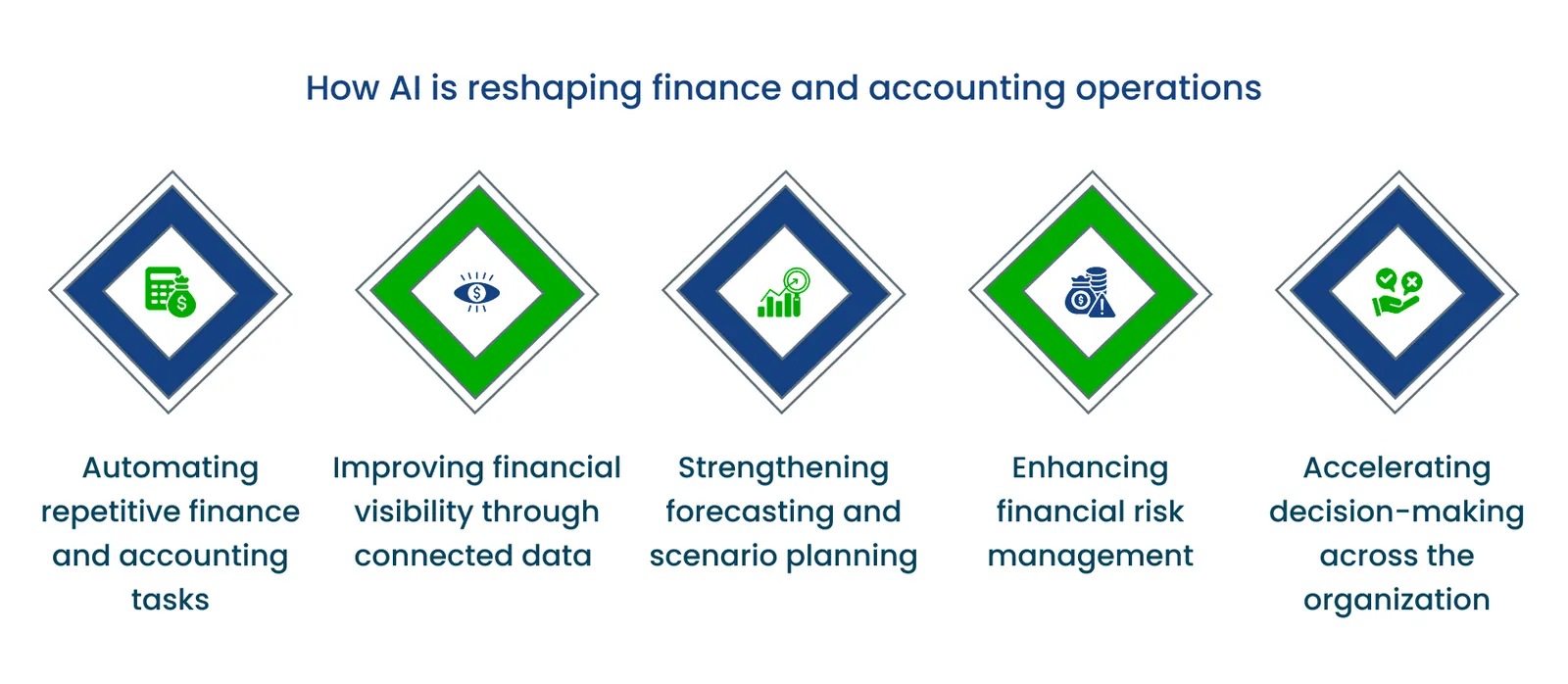
AI is reshaping finance and accounting operations by improving how financial data is processed, analyzed, and translated into business insights.
While automation remains an important benefit, the larger transformation is happening in how AI supports teams with forecasting, managing risk, and making faster decisions.
1. Automating repetitive finance and accounting tasks
One of the most immediate impacts of AI is reducing the manual effort associated with repetitive activities such as reconciliations, invoice processing, and exception handling. These processes eat up significant time and effort, often leading to delays when data volume increases.
By automating these processes, AI helps reduce dependency on spreadsheets and manual checks while improving consistency and control. The benefit is not just efficiency - it is reliability at scale, especially during close cycles and periods of operational strain.
2. Improving financial visibility through connected data
One of the most practical ways AI is transforming finance operations is by improving visibility across fragmented data environments. In many organizations, financial data sits across ERPs, accounting systems, and payroll platforms that are not designed to work together.
That's where connected, AI-driven visibility becomes valuable.
For example, Hobasa can consolidate and analyze data from across your finance systems in real time. This allows you to gain prompt visibility into cash flow trends, operational costs, profitability drivers, and overall financial performance indicators.
Instead of navigating multiple reports and disconnected data sources, you can gain proactive visibility into financial trends and patterns.
When data is synchronized across systems, you can see emerging issues - such as cash-flow pressure, margin shifts, or cost variances - before they become difficult to address.
3. Strengthening forecasting and scenario planning
Forecasting is becoming increasingly dynamic as organizations navigate market volatility, changing customer demands, and economic uncertainty.
AI strengthens your team's forecasting capabilities by analyzing large data sets, identifying patterns, and exploring multiple scenarios more quickly than traditional approaches.
This helps you evaluate how shifts in volume, pricing, costs, or timing affects outcomes.
Rather than relying solely on periodic forecasts, you can continuously discuss ranges, sensitivities, trade-offs, and refine projections based on changing business conditions and emerging trends.
4. Enhancing financial risk management
AI also improves how you and your team identify and monitor financial risks.
AI is particularly effective at identifying patterns that indicate emerging risks such as unusual transactions, irregular accounting entries, and cash flow blockers, empowering you to course correct before they escalate.
For example, Hobasa's AI-driven monitoring surfaces unusual payment activity, unexpected spending trends, irregular accounting entries in real-time, empowering you to course correct before these risks escalate.
At the same time, AI does not replace financial judgment or governance - the final call remains yours. Human oversight remains critical when interpreting risks, validating outputs, and making final decisions.
5. Accelerating decision-making across the organization
As AI improves access to financial insights, it helps you and your team make faster and more strategic business decisions.
Instead of spending excessive time preparing reports manually, you can focus more on interpreting results, evaluating trade-offs, and guiding discussions.
This positions you as a stronger strategic partner across the business - supporting decisions related to growth, investments, workforce planning, operational efficiency, and risk management.
AI that elevates finance, not just automates tasks.
See how Hobasa supports forecasting, exception detection, and cross-system clarity for accounting teams.
Get in touchWhat AI adoption means for modern CFOs
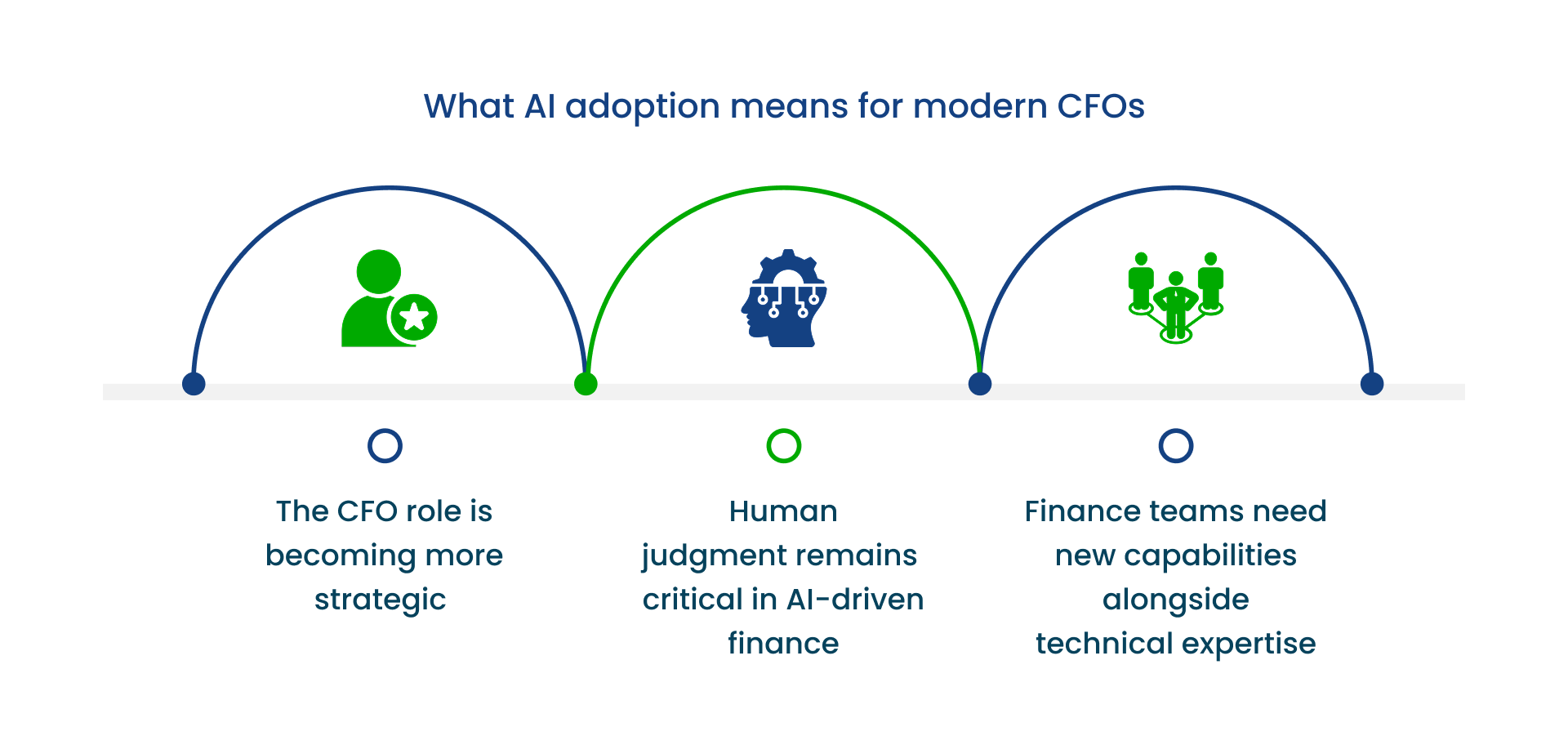
As AI becomes more embedded across finance and accounting operations, the role of the CFO is also evolving.
1. The CFO role is becoming more strategic
AI is reducing the amount of time that is spent on data validation, reconciliations, and reporting.
This leaves you with greater opportunity to focus on the work that matters the most - risk management, financial planning, forecasting, investments, and more. This further positions finance as a strategic driver of business performance rather than solely a reporting function.
2. Human judgment remains critical in AI-driven finance
While AI can improve analysis speed and generate valuable insights, it cannot fully understand organizational context, business priorities, or strategic trade-offs.
This means human judgment still remains critical for evaluating AI-generated recommendations, balancing risk and opportunity, and maintaining overall governance and compliance oversight.
AI may support decisions, but responsibility for those decisions still rests with leadership.
This makes financial judgment and critical thinking even more important in AI-enabled finance environments.
3. Finance teams need new capabilities alongside technical expertise
As finance operations evolve, finance professionals increasingly need capabilities that extend beyond traditional accounting expertise. This includes stronger skills in analytical thinking, financial storytelling, AI fluency, and scenario planning.
Finance teams are increasingly expected to explain not just what the numbers show, but what they mean for business decisions and future planning.
The organizations that benefit most from AI adoption are often the ones that combine strong technology capabilities with strong financial leadership and business understanding.
Build a more strategic finance function with AI
AI is reshaping finance and accounting operations in ways that go far beyond automation.
While improving efficiency remains important, the larger shift is toward creating finance functions that are faster, more connected, more insight-driven, and better positioned to support strategic business decisions.
For CFOs, this transformation creates an opportunity to improve forecasting, manage risks more proactively, and elevate the role of finance across the organization.
At the same time, AI does not reduce the importance of finance leadership. In many ways, it makes strong leadership even more essential as there's an increased reliance on CFOs for evaluating AI-generated outputs.
Organizations still rely on CFOs to apply judgment, evaluate trade-offs, interpret financial context, and guide decisions that balance operational realities with long-term business priorities.
The most effective finance organizations will therefore not be defined simply by how much AI they adopt, but by how effectively they combine technology with strong financial leadership, governance, and strategic thinking.
Turn finance data into real-time strategic insight.
Hobasa connects your finance systems to surface cash flow trends, risks, and performance signals in real time - so your team can focus on judgment, not reconciliation.
FAQs
AI is reshaping finance by automating high-volume, repetitive tasks, improving data integration across systems, enabling dynamic forecasting, and providing earlier visibility into financial risks. This allows finance teams to focus more on analysis and decision support.
Traditional workflows rely on manual effort, siloed systems, and periodic reporting cycles. As data volume and complexity increase, these approaches struggle to keep pace and often delay insight until after decisions have already been made.
AI is particularly effective in transaction processing, reconciliations, reporting and variance analysis, forecasting, scenario planning, and risk monitoring - areas where volume and pattern recognition matter most.
No. AI can improve efficiency and provide analytical support, but it cannot replace human judgment, business context, strategic decision-making, or accountability. CFOs and finance leaders remain responsible for evaluating insights, managing risks, and guiding organizational decisions.
In addition to technical expertise, finance teams need strong analytical thinking, scenario planning, financial storytelling, and AI fluency. These skills help translate AI-generated insights into clear, actionable guidance.