- HR has evolved into a strategic function, but many teams still operate reactively - addressing issues only after they arise
- Reactive HR leads to delayed decisions, limited foresight, and reduced strategic influence
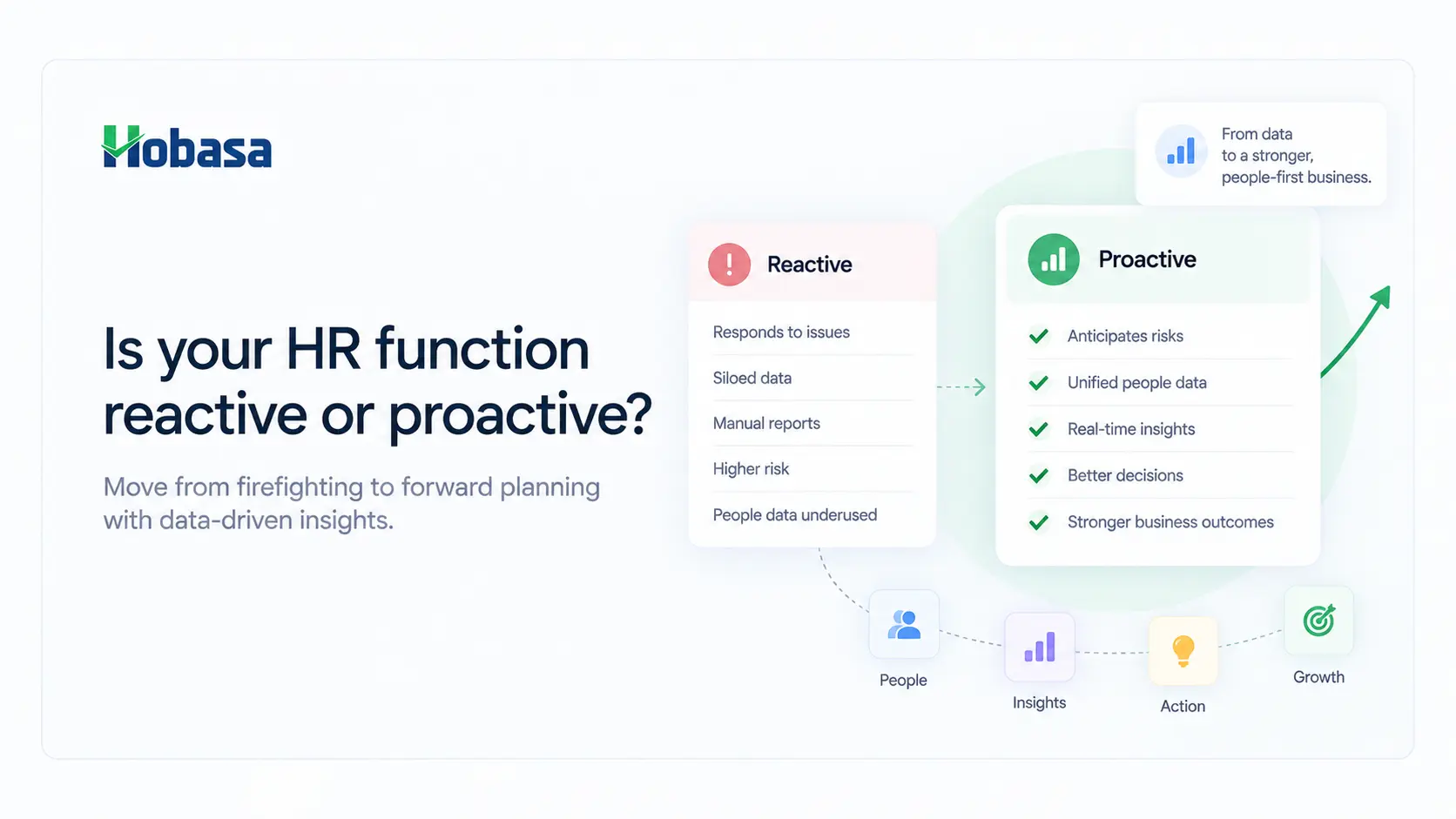
- Proactive HR focuses on anticipating risks, enabling real-time visibility, and guiding business decisions
- The shift requires better access to unified workforce data and embedding insights into leadership conversations
- Moving from hindsight-driven reporting to forward-looking planning is key
- Proactive HR strengthens decision-making, improves workforce planning, and enhances organizational resilience
- For CHROs, this transition is critical to elevating HR's role as a true strategic partner
The role of HR has evolved significantly over the past decade.
CHROs are no longer expected to focus solely on compliance, administration, and employee support. Today, HR is a critical strategic partner - expected to anticipate workforce risks, guide business decisions, and align people strategies with outcomes.
Yet many HR functions remain stuck in a reactive operating model. They respond to issues after they arise, manage crises as they unfold, and rely on historical data to explain outcomes that have already occurred.
In an environment defined by constant change - shifting workforce expectations, economic uncertainty, and increasing regulatory complexity - this approach is becoming unsustainable.
This raises an important question for HR leaders: Is your HR function primarily reactive, or is it truly proactive?
In this blog, we will shed light on both reactive and proactive HR approaches, how they are different from each other, and the steps you can take to shift to a proactive model.
What does a reactive HR function look like?
Reactive HR functions are characterized by a constant state of addressing issues as they arise, often lacking strategic foresight and acting in a "firefighting" mode. It's like crisis management where problems are handled urgently without much preparation.
Common characteristics of a reactive HR function are:
1. Crisis response
Primarily reacts to immediate problems like high turnover, compliance breaches, or employee grievances after they escalate.
2. Lack of strategic planning
Absence of proactive workforce planning, talent development, or strategic initiatives to support future business goals.
3. Constant firefighting
Always managing urgent, unplanned issues, leaving little time for strategic contribution or long-term growth.
4. Transactional focus
Emphasis on administrative tasks and transactional processing rather than strategic value creation for the business.
5. Limited data utilization
HR decisions are made based on anecdotal evidence or gut feelings instead of data-driven insights and analytics. A reactive environment is built when you and your team don't have access to early warning signals, forcing reactive actions rather than preemptive measures.
If you can relate to these signals, your HR function is working in reactive mode:
• Addressing attrition only after resignation rates have spiked
• Responding to compliance or documentation issues after audits raise concerns
• Acting on employee engagement problems once dissatisfaction becomes prominent
• Policies are updated after audit failures happen
• Analyzing reports that explain past outcomes rather than inform future decisions
The result is a never-ending vicious cycle in which strategic activities such as employee skill development, leadership training, and workforce planning take a back seat, as all resources are stretched thin with much of their time going into handling escalations and solving immediate problems.
Still firefighting HR issues after they land?
Hobasa gives CHROs earlier signals across HRIS, payroll, and operations so the function can lead, not chase.
Talk to our teamWhat does a proactive HR function look like?
A proactive HR function operates with foresight. Instead of waiting for issues to surface, it identifies patterns, risks, and opportunities early and acts before they escalate.
Key characteristics include:
1. Strategic workforce planning
Anticipates future talent needs and skill gaps, aligning HR strategies with long-term business objectives and growth plans.
2. Data-driven decision making
Leverages HR analytics to inform talent acquisition, hiring strategies, attrition management, and employee engagement.
3. Continuous talent development
Invests in employee growth through robust learning programs, career development, and leadership training to build future capabilities.
4. Culture & engagement building
Intentionally designs and nurtures a positive organizational culture, fostering high employee engagement and well-being.
5. Proactive risk management
Data-backed HR risk management helps you identify potential compliance issues, documentation gaps, or workforce challenges before they become significant problems.
6. Innovation & adaptability
Embraces new technologies and methodologies to continuously improve HR processes, enhancing efficiency and employee experience.
A few signals showing your HR function is proactive:
• Anticipating attrition risks through workforce trends and signals
• Planning talent needs based on business growth and scenario analysis
• Identifying compliance gaps before they become regulatory issues
• Getting timely insights to guide people decisions
Proactive HR teams rely on continuous visibility rather than periodic checks. Most importantly, they shift the nature of HR conversations - from explaining what happened to advising on what should happen next.
In this model, HR becomes a strategic enabler of business resilience and performance.
Reactive vs. Proactive HR: key differences
The distinction between reactive and proactive HR is not about effort - it is about orientation and capability.
Focus
Reactive HR: Addresses immediate issues and urgent problems as they arise.
Proactive HR: Shapes workforce strategy in advance to prevent problems and enable growth.
Timeline
Reactive HR: Short-term, event-driven, and often centered on today's pressing needs.
Proactive HR: Long-term, forward-looking, and built around future workforce needs.
Decision-making
Reactive HR: Triggered by incidents or escalations that require a quick response.
Proactive HR: Based on trend analysis, planning, and early signals before issues escalate.
Staffing approach
Reactive HR: Adds headcount or support when workload spikes, turnover occurs, or capability gaps appear.
Proactive HR: Plans capacity and skills in advance to stay ahead of demand.
Technology use
Reactive HR: Uses systems mainly for administration, reporting, and issue tracking.
Proactive HR: Uses data, analytics, and automation to forecast needs and guide action.
Leadership role
Reactive HR: Acts as a problem-solver and responder when leaders need immediate support.
Proactive HR: Acts as a strategic advisor shaping decisions before they become operational crises.
The costs of staying reactive
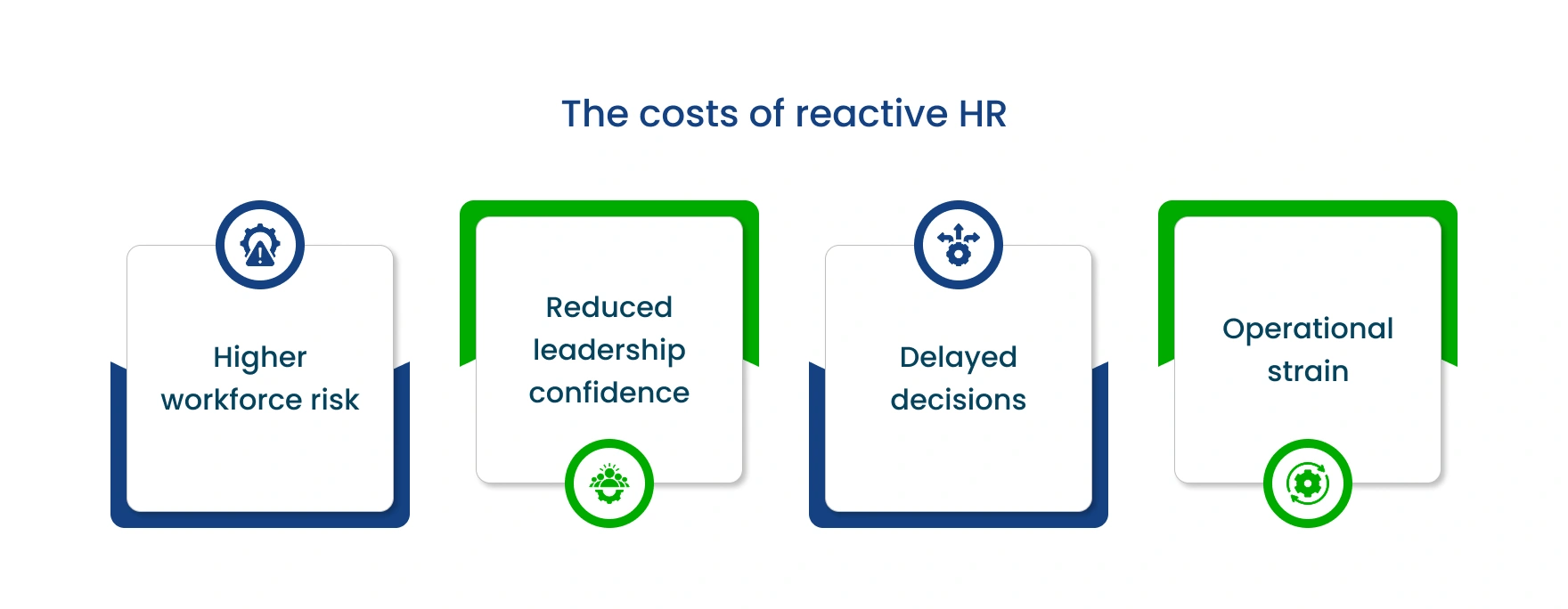
The cost of reactive HR is often underestimated because it accumulates gradually over time rather than appearing as a single failure.
Here's how it impacts your business:
• Higher workforce risk: Attrition, burnout, and skills gaps are identified late, limiting response options.
• Reduced leadership confidence: Business leaders hesitate to rely on HR insights when data feels outdated or incomplete.
• Delayed decisions: Workforce decisions are made under pressure rather than with preparation.
• Operational strain: HR teams spend disproportionate time fixing issues instead of improving systems and strategy.
Over time, reactive HR limits your organization's ability to adapt. It also constrains your influence at the leadership table, as HR becomes associated with problem resolution rather than strategic foresight.
The cost of reactive HR compounds every quarter.
See how Hobasa helps teams shift from after-the-fact fixes to proactive workforce decisions.
Get in touchWhy even strong HR teams fall into reactive patterns?
Reactive HR is rarely the result of weak leadership or lack of intent. In many organizations, even highly capable HR teams find themselves operating in reactive mode because the conditions around them make proactivity an arduous task.
One of the most common constraints is a fragmented HR infrastructure. When core systems don't operate in sync, gaining reliable workforce insights becomes a task. HR teams are forced to reconcile data manually, rely on spreadsheets, or wait for periodic reports. In such environments, early signals are easily missed, and insights arrive only after issues have already surfaced.
Operational overload also plays a role. HR teams are often consumed by execution - handling employee concerns, compliance requirements, and urgent requests. When time and capacity are dominated by day-to-day demands, there is little space left for analysis, pattern recognition, or forward planning.
Finally, reporting is not forward-looking. Traditional HR reporting focuses on explaining what happened - attrition last quarter, headcount changes, engagement scores - rather than highlighting what may happen next.
Together, these factors create a situation where reactivity is not a choice, but a default mode of operation.
Moving from reactive to proactive: practical steps you can take today
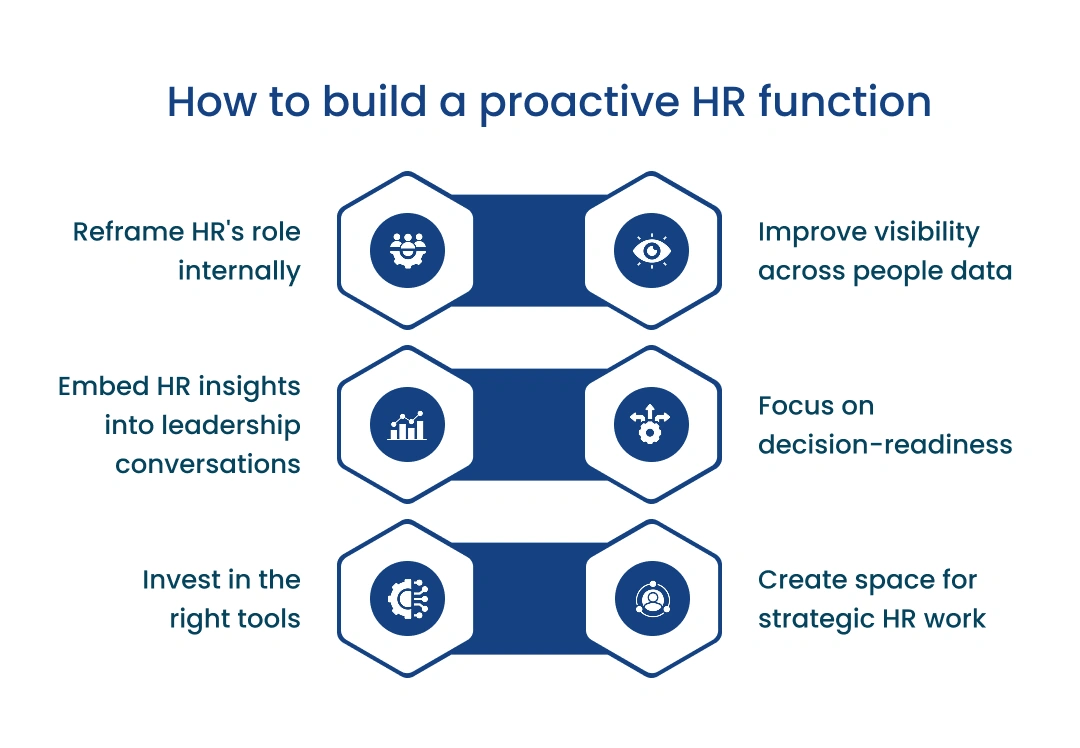
Transitioning to proactive HR does not require an overnight transformation. It requires intentional shifts in focus, capability, and operating rhythm.
Key steps include:
1. Reframe HR's role internally
Shift expectations from "handling issues" to "anticipating workforce outcomes."
HR must be positioned not just as a function that resolves employee concerns or ensures compliance, but as one that anticipates workforce risks and prepares the organization for what lies ahead. This requires shifting conversations with leadership from "What happened?" to "What could happen next - and how prepared are we?"
Practically, this means encouraging HR teams to spend less time firefighting and more time identifying patterns - early signs of disengagement, turnover risk, capacity constraints, or compliance exposure. Without this mindset shift, even the best tools and data will continue to be used reactively.
2. Improve visibility across people data
One of the most common barriers to proactive HR is fragmented people data. Workforce data typically lives across HRMS, payroll, attendance, performance management, and engagement tools. When these systems operate in isolation, you are forced to rely on partial views and delayed reports.
As a CHRO, you need to prioritize consistency and continuity of workforce insight. This does not necessarily mean replacing existing systems, but ensuring that data can be viewed holistically and interpreted together.
As an AI analytics platform, Hobasa helps you not just track but also connect different HR metrics together to understand what's going on behind the curtains, detect risks and gaps, identify policy deviations, and much more in one single view. This means you don't have to stitch reports from multiple sources – Hobasa does that for you by integrating with the HR systems you and your team frequently use.
This helps you look at attrition trends, compensation changes, absenteeism, and performance indicators more closely and also dive deep into their root causes.
Without this unified view, HR remains reactive by default, as early warning signals are either missed or identified too late to influence outcomes.
3. Embed HR insights into leadership conversations
Even when HR has access to better data, it often remains underutilized if it is not embedded into leadership conversations. Proactive HR requires that people insights inform planning discussions - not just post-decision reviews.
As a CHRO, you can drive this shift by ensuring workforce considerations are consistently included in:
• Business planning and budgeting discussions
• Growth and restructuring scenarios
• Risk and compliance reviews
This elevates HR's role from reporting function to strategic advisor. Over time, leaders begin to rely on HR not just for execution, but for foresight - strengthening HR's influence and relevance.
4. Focus on decision readiness, not data volume
The goal is not more data - it is clearer insight that supports timely, confident decisions.
A common mistake in HR transformation efforts is equating progress with more data or more dashboards. Proactive HR is not about volume - it is about decision readiness.
As a CHRO, here are a few questions you should ask:
• Are the HR insights helping us make better decisions today?
• Are we able to answer "what-if" questions with confidence?
• Can we explain not just what is happening, but why - and what to do next?
Such questions require your HR teams to move beyond data collection and focus on interpretation, context, and analysis. When insights are clear, timely, and decision-oriented, HR shifts naturally from reactive reporting to proactive guidance.
Read more: The HR data dilemma: 5 ways HR leaders can turn data chaos into clarity
5. Invest in the right tools – with a clear purpose
Moving toward proactive HR is difficult - often impossible - without the right foundational tools. However, investing in technology does not mean adding more systems or complexity. For many HR functions, the challenge is not a lack of tools, but an excess of disconnected ones that produce fragmented insight.
As a CHRO, you should approach technology investment with a clear objective: enabling earlier visibility, better analysis, and stronger decision support. Tools should help HR teams understand trends as they emerge, connect workforce signals across systems, and support forward-looking questions - not simply generate more reports.
That's where Hobasa comes in – an AI analytics platform that works with your existing HR systems to extract useful insights and bring them to you in a centralized space – helping you make informed decisions quickly.
6. Create space for strategic HR work
Finally, proactive HR requires capacity. If HR teams are overwhelmed by manual processes, reconciliations, and ad-hoc reporting, strategic work will always take a back seat.
CHROs should actively evaluate where time is being spent and identify opportunities to reduce low-value effort - whether through better systems, clearer processes, or improved data access. Creating space for strategic thinking is not a luxury; it is a prerequisite for proactive HR.
Ready to move HR from reactive to proactive?
Hobasa connects the data that makes foresight possible, without replacing your HR stack.
Talk to our teamTransforming the CHRO role: The impact of proactive HR
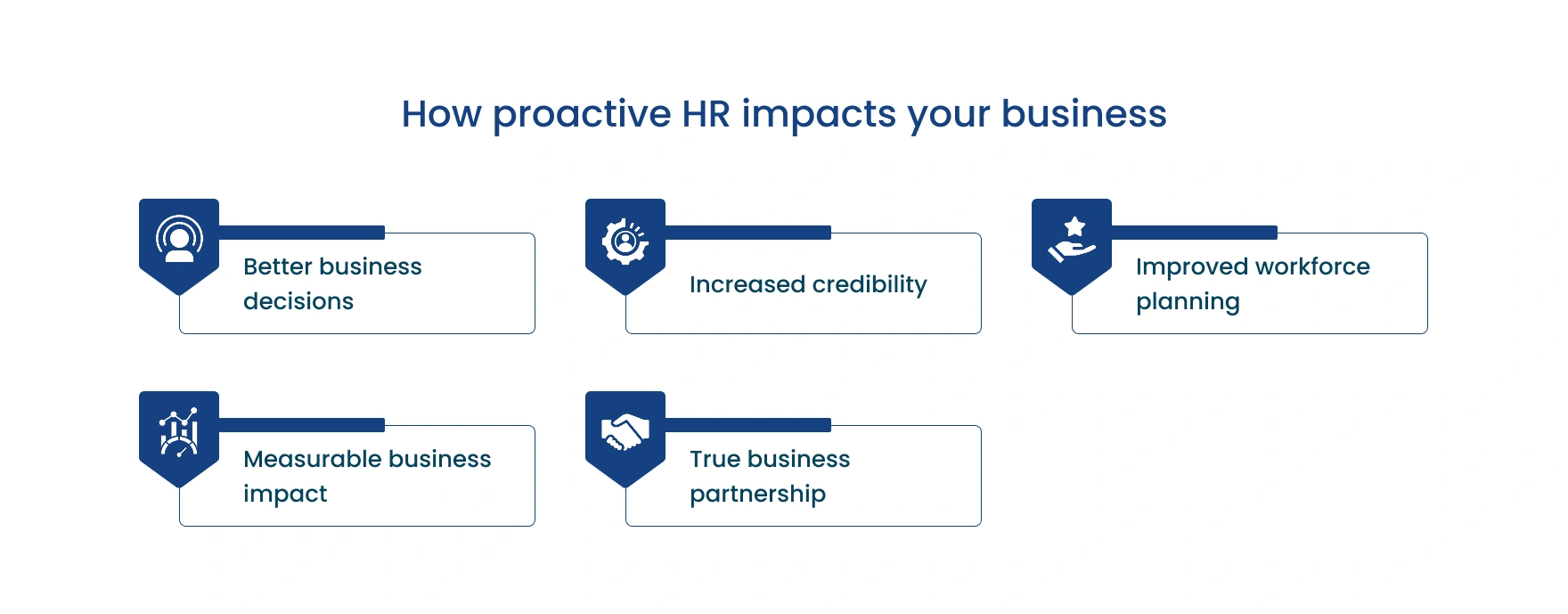
When HR operates proactively, the impact extends well beyond the function itself. Embracing proactive HR fundamentally reshapes your influence and effectiveness within an organization.
1. Better business decisions
You are better positioned to contribute to and shape business decisions before they are made, rather than reacting to them.
2. Increased credibility
There's increased credibility in everything you say and do. Proactive HR enhances your standing through data-driven insights and a clear connection between people strategy and business outcomes.
3. Improved workforce planning
There is greater precision in forecasting talent needs, skills gaps, and succession planning, ensuring future readiness.
4. Measurable business impact
The strategies you build have tangible improvements in revenue, retention, and operational efficiency.
5. True business partnership
HR transitions from an operational function to a valued strategic partner, driving growth and competitive advantage.
Build a more proactive HR function with Hobasa
The shift from reactive to proactive HR is ultimately a shift in visibility and decision-making.
When workforce data remains fragmented, risks are often identified too late when they have already affected your business. But when workforce signals are connected and interpreted in context, you gain the ability to anticipate challenges, guide decisions earlier, and contribute more strategically to organizational outcomes.
This is where Hobasa comes to the picture.
By connecting with the HR systems you already use, Hobasa brings workforce data into a unified environment and flags process anomalies and risks that deserve attention. Combined with conversational AI capabilities, it enables you to investigate issues, uncover root causes, and generate decision-ready insights without disrupting your existing workflow.
With the right insights at the right time, HR can move beyond reporting the past and play a more active role in shaping the future of the business.
Build a more proactive HR function with Hobasa.
Hobasa connects with the HR systems you already use to unify workforce data, flag process anomalies, and surface risks that deserve attention - so you can move from firefighting to foresight.
FAQs
Reactive HR responds to workforce issues after they occur, such as attrition spikes or compliance gaps. Proactive HR, on the other hand, anticipates challenges using data and planning, enabling organizations to act before issues escalate.
Many HR teams operate reactively due to fragmented systems, limited real-time visibility into workforce data, and high operational workloads. These factors make it difficult to identify early signals and shift toward forward-looking decision-making.
Reactive HR can lead to delayed decisions, ineffective workforce planning, reduced employee experience, and increased compliance risks. Over time, it also limits HR's ability to contribute strategically to business outcomes.
A proactive HR function uses real-time workforce insights, anticipates risks such as attrition or skill gaps, and aligns people strategies with business goals. It focuses on planning, forecasting, and enabling better decision-making.