
- Many organizations operate with strong individual systems, but disconnected tools and siloed workflows create gaps in visibility, slow decisions, and operational friction as businesses scale.
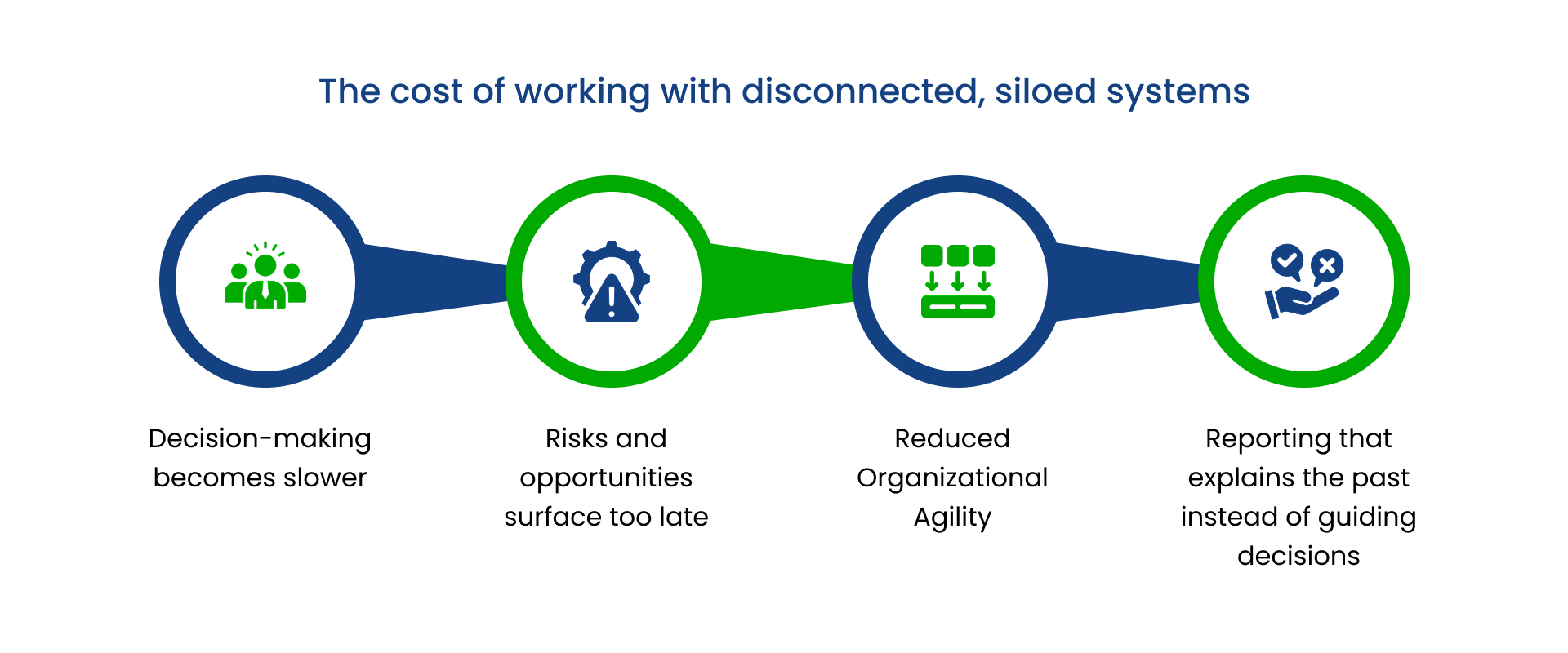
- Disconnected systems make decision-making slower, cause risks and opportunities to surface too late, reduce organizational agility, and turn reporting into a backward-looking exercise rather than a decision-support tool.
- Enterprise connectivity is not about replacing every system, but about creating shared visibility across critical business data, so leaders can act with confidence and speed.
- Leaders can strengthen connectivity by establishing a shared view of key information, using integrated systems, aligning teams around common business outcomes, involving cross-functional input earlier, and reviewing the business through shared data regularly.
- A well-connected enterprise enables faster and more confident decisions, greater agility, improved operational efficiency, earlier risk detection, and stronger alignment between strategy and execution.
- Ultimately, connectivity is a leadership responsibility - not just a technology initiative - and has become a decisive competitive advantage in today's data-driven environment.
Modern enterprises are more connected than ever in terms of technology, data, and communication. Yet behind the scenes, many organizations still operate through disconnected systems and fragmented workflows.
Finance works in one platform. HR relies on another. Different processes exist across multiple systems that rarely communicate seamlessly with one another. Individually, these systems may function well. But collectively, they can create gaps in visibility, delays in decision-making, and operational friction that becomes more noticeable as organizations grow.
The real challenge for business leaders today is turning that fragmented information into connected insight that powers meaningful discussions, informed decisions, and practical strategies. This is why enterprise connectivity is becoming a strategic priority across industries.
In this blog, we explore the cost of disconnected systems, how you can strengthen connectivity across teams and departments, and the business advantages a well-connected enterprise can bring.
The cost of working with disconnected, siloed systems
Organizational silos are bound to occur as teams specialize, systems evolve, and businesses scale. With more processes and never-ending data flow, the first choice is always to use specialized tools for maximum efficiency. However, using different systems for different tasks and processes often drives short-term efficiency but comes with a hefty cost.
1. Decision-making becomes slower
When information is fragmented across departments and systems, a significant amount of time goes into consolidating reports, validating and reconciling data - slowing down analysis and, by extension, the decision-making process. Because clarity arrives late, context is incomplete, and manual reconciliation is needed, such a situation often leads to delayed or overly cautious decisions. This impacts your ability to respond to market changes in time.
2. Risks and opportunities surface too late
In siloed environments, early warning signals often remain trapped within independently working systems. A shift in customer behavior, a cost trend, or an operational bottleneck may be visible to one team but not connected at the enterprise level. This fragmentation means risks escalate before you get to see the full picture - and opportunities tend to be missed too. By the time issues appear in consolidated reports, the window to act may already be narrowing.
3. Reduced organizational agility
Agility depends on alignment. When teams operate independently, dependencies between functions become bottlenecks rather than enablers. Initiatives that require coordination - such as launching new products, entering new markets, or responding to disruption - take longer and cost more than expected. Without a unified, real-time, connected view of data, initiatives take longer to implement, course corrections happen late, and momentum is often lost due to lack of shared visibility.
4. Reporting that explains the past instead of guiding decisions
Reports come in handy when you need a high-level view of business performance or want to dive deep into a specific issue. However, with siloed data, reporting is often fragmented and backward-looking. Each function produces its own reports - finance, operations, sales, HR - optimized for local needs but disconnected from enterprise context. For leaders, this means spending time reconciling reports rather than using them to make decisions, with an increased focus on what happened rather than what needs attention next.
Fragmentation slowing every decision?
Hobasa helps leaders connect finance, HR, and operations into one actionable picture.
Talk to our teamHow you can boost enterprise connectivity
Building a connected enterprise requires alignment across data, workflows, and communication across departments. The goal is to create an environment where information moves efficiently across the organization and you can have clear, uniform visibility of everything that's happening. Here are simple ways you can boost connectivity across your organization.
1. Establish a centralized view of critical business information
Connectivity breaks down when each function operates from a different version of reality. As a business leader, you can play a key role in ensuring that critical business information - financial performance, operational metrics, workforce data, and customer insights - is viewed consistently across the organization. This does not require every team to use the same tools, but it does require common definitions and assumptions, clear ownership of enterprise data, and regular cross-functional review of shared insights.
2. Use integrated systems to create a shared source of truth
Disconnected systems are one of the biggest contributors to siloed decision-making. When finance, operations, HR, and customer teams work from different platforms with different data definitions, your time is bound to go into consolidating reports or reconciling data instead of acting on it. You can strengthen connectivity by prioritizing systems that integrate across functions - or at least ensure critical data flows between them.
This is where platforms like Hobasa can help. By connecting with the systems your teams already use, Hobasa brings together data from across functions and provides a unified view of business performance, process anomalies, policy deviations, and much more. Instead of relying on separate reports, you can access insights in one place and make decisions based on a common set of insights.
3. Align teams around shared business metrics
Silos often persist because your teams' work is measured on different success criteria. When each function has its own set of metrics, collaboration becomes optional rather than essential. While having function-specific metrics is important, you can also develop a small set of enterprise-level metrics - such as profitability, customer retention, delivery performance, or workforce capacity - that cut across departments. When teams are jointly accountable for certain outcomes, information sharing and coordination naturally follow.
4. Bring cross-functional input into decisions earlier
In many organizations, teams coordinate only after decisions are made - during execution. This is where silos create friction. As a leader, you can strengthen connectivity by involving dependent functions earlier in the decision process, especially for initiatives that span multiple teams. Early alignment reduces rework, surfaces constraints sooner, and speeds execution once decisions are finalized.
5. Conduct regular reviews based on shared data
Connectivity improves when everyone at the leadership level reviews the business through a common lens. Establish regular review sessions where you and other department leaders can look at company-wide data together and identify patterns that individual functions might miss. These reviews are most effective when they focus on what has changed, what requires attention, and where teams need to coordinate - keeping discussions grounded in shared reality rather than functional perspectives.
6. Use AI and automation to improve visibility and responsiveness
AI is increasingly helping organizations connect operational insight across functions. Modern AI-enabled systems come with advanced capabilities to monitor patterns across data sets, improve forecasting accuracy, and accelerate analysis - all of which help you gain better visibility into your business. This also helps you move from fragmented reporting toward more connected, real-time decision-making. AI augments your expertise; it doesn't replace it. Using it as a tool to draw meaningful insights across departments can work wonders every time you need to devise strategies or make critical business decisions.
Alignment without a multi-year re-platform.
See how Hobasa builds connected insight across the systems you already run.
Get in touchThe business benefits of a well-connected enterprise
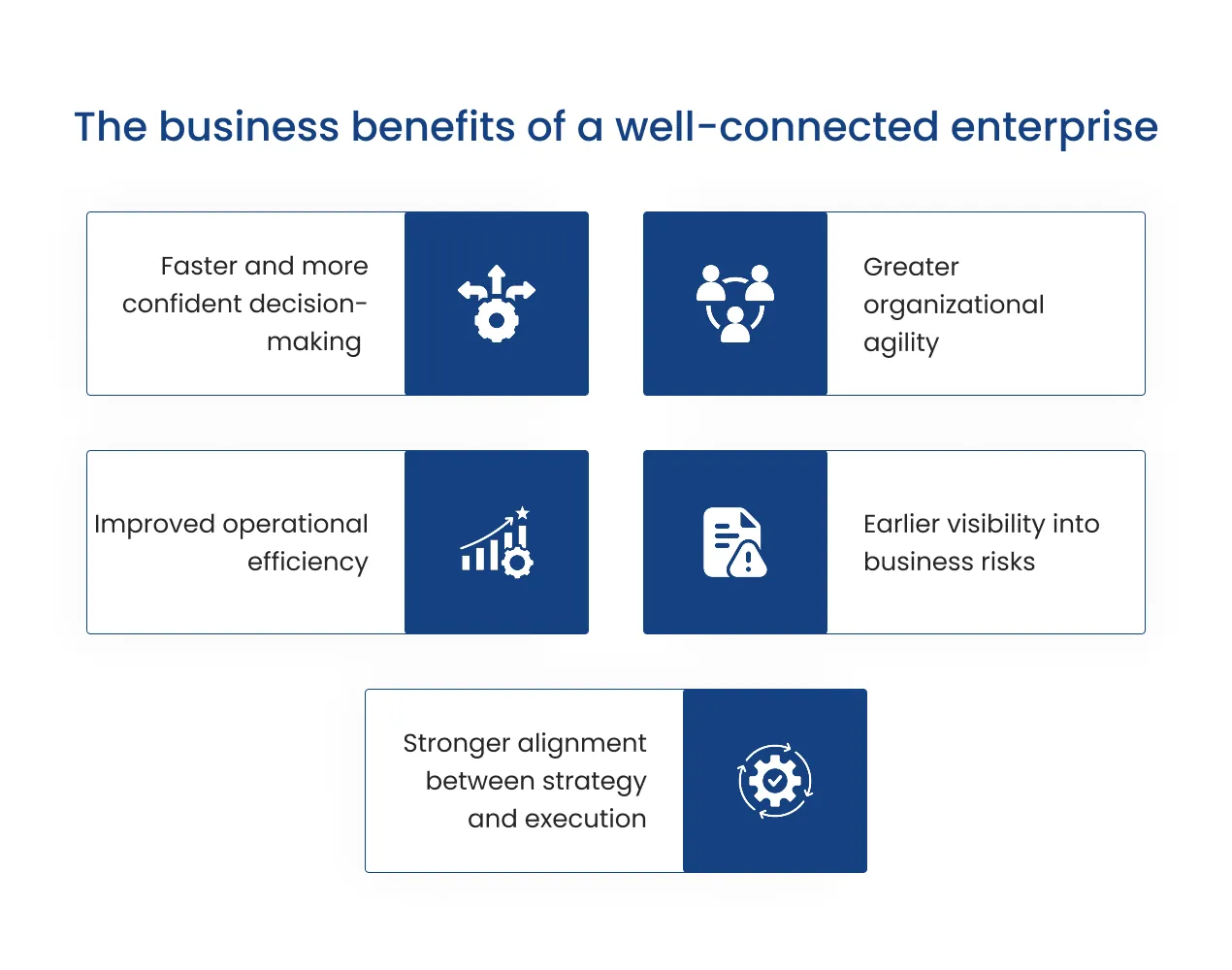
As enterprise connectivity improves, organizations often experience benefits that extend far beyond operational efficiency. It changes how you see the business, how quickly you act, and how effectively strategy is translated into results.
1. Faster and more confident decision-making
Connected enterprises reduce the time spent gathering and reconciling information. When you have access to timely, aligned insights across departments, decisions can be made with greater speed and confidence. This becomes especially important during periods of growth, operational change, or market uncertainty. Instead of reacting to fragmented updates from multiple teams, you can operate from a clearer organizational view.
2. Greater organizational agility
In a well-connected enterprise, teams operate with shared visibility into priorities, constraints, and impacts. This allows you to adjust direction without prolonged back-and-forth, mobilize cross-functional responses more quickly, and make course corrections before issues escalate. As a result, the organization responds to change with coordinated action, not fragmented movement. Agility becomes a built-in capability rather than a crisis response - allowing leadership intent to translate into timely execution.
3. Improved operational efficiency
In disconnected organizations, work moves slowly because handoffs between functions often require manual coordination, repeated validation, and rework. A well-connected enterprise reduces this friction by ensuring that teams operate with shared visibility into key processes and information. For business leaders, improved operational efficiency shows up as fewer delays caused by missing or inconsistent information, less rework when processes cross departmental boundaries, and faster execution of initiatives that require coordination across teams.
4. Earlier visibility into business risks
In a connected enterprise, signals from across the organization - financial, operational, workforce, and customer - can be viewed together. This makes it easier to spot patterns early, before they escalate into material risks or missed opportunities. For leaders, this means risks surface when options are still available, opportunities can be acted on while momentum exists, and fewer surprises appear late in the cycle. Connectivity turns insight into a proactive advantage rather than a reactive response.
5. Stronger alignment between strategy and execution
In most organizations, strategy breaks down because execution happens through different functional lenses. Each department works with its own metrics - necessary, but often not explicitly linked to shared business outcomes. In a well-connected enterprise, teams are aligned around the same strategic outcomes. Finance may track margin performance, operations may track efficiency, and HR may track workforce capacity - but all three are connected to the same strategic objective. Shared visibility into how these metrics relate allows you to see where execution is aligned with the overall business strategy and where it is unintentionally working against it.
Build a more connected enterprise with Hobasa
As organizations generate increasing amounts of data across functions, disconnected systems can quickly become barriers to growth. When teams operate with different versions of the truth, visibility suffers, decisions slow down, and risks become harder to identify.
Hobasa changes that dynamic. By connecting with the systems your teams already use, Hobasa brings together data from across functions and helps you monitor trends, anomalies, and risks in one single space. This shared visibility helps you and your teams align priorities, improve execution, and respond more effectively to changing business conditions.
Importantly, connectivity is not achieved through technology alone. It is shaped by leadership choices - how outcomes are defined, how information is shared, and how teams are aligned around enterprise goals. Integrated systems support this, but leadership intent sustains it.
Turn fragmented data into a connected enterprise.
Connect the systems your teams already use and let Hobasa surface the trends, anomalies, and risks that keep leadership aligned and decisions moving.
FAQs
A connected enterprise is one where data, systems, and teams are aligned so leaders have a consistent, shared view of the business. Information flows across functions such as finance, operations, HR, and customer-facing teams, enabling faster decisions and more coordinated execution.
Disconnected systems slow decision-making, hide risks, and create operational friction. Leaders often spend time reconciling reports instead of acting on insights, which delays execution and reduces agility - especially as organizations scale.
Enterprise connectivity provides leaders with a shared, real-time view of critical business information. When everyone operates from the same data and context, decisions can be made faster, with greater confidence and less debate over conflicting inputs.
Leadership plays a central role. Connectivity improves when leaders align teams around shared business outcomes, establish common metrics, encourage cross-functional input early, and reinforce shared visibility through regular reviews.
A well-connected enterprise enables faster decisions, improved operational efficiency, earlier risk detection, stronger alignment between strategy and execution, and more consistent customer and employee experiences.