
- In a fast-changing business environment, the value of data is directly tied to how quickly it can be accessed, interpreted, and acted upon.
- Data delays are caused by legacy architecture, fragmented systems, manual reporting processes, and limited analytics capabilities.
- The true cost of delayed data extends far beyond financial loss - showing up as missed opportunities, operational friction, higher risk exposure, flawed decisions, and unreliable reporting.
- Real-time data moves organizations from historical snapshots to real-time awareness, enabling smarter and faster decisions without compromising quality.
- Real-time intelligence supports proactive risk identification, operational agility at scale, and cross-team coordination through shared visibility.
- In an always-on business environment, real-time data is a strategic asset - closing the gap between events and insights so leaders can act with precision rather than hindsight.
An astronomical amount of data is generated every day by businesses, which ultimately forms the basis of your strategies and decisions. However, generating data alone is no longer enough.
What really separates forward-looking and resilient organizations from the rest is not how much data they have, but how quickly they can access it, interpret it, and act on it. In a fast-changing business environment, the value of data is directly tied to its timeliness.
Yet, delayed data remains a persistent problem faced by organizations, as a consequence of which reports arrive after the source data has changed, risks surface after they have started materializing, and opportunities are identified when the moment to act has already passed.
The cost of this delay grows slowly, manifesting in the form of inefficient operations, missed opportunities, and uninformed decisions. With this blog, we aim to help you understand the true cost of delayed data and why real-time intelligence is indispensable in a constantly evolving business environment.
What causes data delays?
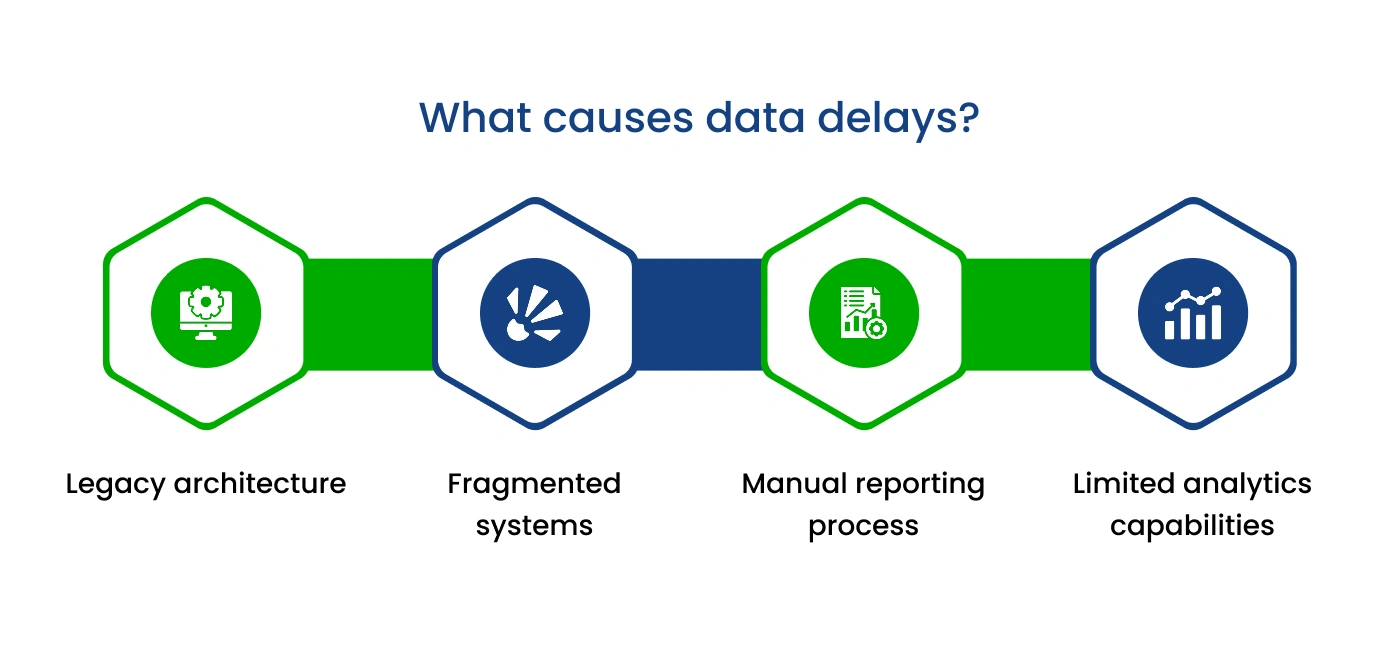
There is no single reason data delays happen. The root causes of late-arriving insights are many - from structural issues to operational bottlenecks that amplify over time. It's essential to understand each of these issues before addressing the cost and impact of delayed data.
1. Legacy architecture
Reliance on legacy systems is a major reason data delays occur. These systems are unsuitable for the current work environment, where continuous updates are important for real-time reporting and analysis. Clinging to legacy architecture means you are still using tools that update data in batches, not in real-time, creating a lag between the occurrence of an event and the moment when that data becomes visible in reports.
2. Fragmented systems
If you have multiple specialized tools in your organization and they are not fully integrated, teams have to put in significant manual effort to extract, consolidate, and validate data before insights are generated. By slowing the availability of decision-ready information, this process often delays the reporting cycle and decision speed.
3. Manual reporting process
Another reason for data delays is the fact that a lot of times, departments stick to spreadsheets and manual validation for reporting. It may take hours, days, or even weeks to gather data, validate it, and reconcile discrepancies - and by the time reports are finalized, it's already too late.
4. Limited analytics capabilities
As data volume grows, many teams struggle to scale ingestion and processing at the same pace. Without a modern, automated infrastructure, it takes hours or even days to decode that data and pull out meaningful insights that can be further used for business strategies and decisions.
Decisions still waiting on last week’s export?
Hobasa reduces the delay between what systems know and what leaders can act on.
Talk to our teamThe true cost of delayed data: what's actually at stake?
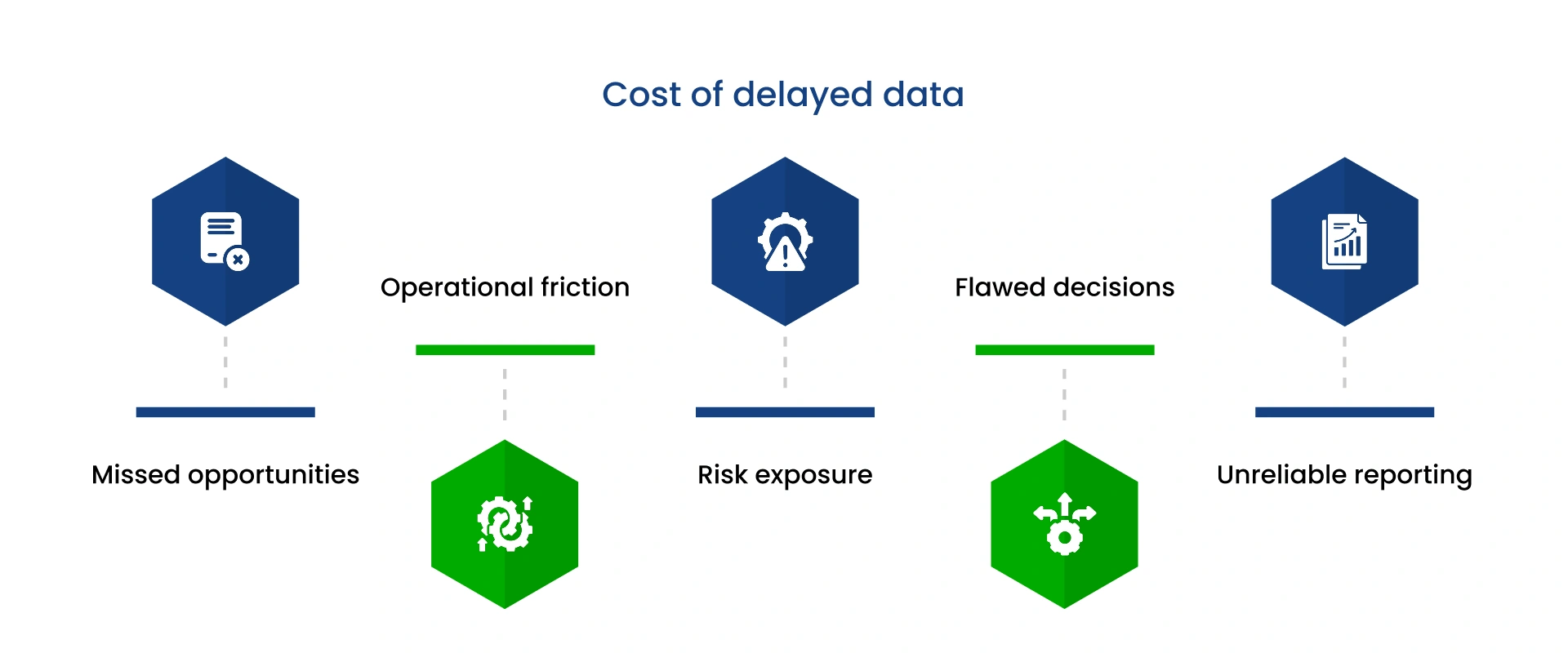
The always-on digital world is constantly changing, which means every minute matters more than ever. There's an ocean of data that's being generated by organizations; however, what's limited is their ability to analyze and act on that data. Slow and stale data ends up impacting not just the speed of decisions but multiple other aspects of a business - across revenue, operations, and long-term strategy.
1. Missed opportunities
With decisions, timing is of utmost importance. When insights arrive late, you lose the ability to act at the moment of highest impact - which can prove disastrous for time-sensitive functions like finance. Pricing decisions are made after the demand has shifted, campaigns continue running even after performance drops, and security threats come to the surface long after they have already caused damage.
Your team keeps investing in low-value initiatives, while high-value opportunities often go unrecognized. Over a period of time, the signals that you keep missing escalate into revenue loss that's difficult to reverse. This happens due to the cumulative effect of acting too late, every time there is an opportunity or threat.
2. Increased operational friction
Business operations depend on timely, accurate data. If you lack clear visibility of what's happening behind the curtain, workflows become slower and more prone to errors. Decisions are often already made by the time data arrives, forcing your teams to move into reverse gear - reworking plans and adjusting strategies. This creates operational drag with more meetings, re-approvals, and manual intervention, where teams spend significant time correcting earlier actions instead of executing the planned activities. If this becomes a norm, there's a high likelihood of operations going awry often and impacting your team's productivity.
3. Higher risk exposure
Risks don't emerge out of the blue. They grow gradually, with early signs appearing way before the impact becomes visible. The right data at the right time helps you spot business risks at an early stage - when it's plausible to course-correct and prevent potential losses. In a situation where there is a lack of real-time data, it gets challenging to keep a tab on every area of your business and foresee the risks coming your way. In finance, this may mean slower identification of unauthorized transactions by vendors or a delay in tracking fake invoices. In supply chains, it can translate into delayed responses to disruptions. In HR, this may mean documentation discrepancies going unchecked.
By the time reports start reflecting these risks, they have already started hampering operations - pushing you into reactive mode. The cost of late risk detection extends beyond financial loss, impeding workflows, slowing down projects, and blocking growth.
4. Flawed decisions driven by outdated context
Decision-making gets slow and cautious when you know that you are working with stale data. That's where teams seek additional validation or confirm their assumptions before taking any action. Decisions are drawn from signals reflecting near-past conditions rather than current realities. Operational constraints may have emerged, customer outstanding may have cleared, or employee attrition increased - but these signs haven't yet surfaced in the data. For a fast-changing business environment, this process can slow both operational and strategic decisions. Lack of confidence in the late-arriving data makes you and your teams more cautious in responding to opportunities or risks, with the entire process taking longer than expected.
5. Unreliable reporting
Data delays show up most clearly in reporting. This means if data is some days or weeks old, your reports will reflect exactly that - blocking visibility of events currently happening across your organization. With such reports, decisions are often guided by stale data around what has already happened, rather than conditions that are currently occurring. When reporting lags behind real-world activity, you end up managing the past instead of steering the present. Performance blockers are identified only after they have escalated - again pushing you into corrective action rather than timely intervention. By the time current trends appear in reports, the opportunity to course-correct has often passed.
Delayed data has a real P&L cost.
See how Hobasa helps teams move from lagging reports to timely, cross-system intelligence.
Get in touchReal-time data: why it is indispensable for businesses today
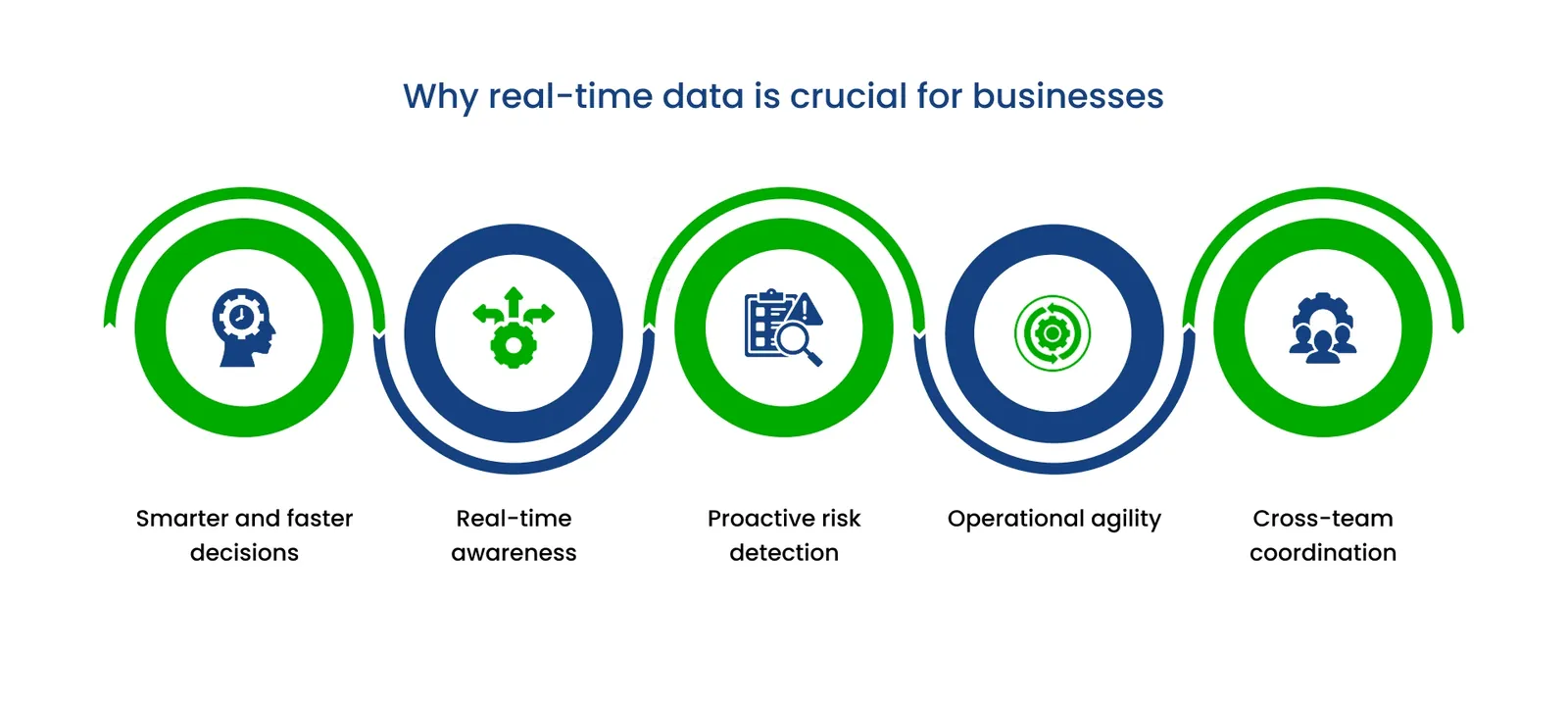
With the business landscape continuously evolving, real-time data has become indispensable for businesses to make prompt decisions, drive smarter strategies, and stay one step ahead of risks. If costly delays are bothering you and decisions are not paying off, real-time data integration is what you really need to ensure that every action you take is backed by up-to-date insights.
1. From historical snapshot to real-time awareness
While traditional analytics focuses more on what happened in the past, real-time data analysis provides a peek into what is currently happening across your business. This real-time situational awareness makes you better positioned to make contextual decisions that take into account past as well as current events. Decisions that factor in the most recent conditions tend to produce better results - whether it's about seizing an opportunity, addressing cyber threats, or handling attrition at an early stage.
Platforms like Hobasa support this shift by working with your existing systems and continuously bringing useful insights. Instead of waiting for month-end reports to reveal what changed, you can stay informed about evolving patterns, dig into unusual developments, and address challenges before they start impacting your business.
2. Smarter and faster decisions without compromising quality
Speed matters in decision-making, but the quality of the decisions you make is non-negotiable. By removing uncertainty from the picture, real-time data helps improve the quality of your decisions. With live indicators and early signals at your disposal, you can calibrate your responses to every situation more carefully, quickly adjust as conditions change, and be more confident of your actions. Real-time data helps you become more precise at what you do and reduce unnecessary risk-taking.
3. Proactive risk identification and mitigation
Reports based on real-time data surface anomalies, risks, trends, and early warning signals well in time - empowering you to act promptly before any untoward incident hits. Whether it's unusual transaction patterns, sudden change in customer behavior, or suspicious employee activities - when insights arrive on time, you can contain issues and nip them in the bud before they spiral out of control.
Hobasa makes this easier by continuously monitoring data across your existing systems and bringing important developments to your attention as they occur. The insights you get keep evolving based on the new data sets analyzed - which means no risk, gap, or anomaly ever goes unnoticed.
4. Operational agility at scale
There needs to be a seamless alignment between what's happening on the ground and how your organization responds to it. Real-time data makes this possible by bridging the gap between visibility and execution. With real-time data, you get immediate insights into operational constraints, financial performance, customer risks, and much more, right when they emerge. This immediacy takes you and your team from a reactive mode to a state where there are continuous, ongoing improvements and a lot of proactiveness.
5. Cross-team coordination through shared visibility
One of the most underappreciated benefits of real-time data is its ability to help teams work together in absolute sync. With current data easily flowing across departments, you can have a single high-level view of your business. These live signals from marketing, sales, operations, and finance available for everyone, significantly improves team collaboration. Big decisions can be made unanimously, reducing approval loops and unnecessary back and forth. This shared visibility also speeds up execution, helping different teams work faster as one coherent unit, instead of operating in isolation.
In a world that moves fast, real-time data is a strategic asset
To flourish in an always-on, constantly changing business environment, you need to have the most updated, recent data at your fingertips.
The strategies you suggest, or the decisions you make are all guided by data, and if this data is stale or doesn't involve the most recent events, every action you take may backfire. The cost of data delays extends far beyond just financial loss. Decisions often go slow, risk exposure increases, and internal friction is amplified, worsening the matter even more.
Real-time data closes the gap between events and insights, so you can work with precision rather than hindsight.
Close the gap between events and insight.
Hobasa works with your existing systems to continuously surface trends, anomalies, and risks in real time - so decisions are backed by up-to-date insight, not stale reports.
FAQs
Delayed data is information that reaches decision-makers after the underlying conditions have already changed. It matters because decisions made on stale data often miss opportunities, react to risks too late, and reduce the quality of both operational and strategic choices.
The most common causes are legacy architecture that updates in batches rather than real-time, fragmented systems that require manual consolidation, spreadsheet-driven reporting processes, and limited analytics capabilities that can't keep pace with growing data volumes.
Beyond direct revenue loss, delayed data drives missed opportunities, operational friction, higher risk exposure, cautious or flawed decisions, and unreliable reporting - together they compound into slower growth and reduced organizational agility.
Real-time data shifts organizations from historical snapshots to live awareness. It enables smarter, faster decisions, earlier risk detection, greater operational agility, and stronger cross-team coordination - all of which are essential in a fast-changing environment.
Leaders can integrate fragmented systems, replace manual reporting with automation, invest in modern analytics infrastructure, and adopt platforms that continuously monitor data across the business to surface anomalies, risks, and trends as they occur.