
- AI is transforming how work is done and decisions are informed, but leadership challenges have not become simpler.
- While AI provides speed, scale, and insight, judgment, accountability, and context remain human responsibilities.
- As AI becomes pervasive, human skills - not technology access - are the true differentiator between effective and ineffective leadership.
- Leaders must balance AI-driven insight with judgment, critical thinking and ethical decision-making.
- AI-ready leadership is human-led: AI informs decisions, but people remain accountable for outcomes.
- Organizations that thrive in the AI era are those where leaders combine machine intelligence with strong human skills.
AI is moving faster than any technology most organizations have encountered. It is reshaping how work is executed, and decisions are made.
Yet as AI becomes more pervasive, a paradox is emerging. While organizations have access to more insights than ever before, leadership challenges have not become simpler. Decisions still require judgment. And accountability still rests with people, not systems.
What increasingly separates effective leaders from the rest is not their ability to deploy AI, but their ability to apply human skills alongside it - to interpret insights, apply them thoughtfully, and lead with clarity, especially in situations where data alone is not enough.
This is why human skills are becoming more critical for business leaders in the AI era. In this blog we explore why human skills matter more than ever, the leadership skills that will define success, and what strong leadership looks like in practice in the AI-dominated world.
Why human skills matter more than ever as AI becomes pervasive
AI excels at processing vast amounts of data, identifying patterns, and generating recommendations. What it cannot do is fully understand organizational context, weigh competing values, or take accountability for decisions. As technology becomes more capable, the importance of human-led leadership is becoming even more pronounced.
1. AI can accelerate decisions, but leaders provide direction
AI can surface patterns, analyze trends, and generate recommendations quickly. However, leadership decisions often involve factors that extend beyond data alone - organizational priorities, market realities, employee impact, customer trust, and long-term business goals. This is where human judgment remains essential. Leaders are responsible for balancing competing priorities, interpreting nuance, and making decisions in situations where there may not be a perfectly measurable answer. AI can support that process, but it cannot fully replace strategic judgment and accountability.
2. Workforce expectations are evolving
As organizations adopt AI more aggressively, employees are looking to leadership for clarity, stability, and transparency. Periods of technological change often create uncertainty around roles and responsibilities, changes in work styles and collaboration patterns, and a pressure to adapt to new systems. In such environments, human-centered leadership becomes increasingly important. Employees value leaders who communicate clearly, listen actively, provide context, and create trust during change.
3. Technology is becoming accessible. Human capability is the differentiator.
AI tools are becoming more widely available across industries. Over time, access to technology itself will become less of a competitive differentiator, and what will really separate organizations is how their leaders make the most of the tools and systems available. The real competitive differentiator is going to be how good leaders are at using AI insights to make strategic decisions, guide teams, manage uncertainty, and build resilience. In other words, leadership quality becomes a long-term advantage. The organizations that succeed in the AI era are often not the ones with the most advanced tools, but the ones that combine technology with strong leadership capability and organizational alignment.
4. Leadership responsibilities are expanding, not shrinking
One common misconception is that AI will reduce the need for leadership involvement. However, that's not the case. In reality, the role of leaders is now becoming more important and complex than ever. Business leaders are now expected to oversee AI adoption, evaluate its ethical and operational implications, and guide adoption across departments. This further expands the role of leadership where they have to adopt AI, while ensuring a good balance of human judgment as well. AI may change how work gets done, but leaders still shape how organizations evolve.
AI is rising. Judgment still has to lead.
Hobasa gives leaders clearer system-backed context so human decisions stay accountable and informed.
Talk to our teamThe human skills leaders need to thrive in the AI era
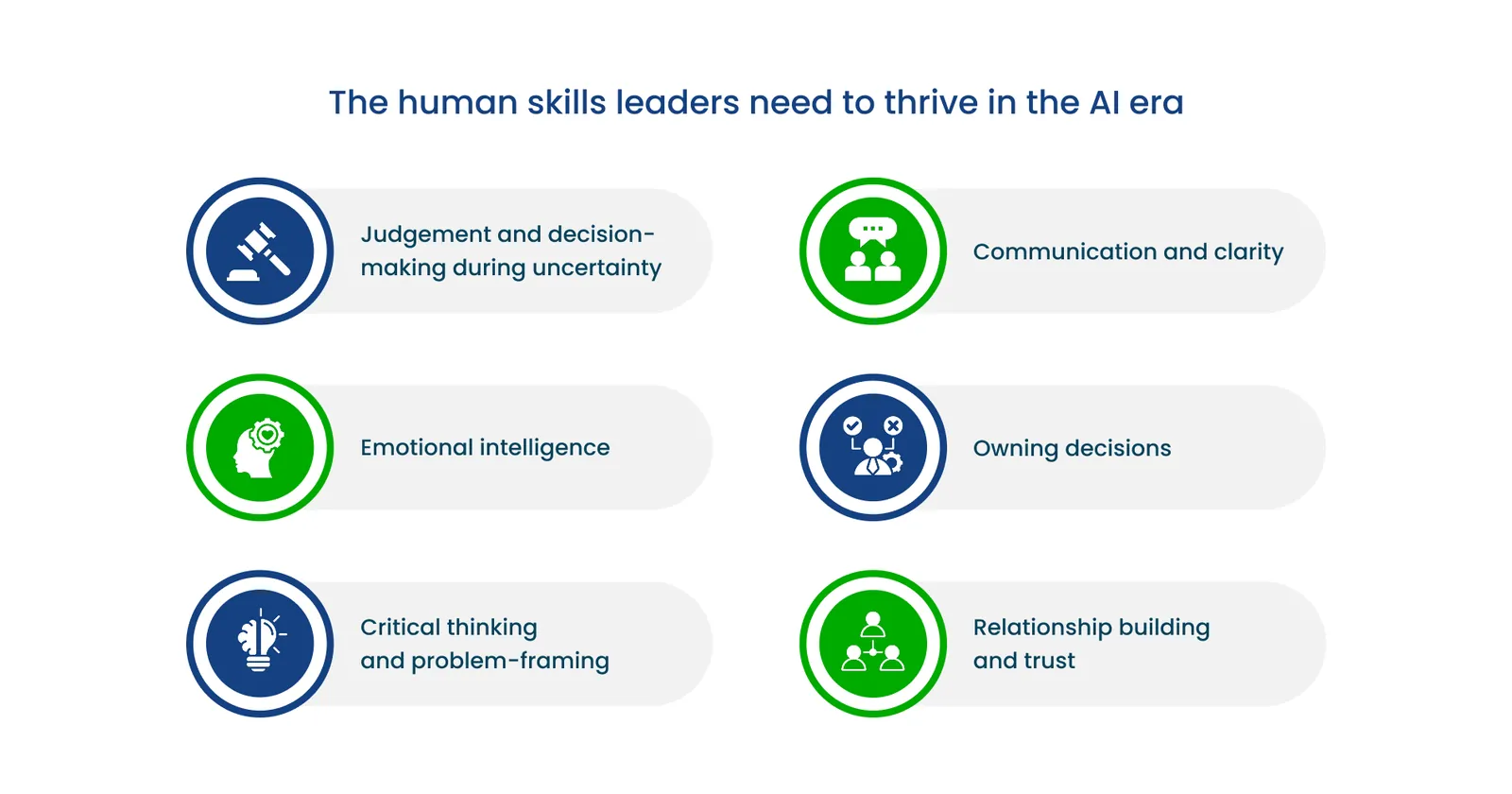
As AI becomes embedded in everyday decision-making, leadership effectiveness is increasingly defined by how well human capabilities complement machine intelligence. The leaders who thrive are not those who rely most heavily on AI, but those who use it thoughtfully - anchored by strong human skills that guide interpretation, judgment, and action.
1. Judgment and decision-making during uncertainty
AI excels at presenting options, forecasts, and probabilities. Leadership begins where those outputs stop. It's important for you to evaluate recommendations in context - considering business priorities, timing, and consequences that data alone cannot fully capture. In practice, this means knowing when to trust AI-generated insight, when to question them, and when to reject the recommendations based on experience or values. As uncertainty increases, sound judgment - not speed - becomes the real differentiator.
2. Communication and clarity
AI often produces complex or abstract outputs. Translating those insights into clear direction that teams can understand and act on is not a nice-to-have but an essential capability that can help you bring more clarity across processes. This sense-making role involves explaining not just what the data suggests, but why a decision is being made and how it aligns with broader goals. Clear communication ensures AI enhances alignment rather than creating confusion or disengagement.
3. Emotional intelligence
AI can automate processes, but it cannot fully understand human emotions, motivation, or workplace dynamics. This is why emotional intelligence remains one of the most important leadership capabilities in the AI era. It's a quality that enables you to understand employee concerns, manage change sensitively, support team morale during transformation or periods of uncertainty, and build stronger collaboration and trust across levels.
4. Owning decisions
As AI drives automation and analysis, one leadership skill becomes critical: the ability to clearly own decisions. This skill shows up when you evaluate AI-generated recommendations instead of automatically accepting them, decide how much weight to give AI input relative to experience, context, and values, and take responsibility for outcomes - positive or negative. In practice, decision ownership means you can explain why a particular AI insight was used, what alternative options were considered, and what judgment call was made - and by whom.
5. Critical thinking and problem-framing
AI can only solve the problems it is asked to address. Leaders play a critical role in defining the right questions before turning to data or models. Strong problem framing involves clarifying objectives, constraints, and risks, and ensuring AI is applied to meaningful business challenges rather than symptoms. To excel here, it's vital that you use AI as a tool for exploration and insight, not as a shortcut to answers.
6. Relationship building and trust
As AI becomes more involved in analysis and decision support, trust becomes a defining leadership currency. Data and algorithms may inform decisions, but people still look to leaders to understand intent and direction. Strong relationship-building skills help you create confidence in AI-influenced decisions. This means being present in conversations, listening to concerns, and engaging openly when change or uncertainty arises. Employees are more likely to trust decisions when they trust the person explaining them.
What human-led, AI-powered leadership looks like
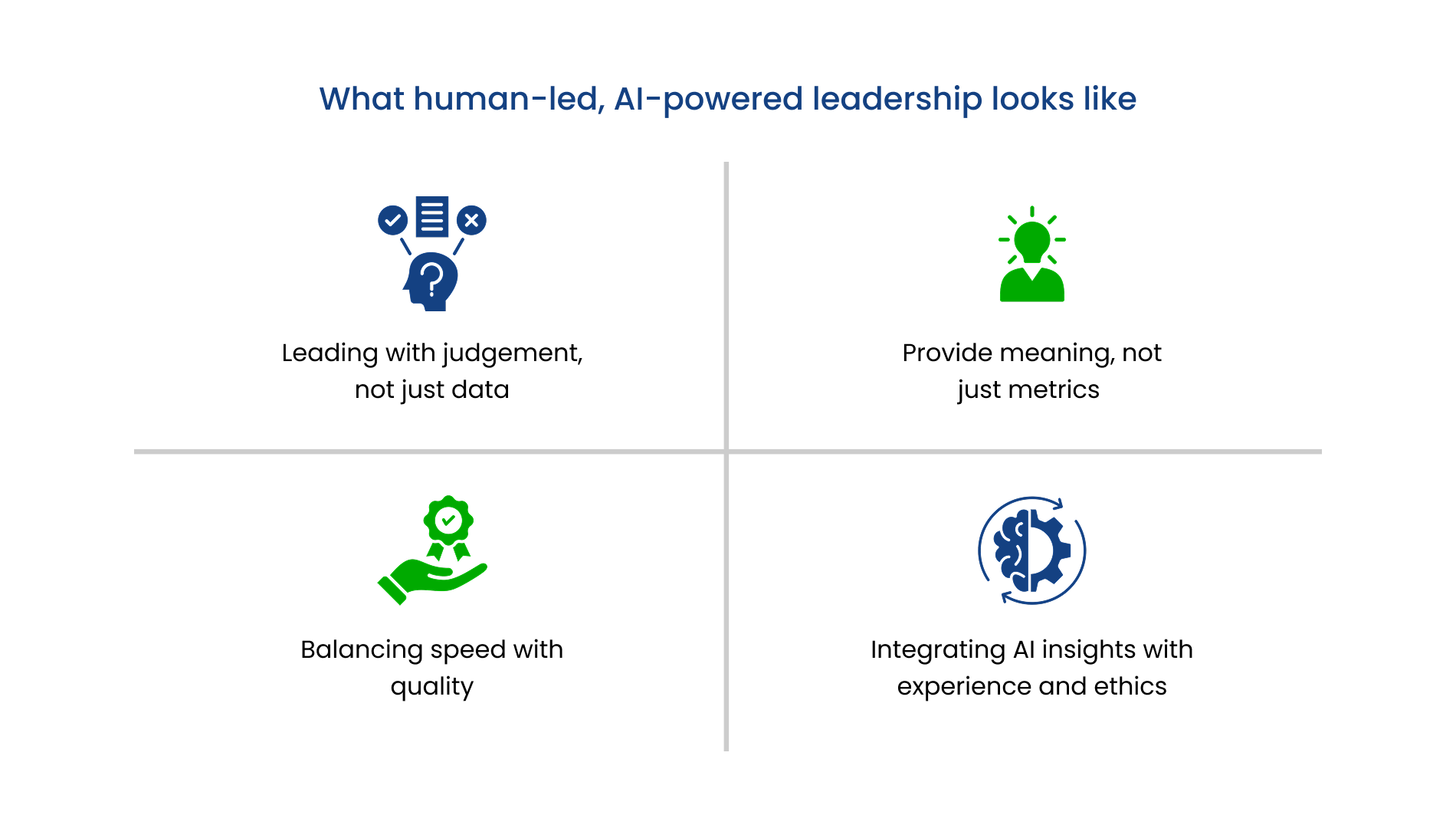
As AI becomes more deeply woven into decision-making, leadership is increasingly judged by how well you maintain clarity of purpose and sound judgment amid growing technological capability. Here's what human-led, AI-powered leadership looks like in practice.
1. Leading with judgment, not just data
AI can surface patterns, forecasts, and recommendations at scale. But leadership begins after those insights appear. Human-led leadership shows up in how you evaluate AI outputs before acting - by applying business context, timing, trade-offs, and consequences that data alone cannot capture. Instead of asking, "What does the model say?", you ask, "Does this align with our priorities, constraints, and long-term objectives?" Judgment - not data volume - remains the final filter.
2. Provide meaning, not just metrics
AI can generate insight, but it often fails to explain the right meaning. Human-led leadership requires translating AI-supported analysis into a clear direction - so people understand why a decision is being made and what matters next. This sense-making role is essential for alignment. When insights are left unexplained, AI can create confusion or disengagement. When meaning is clearly communicated, AI strengthens focus and execution.
3. Balancing speed with quality
AI dramatically accelerates access to information. Human-driven leadership ensures that speed does not come at the expense of thoughtfulness. You use AI to reduce analysis time, not to rush decisions. By creating space for reflection, discussion, and deliberate choice - especially in high-impact situations - you ensure that faster insight leads to better outcomes, not reactive ones.
4. Integrating AI insights with experience and ethics
Human-led leadership does not mean avoiding AI - it means using it in ways that strengthen decision-making rather than replace it. This is where platforms like Hobasa can play a supporting role. By bringing together information from across your existing systems and presenting insights through conversational AI, Hobasa highlights risks, process anomalies and trends in real time. The goal is not to automate judgment, but to give you better information so you can make more informed decisions with confidence. Ultimately, AI delivers the greatest value when it is used mindfully to amplify your expertise and experience.
Human-led, AI-powered operating rhythm.
See how Hobasa supports leaders who want AI leverage without losing ownership of the call.
Get in touchHuman skills are the real differentiator in the AI-dominated world
AI will continue to accelerate - bringing faster analysis, broader visibility, and new possibilities across your business. But as technology becomes more capable, the role of leadership does not diminish. It becomes more consequential.
What distinguishes effective leadership in the AI era is not how quickly you deploy tools, but how smartly you apply human skills alongside technology use. Judgment, critical thinking, communication, ethical reasoning, and relationship-building are the skills that ensure AI-driven insights lead to sound decisions rather than unintended outcomes.
AI can surface patterns and suggest options, but it cannot define priorities, balance competing interests, or take responsibility for decisions that shape your organization's culture or long-term growth. These responsibilities remain firmly human - and they are where leadership matters most.
Amplify human judgment with AI-powered insight.
Hobasa brings together information from across your existing systems and surfaces risks, anomalies, and trends in real time - so leaders can make more informed decisions with confidence.
FAQs
As AI becomes more capable, it handles analysis and pattern recognition at scale. However, it's the human skills that are needed to interpret insights, draw meaningful conclusions, and make the right decisions.
Key human skills include judgment under uncertainty, critical thinking, clear communication, emotional intelligence, ethical reasoning, problem-solving, and relationship-building. These skills ensure AI insights lead to sound decisions.
No. AI can improve efficiency, generate recommendations, and accelerate access to information, but it cannot fully replicate human judgment, strategic reasoning, empathy, trust-building, or accountability. Leadership still depends heavily on human capabilities, especially in complex or uncertain situations.
It means leaders use AI as an input - not an authority. AI helps surface insight and options, while humans apply context, experience, values, and accountability to decide what actions to take.
Over time, access to AI will become widespread. The real competitive advantage will come from how effectively leaders use AI insights - through strong judgment, clear communication, and thoughtful decision-making.