- AI adoption alone does not guarantee business value.
- Many organizations struggle to realize returns from AI because of fragmented data, unclear objectives, weak adoption, and unrealistic expectations.
- The most successful AI initiatives start with establishing clear business priorities at the very start.
- A strong data foundation, AI fluency, and cross-functional collaboration are critical to maximizing AI ROI.
- AI works best when it augments human judgment rather than replacing it.
- Scaling proven AI use cases gradually often delivers better outcomes than pursuing enterprise-wide transformation too quickly.
- Organizations that treat AI as a long-term capability - not a one-time project - are more likely to generate sustainable value.
The first wave of AI adoption was driven by curiosity. The second wave is being driven by accountability.
Over the past few years, organizations have raced to experiment with AI, launch pilots, and explore new use cases. For many leadership teams, the priority was simple: understand the technology and avoid being left behind. Today, the conversation has changed.
Leaders now look for the impact created by AI, trying to find answers to a whole new set of questions: Which initiatives are creating value? Which ones are not? And how do we scale what works?
This shift marks an important turning point. The challenge today is no longer whether you should adopt AI. It is whether you can consistently convert AI investments into better decisions, stronger operations, and noticeable business outcomes. Because while AI capabilities are becoming easier to access, realizing value from them remains considerably harder.
This blog sheds light on why gaining value from AI is challenging, what you can do about it, and the pitfalls to avoid.
Why realizing value from AI investments remains challenging
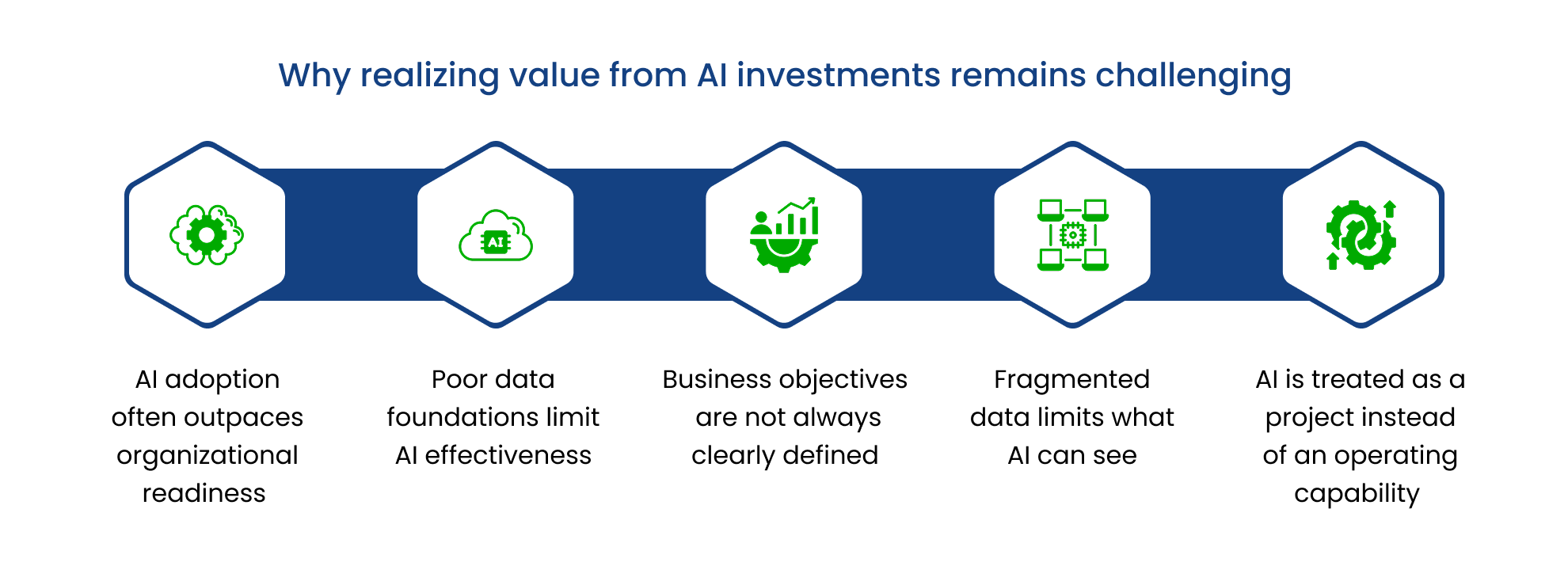
Despite widespread investment, organizations often find that AI initiatives plateau after early wins. Several structural factors explain why.
1. AI adoption often outpaces organizational readiness
Many organizations are moving quickly to experiment with AI in response to growing competitive pressure. While companies are quick to adopt technology, supporting capabilities such as governance, process redesign, and change management often take a backseat. As a result, AI initiatives may demonstrate technical success without creating meaningful business impact.
2. Poor data foundation limits AI effectiveness
AI systems depend heavily on data quality. Disconnected systems, duplicate records, and fragmented data reduce the accuracy and reliability of AI-generated outputs. Even sophisticated AI models struggle when underlying data lacks consistency or context. That's precisely why improving data quality becomes just as important as investing in AI itself.
3. Business objectives are not always clearly defined
Some AI initiatives begin with the question "Where can we apply AI?" rather than "Which business problem are we trying to solve?" Without clearly defined objectives, it becomes difficult to measure success or prioritize investments effectively. AI delivers the greatest value when it is tied to specific business objectives such as reducing operational inefficiencies, accelerating decision-making, or improving risk management.
4. Fragmented data limits what AI can see
AI systems depend on the data they are fed. In many organizations, critical data remains fragmented across functions and systems. As a result, AI platforms surface insights based on incomplete information and partial views of the business. This data fragmentation limits context. Patterns that matter at the enterprise level - emerging risks, cross-functional dependencies, or operational inefficiencies - are harder to detect when data is siloed. In these cases, AI can inadvertently reinforce existing blind spots rather than eliminate them.
5. AI is treated as a project instead of an operating capability
Many AI initiatives are managed as independent projects rather than being embedded into the operating workflows. Pilots succeed, tools are deployed, but processes, governance, and behaviors remain unchanged. Sustained value requires AI to be embedded into how data flows, how decisions are reviewed, and how risks are monitored - on an ongoing basis. Without this integration, there may be early gains but no long-lasting impact.
AI spend up. Business value still unclear?
Hobasa helps leaders ground AI in real cross-system data and priorities that move the P&L.
Talk to our teamHow C-suite leaders can maximize value from AI investments
Realizing AI's real value depends largely on how effectively it is aligned with business priorities and integrated into workflows. To generate meaningful returns from AI, you need to focus on creating the right operating conditions where it can impact the way everyone works. Here are a few suggestions to turn your AI investments into tangible results.
1. Leverage AI to surface early risk signals
Many AI initiatives focus on explaining what has already happened. While this has value, the greater opportunity lies in using AI to surface what is beginning to change - before your business is impacted. AI is particularly effective at identifying subtle patterns across large data sets that may indicate emerging risk, inefficiency, or opportunity. Leaders who use AI as an early-warning system gain more room to act, adjust, and sequence decisions deliberately rather than react under pressure.
This is where platforms such as Hobasa can help. By connecting operational data across systems and continuously monitoring key metrics, Hobasa helps you identify process anomalies, policy deviations, and potential risks in real time. Whether in HR or finance, you can gain earlier visibility into the signals that really matter for your business and address issues before they escalate into major challenges.
2. Maintain clear human ownership
AI can surface insights, but it cannot own decisions. Organizations that realize sustained value are explicit about where AI informs judgment and where leaders remain accountable. Clear decision rights, escalation paths, and ownership ensure that AI outputs translate into action rather than awareness alone. This clarity also builds trust - both in the insights generated and in how they are used.
3. Be specific with your AI goals
The most successful AI initiatives begin with clearly defined business objectives. Rather than asking where AI can be applied, you can focus on identifying the operational challenges, inefficiencies, or decision gaps that need to be addressed. AI creates the greatest impact when it is tied to measurable outcomes such as reducing operational inefficiencies or accelerating the reporting cycles. When AI investments are linked to strategic priorities, it becomes much easier to use it for long-term organizational growth.
4. Break down data silos
AI needs a connected data environment to reveal patterns that would otherwise remain hidden. Maximizing AI value requires you to prioritize connected insight across functions and processes. When data flows seamlessly across systems and departments, AI can support enterprise-level understanding - making insights more relevant to senior leadership.
This is another area where Hobasa can add value. Our AI analytics platform integrates with the systems you already use and delivers unified insights across processes within seconds. This means you don't have to switch between multiple tabs and piece together all that data for a detailed analysis.
5. Embed AI into existing workflows
AI delivers the most value when it becomes part of everyday operations rather than functioning as a separate technology layer. Instead of requiring employees to adapt their work around AI tools, you can integrate AI into existing processes so your teams can surface process anomalies faster, spot emerging trends, reduce repetitive work, and access insights at their fingertips. The easier AI fits into normal workflows, the more likely it is to be adopted and trusted.
6. Position AI as a decision support capability
AI excels at processing large amounts of information and identifying patterns that would be difficult to detect manually. However, context, trade-offs, and strategic priorities still require human judgment. The organizations generating the greatest value from AI are not replacing expertise - they are augmenting it. When leaders position AI as a tool that supports decisions rather than makes them, teams are more likely to trust the outputs and incorporate them into their daily work.
7. Build AI fluency across the organization
AI fluency is the ability to understand what AI can do, where it should be applied, and how to interpret AI-generated insights responsibly. Importantly, AI fluency does not require everyone to become data scientists. Instead, it enables teams to ask better questions, evaluate outputs critically, and use AI with greater confidence. Encouraging experimentation, providing training, and fostering a culture of continuous learning can help you ensure that AI capabilities translate into real business outcomes. Ultimately, AI creates value not only through algorithms and models, but through the people who understand how to apply them effectively.
8. Focus on outcomes rather than adoption metrics
AI success should not be measured by the number of pilots launched or tools deployed. The more important question is whether AI is improving business performance. You can evaluate AI initiatives through outcomes such as time saved through automation, faster access to insights, improved forecasting accuracy, reduced operational costs, and earlier identification of risks.
9. Scale AI use cases gradually
The pressure to move quickly with AI can sometimes encourage organizations to pursue large-scale transformation initiatives before establishing the necessary foundation. However, the truth is AI success is incremental. Rather than attempting to deploy AI across the entire enterprise at once, you can begin with a small number of high-impact use cases that address clearly defined business problems. Early successes not only help demonstrate value, but also provide opportunities to refine governance, improve data quality, and build teams' confidence. For example, you can kickstart by deploying AI for automating repetitive workflows or improving reporting. As these initiatives are successful, start expanding AI into additional functions and processes with greater confidence.
Turn AI pilots into durable operating value.
See how Hobasa strengthens the data foundation AI needs to produce outcomes leadership can measure.
Get in touchCommon AI investment pitfalls leaders should avoid
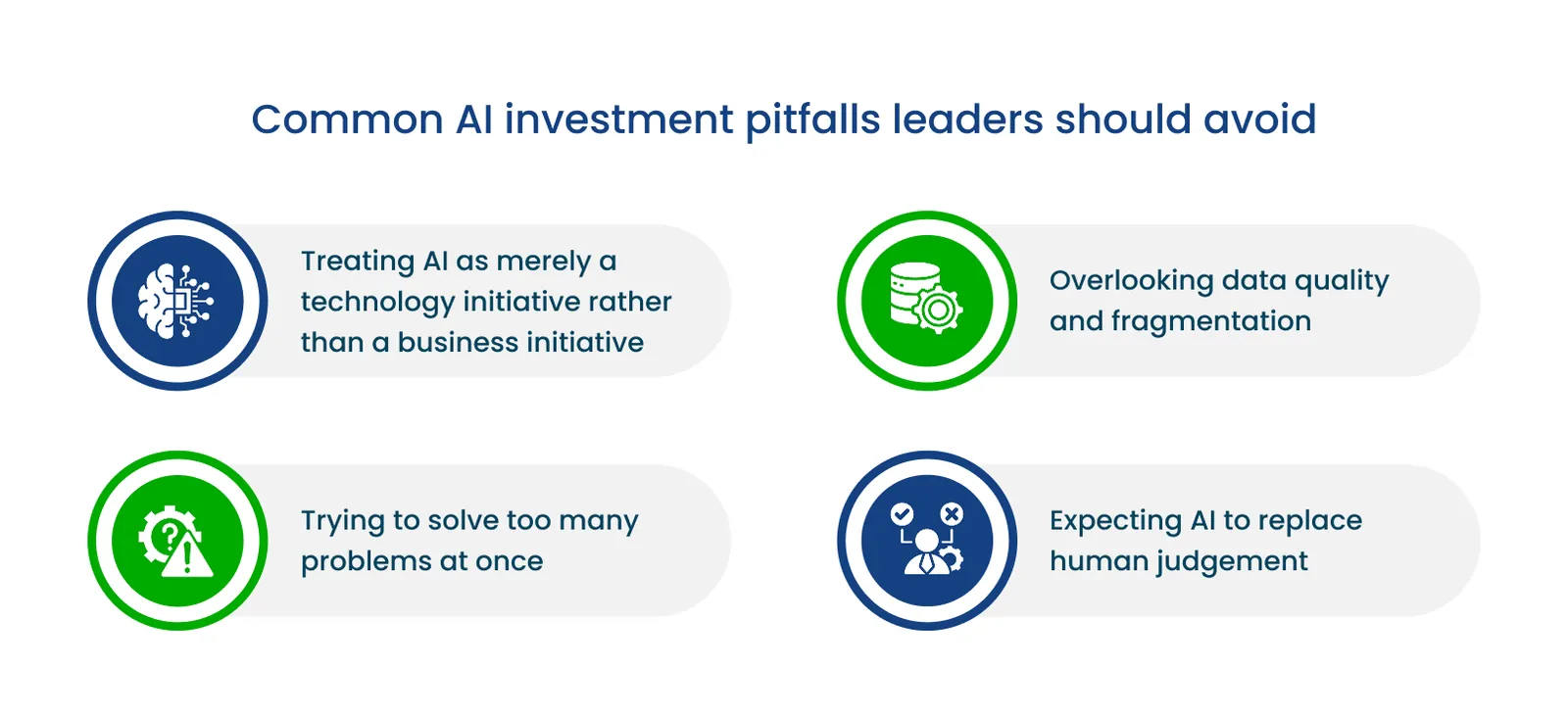
Challenges mostly arise when AI programs are implemented without sufficient alignment between business priorities, data readiness, and organizational adoption. Understanding these common pitfalls can help you avoid unnecessary setbacks and generate sustainable value from your AI investment.
1. Treating AI as merely a technology initiative rather than a business initiative
One of the most common mistakes organizations make is approaching AI primarily from a technology perspective. In many cases, AI adoption begins with enthusiasm around new tools rather than a clearly defined business problem. While experimentation is valuable, technology alone rarely creates a measurable impact. To achieve better outcomes, begin your AI journey by asking questions such as: Which business challenges are we trying to solve? Which operational inefficiencies are we trying to address? Which decisions would benefit from better insights? When AI initiatives are anchored in business objectives, it becomes easier to prioritize investments and measure results.
2. Trying to solve too many problems at once
The excitement surrounding AI can create pressure to launch multiple initiatives simultaneously. However, spreading resources across too many projects often dilutes focus and makes it harder to demonstrate meaningful returns. Teams become overwhelmed, governance becomes inconsistent, and individual initiatives may struggle to gain traction. To create greater long-term value, you need to focus on a few high-impact use cases first and then expand gradually.
3. Overlooking data quality and fragmentation
AI systems rely heavily on the quality, consistency, and accessibility of underlying data. Disconnected systems and duplicate data can undermine AI outputs and reduce confidence in the insights generated. This makes data readiness a major barrier to AI success. Without strong data foundations, even the most advanced AI solutions may struggle to deliver reliable business outcomes.
4. Expecting AI to replace human expertise
AI can analyze data quickly and identify patterns that may otherwise remain hidden. However, it cannot fully understand business context, strategic priorities, or organizational trade-offs. Leaders who view AI as a replacement for expertise often encounter resistance, trust issues, and unrealistic expectations. The greatest value is realized when AI complements human capabilities by helping teams make faster, more informed decisions while leaving accountability and judgment firmly in human hands.
Turn your AI investment into lasting business value
AI has reached a point where access is no longer the differentiator. Most organizations have started investing heavily in AI tools for different purposes. However, what separates those that see real value from those that don't is how meticulously AI is integrated into daily workflows and leadership decision-making.
Value emerges when AI improves what you see, when you see it, and how quickly you can act. That requires clear ownership, connected data, and leaders who are fluent enough to interpret insights and apply human judgment. It also requires moving toward a mechanism where AI supports early awareness and risk detection across your organization.
The companies that benefit most from AI are not those with the most advanced models, but those that treat AI as a shared leadership capability - one that strengthens visibility, sharpens decisions, and reduces surprise. For C-suite leaders, the opportunity is clear: use AI not just to automate work, but to see the business more clearly and act with greater confidence. That is where AI delivers its most enduring value.
Turn your AI investment into decisions leaders can trust.
Connect operational data across your business and let Hobasa surface the early signals, anomalies, and insights that make AI worth the investment.
FAQs
Because AI is often deployed to automate tasks rather than improve leadership decisions. Poor data quality, fragmented systems, and lack of organizational readiness can also limit AI's impact.
Business leaders can maximize AI value by starting with clearly defined business problems, strengthening data quality and governance, embedding AI into existing workflows, building AI fluency across the organization, measuring business outcomes instead of adoption metrics, and scaling AI use cases gradually.
For many organizations, the biggest challenge is not being able to create a supporting environment for AI to deliver real results. Data fragmentation, lack of organizational readiness, and inefficient change management frequently prevent AI initiatives from delivering expected results.