

The proof a lender, buyer or surveyor asks for - before they ask.
A readiness view is a standing, evidence-backed picture of your agency: revenue quality, AR and denials, caregiver stability, documentation completeness and referral economics - each figure traceable to the system it came from. Below is what it covers, what it needs from you, and what changes once it is running.
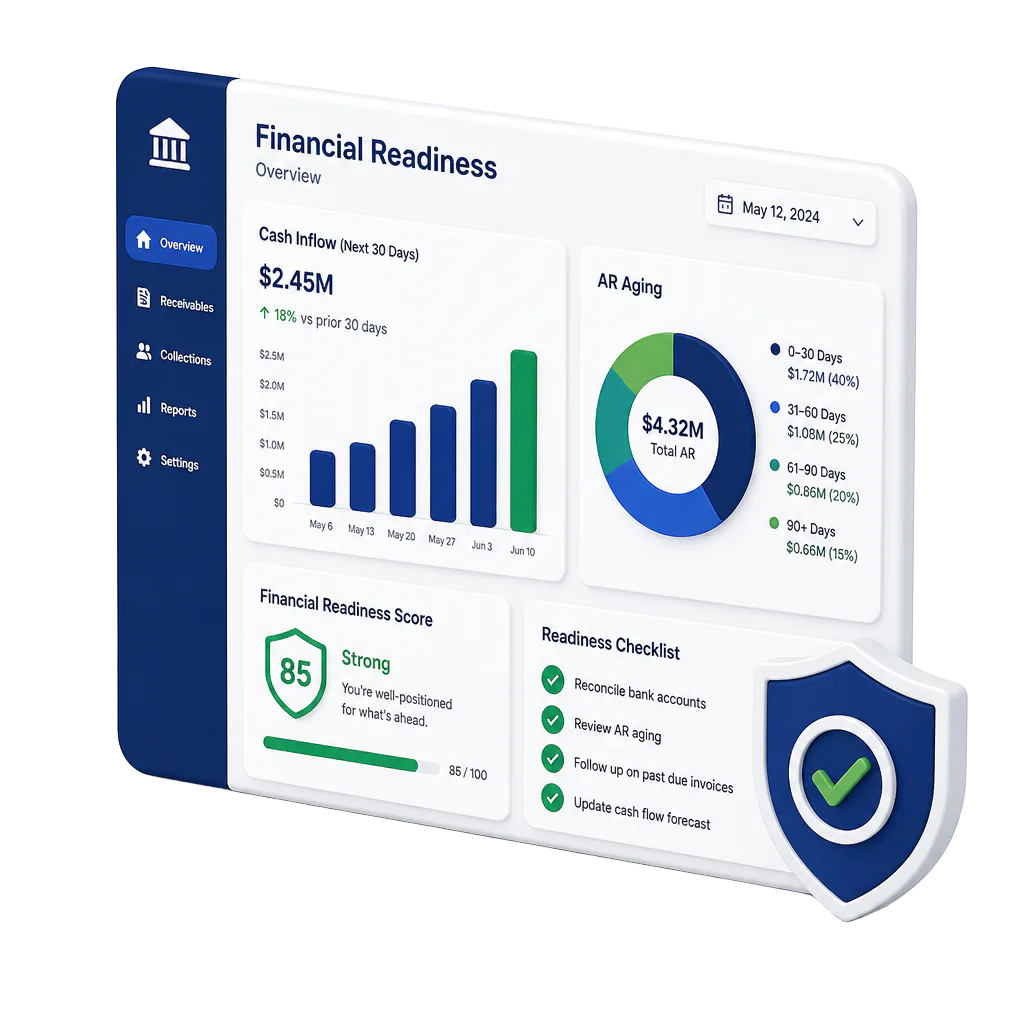
Five areas, each backed by traceable evidence.
These are the same five areas referenced on the Hospice page, expanded into what each one actually contains once your systems are connected.
Revenue quality, by payer and program
Revenue that holds up under scrutiny, not just revenue that was booked.
- Net revenue per patient day split by payer, program and location, with routine, continuous, respite and inpatient levels of care separated.
- Cap and eligibility exposure tracked as it accrues, so the aggregate cap conversation happens early rather than at reconciliation.
- Unbilled and late-billed visits surfaced against the schedule and the EVV record, with the dollar value attached.
- Rate and authorisation mismatches flagged where the contracted rate, the authorised units and the billed amount disagree.
AR aging with denial cohort analysis
Where cash is stuck, why it is stuck, and which causes repeat.
- AR aged by payer and bucket, reconciled to the general ledger so the number in the pack matches the number in accounting.
- Denials grouped into cohorts by reason code, payer and originating step, showing whether the failure is eligibility, authorisation, documentation or coding.
- Rework cost and recovery rate per cohort, so effort goes to the denials that are actually winnable.
- Days to bill and days to cash trended by cohort, with the top repeat causes named and owned.
Caregiver retention and credential currency
Workforce stability evidenced, not asserted.
- Turnover and tenure by role, discipline and location, separating voluntary from involuntary exits.
- Credential, license and competency expiry tracked forward, with visits at risk if a lapse is not closed.
- Overtime, agency use and visit-per-clinician load shown against capacity, so cost pressure is visible before it hits margin.
- Open-requisition and time-to-hire trends alongside census growth, which is the pairing diligence actually tests.
Survey-ready documentation evidence
Completeness you can demonstrate on the day of a survey.
- Face-to-face encounters, certifications and recertifications tracked against their due windows.
- Plan-of-care review, IDG meeting cadence and physician-signature status monitored as an exception list, not a report.
- Visit-note timeliness and EVV match rates by clinician, with the gaps routed to the person who can close them.
- A stable, exportable evidence trail that ties each item back to its source system and timestamp.
Referral source ROI, by admission
Which relationships create profitable admissions.
- Referral to admission conversion by source, with reasons for non-admission captured.
- Length of stay, level-of-care mix and contribution per admission by referring source.
- Liaison activity mapped to admitted volume, so business-development spend is judged on outcomes.
- Concentration risk quantified where a small number of sources drive a large share of census.
What it takes to stand this up.
Nothing here requires replacing a system or hiring a team. Most agencies are live in weeks using the tools they already run.
System access
Read-only access to your EHR, EVV, payroll or HRIS, and accounting ledger. Native connectors where they exist, secure file drops where they do not.
Definitions agreed once
A short working session to lock net revenue, admission, visit completion and turnover definitions, so every figure means the same thing to every reader.
Named owners per exception
Each exception type gets an owner in billing, clinical or HR. Findings are routed to a person, not published to a dashboard nobody opens.
A reconciliation baseline
One closed period reconciled between the EHR and the ledger. That baseline is what makes every later figure defensible.
Controls and access rules
Data masked, access-controlled and audit-logged. PHI stays scoped to who needs it, and your data is never used to train models.
A short review rhythm
A weekly exception review and a monthly readiness review. Roughly two hours a month from your team keeps the pack current.
What changes once the readiness view is running.
Connect, reconcile one closed period, and publish. The first pack is usable before the next board meeting.
Requests are answered from a standing pack with lineage, instead of a scramble across spreadsheets and inboxes.
Unbilled visits, rate mismatches and preventable denials surface while they are still correctable.
Clinical, billing, finance and HR read the same definitions, so internal debate moves from the data to the decision.
Figures shown are representative of engagements to date and depend on payer mix, data quality and how quickly exceptions are worked.
Readiness considerations we raise up front.
Data quality is the first finding
Early exception volume is usually a data-hygiene signal, not a fraud signal. We separate genuine leakage from mapping and entry issues before anything reaches a lender-facing pack.
Readiness is continuous, not a project
A pack prepared for one transaction goes stale. Because the view refreshes from source systems, evidence stays current between raises, renewals and surveys.
Audience-specific views
Lenders want covenant and cash evidence, buyers want revenue quality and concentration, surveyors want documentation completeness. Same source, different cut.
Multi-site and multi-payer complexity
Locations, taxonomies and payer contracts are normalized once, so consolidated figures roll up cleanly and site-level detail stays intact.
Compliance posture
ISO 27001 certified, SOC 2 Type II certified, PHI masked and access-controlled, with a sub-processor list available on request.
Who runs it
Hobasa sets it up and runs it with your team. You are not handed a tool and left to staff it.