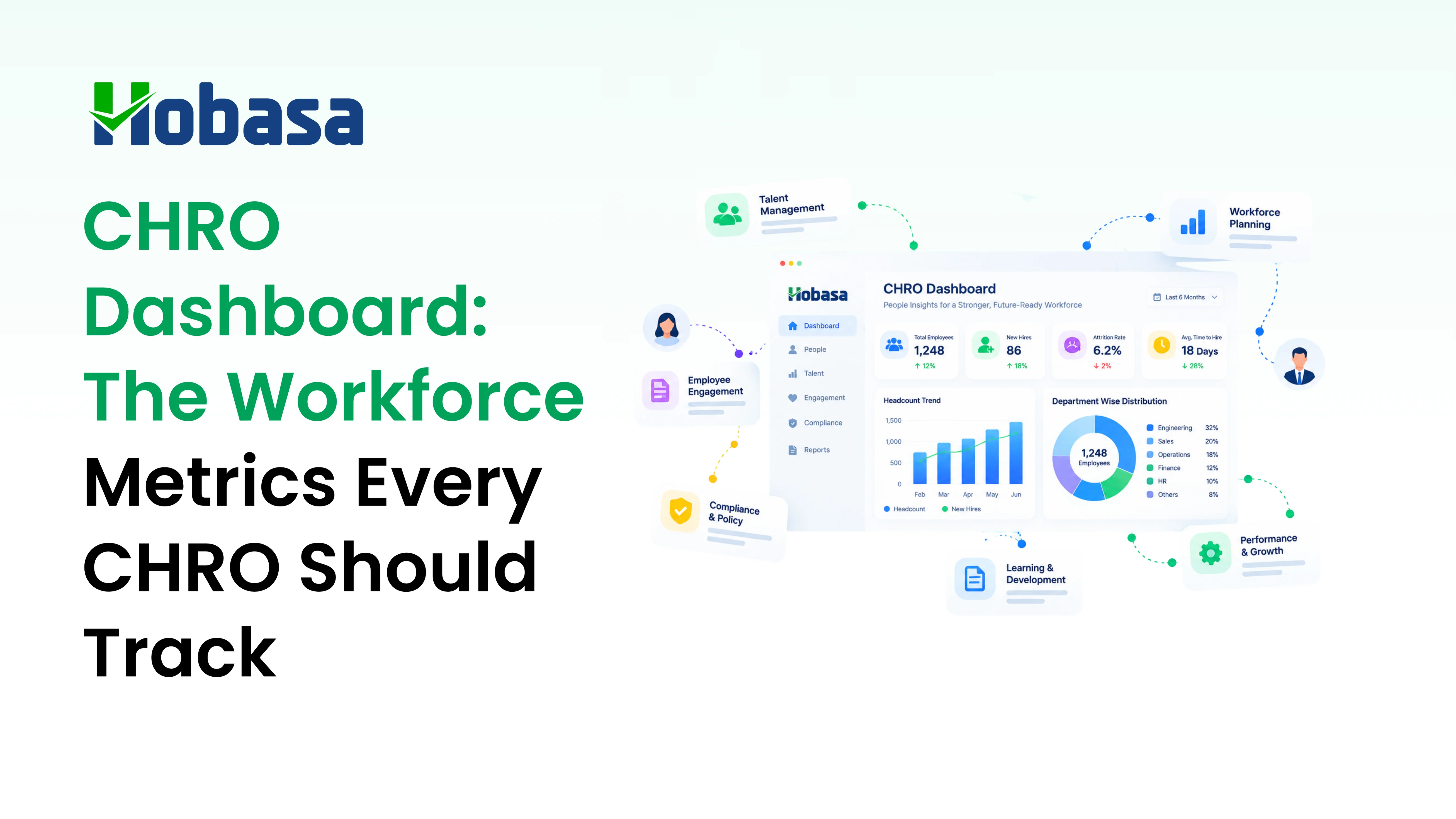
- A CHRO dashboard needs two layers: standard workforce KPIs (headcount, turnover, cost) and a risk-signal layer (burnout, attrition prediction, compliance exposure) that most HR reporting tools stop short of.
- Workforce data usually sits across the HRIS, payroll, ATS, and operations tools, which is why a dashboard built inside just one of them is structurally incomplete.
- Hobasa's platform includes six named workforce signals, paired with an AI summary, observations, and a recommended next step, not a raw number on a chart.
- A CHRO dashboard should surface what changed and why; it should not replace an HRIS, payroll system, or the judgment of the person reading it.
- Below: the core metrics, the risk signals most dashboards miss, what a dashboard should never try to do, and how to build this across a growing organization.
What Should a CHRO Dashboard Include?
A CHRO dashboard should include core workforce KPIs (headcount, turnover, cost per hire) alongside a risk-signal layer, burnout, attrition prediction, and compliance exposure, drawn from HRIS, payroll, and operations data together, not from HR data alone.
The distinction matters because most HR reporting tools stop at the first layer. They report what already happened. A dashboard built for a CHRO specifically needs to answer a harder question: what is about to happen, and where?
Why Generic HR Reports Aren't a CHRO Dashboard
Search for HR dashboard templates and you'll find dozens built around the same handful of charts: headcount over time, turnover rate, time-to-fill. None of that is wrong. It's just built on assumptions that break down at the CHRO level.
They assume HR data is enough. A turnover chart built from the HRIS alone has no visibility into whether payroll or scheduling issues are driving the departures.
They show a number, not a cause. Turnover rose two points. The report stops there. Someone still has to go find out why.
They're historical. A monthly or quarterly refresh means the pattern was already true weeks before anyone saw it.
They live in one system. A dashboard built inside the HRIS is blind to payroll, ATS, and operational data the moment the real question crosses into one of those systems.
A CHRO does not need another chart. The role needs the same set of workforce questions answered consistently, with enough context to act before the number becomes a resignation letter.
Building a CHRO dashboard that actually leads?
Hobasa connects HRIS, payroll, and finance signals so workforce metrics reflect risk and cost, not just headcount charts.
Talk to our teamThe Metrics at a Glance
| Layer | What it covers | Question it answers |
|---|---|---|
| Workforce Health Score | Engagement, tenure, and productivity signals combined | Is the workforce stable, or is stress building somewhere? |
| Burnout Risk Score | Workload, hours, and time-off patterns | Which teams are heading toward burnout before it shows up as attrition? |
| Forecasted Attrition | Predicted departures over the next one to two quarters | Which roles and teams are likely to lose people, and when? |
| Quality of Hire Score | Post-hire performance, retention, and ramp signals | Are recent hires actually working out? |
| Payroll Anomaly Score | Unusual pay, hours, or classification patterns | Does what payroll is running match what HR expects? |
| Regulatory Compliance Risk | Exposure across labor, tax, and workforce reporting obligations | Where is policy or statutory drift building quietly? |
The first four sit closer to workforce strategy. The last two sit closer to risk and compliance. A dashboard that only covers one half is only doing half the job.
Core Workforce KPIs Every CHRO Should Track
Before the risk layer, the baseline still matters. Every CHRO dashboard needs a solid foundation:
Headcount and headcount trend, by department and role, not just a company-wide total.
Turnover rate, split between regretted and non-regretted departures, since the two mean very different things.
Time-to-fill and cost-per-hire, tracked as a trend rather than a single snapshot.
Workforce cost as a share of revenue or budget, so HR and Finance are working from the same number.
Engagement or sentiment trend, where available, read alongside the metrics above rather than in isolation.
None of this replaces judgment. It's the baseline a CHRO needs in view before the more predictive layer becomes useful.
See these metrics pulled from your own systems. Explore the Hobasa platform to see how workforce KPIs get built from HRIS, payroll, and operations data together.
The Risk Signals Most Dashboards Miss
This is where a standard HR report stops and a genuine CHRO dashboard should keep going. Six specific signals, each paired with an AI-generated summary and a recommended next step rather than delivered as a bare number:
Workforce Health Score: a composite read on engagement, tenure, and productivity, rather than any one of those in isolation.
Burnout Risk Score: an early-warning signal built from workload, hours, and time-off patterns, surfaced before it shows up as a resignation.
Forecasted Attrition: a forward-looking view of likely departures over the next one to two quarters, by team and role, rather than a historical turnover rate that only confirms what already happened.
Quality of Hire Score: post-hire performance, retention, and ramp signals rolled into one view, so recruiting decisions get judged on outcomes, not just speed to fill.
Payroll Anomaly Score: unusual pay, hours, or classification patterns flagged for review, catching a drift between what payroll is running and what HR's records say.
Regulatory Compliance Risk: exposure across labor, tax, and workforce reporting obligations, calculated through compliance monitoring against the applicable requirements rather than left to be caught at an audit.
A scenario worth recognizing. A mid-sized services firm's HRIS shows a role classified part-time at 25 scheduled hours a week. Payroll has been processing that same person at consistent full-time hours for two months. Neither system is malfunctioning. HR's record reflects what was entered when the role was set up; payroll is executing what it was told. Nobody compared the two, because neither system was built to look at the other. That comparison, not an error in either system, is the finding a CHRO dashboard should have caught in week two, not at the next audit.
Bring a real workforce question you can't fully answer today. Talk to the Hobasa team and see whether the signal is already sitting in your HRIS, payroll, or ATS data.
Catch workforce risk before it hits the board pack.
See how Hobasa flags the early signals most HR dashboards never surface.
Get in touchWhat a CHRO Dashboard Should Not Do
Worth being direct about this, since plenty of tools blur the line.
It should not replace your HRIS, payroll system, or engagement platform. A dashboard reads from these systems; it doesn't take over their job.
It should not present a prediction as a decision. Forecasted attrition is a signal to investigate, not an instruction to act on unreviewed.
It should not hide where a number came from. If a finding can't be traced back to a specific record, it isn't ready for a leadership conversation.
It should not skip human review. An AI-generated signal that reaches a CHRO or a board without anyone checking it first is a liability, not a shortcut.
Why Choose Hobasa for Your CHRO Dashboard
Hobasa is not an HRIS, payroll system, or engagement platform, and it doesn't try to replace any of them. It's a cross-system intelligence layer that connects to the HR, payroll, ATS, and operational systems an organization already runs, and reads across all of them to build the six signals above.
What that means in practice:
Every finding is source-grounded. Findings cite the exact record, row, or document behind them, an HRIS field, a payroll entry, an ATS record, rather than arriving as an unsupported conclusion.
A person reviews every finding before it reaches you. Findings are checked by an analyst before they reach an owner, controller, or CHRO, consistent with Hobasa's AI-assisted, human-reviewed approach.
It reads across systems that don't normally talk. HRIS, payroll, ATS, and operations data get reconciled into one consistent view, rather than analyzed one system at a time.
It works alongside what you already run. Hobasa connects to platforms like BambooHR, Workday, ADP, Gusto, Paychex, Rippling, and Justworks, among others, rather than asking an organization to migrate anything.
The trust posture is documented. ISO 27001 certified, SOC 2 Type II Certified, sensitive HR data masked and access-controlled, and client data never used to train external models.
For a fractional CHRO or an HR advisory firm carrying more than one client, this is also what makes the model scale: a consistent review layer across every engagement, rather than rebuilding the same manual analysis for each client separately.
See what this looks like for your organization. Explore Hobasa's platform built for fractional CHROs to see the full picture, including how it supports PE and portfolio HR leads managing workforce data across multiple companies.
How to Build This Across a Growing Organization
Start with the baseline metrics, headcount, turnover, cost, and engagement, before layering in predictive signals. A risk score means little without the foundation underneath it.
List every system that holds part of the picture. HRIS, payroll, ATS, and any scheduling or operations tool. Most organizations are surprised how many there are once it's written down.
Decide which risk signal matters most right now. Burnout, attrition, compliance, and quality of hire are not equally urgent for every organization at every stage.
Confirm how findings get reviewed before they reach you. A dashboard that skips this step is asking you to trust an unverified number with real people's careers attached to it.
Add a cross-system layer rather than rebuilding reports by hand. The HRIS stays the system of record; a layer like Hobasa sits on top and does the reconciliation work manually pulled reports currently require.
This is the same approach behind Hobasa's own fractional CHRO model: connect what's already there, surface what matters, and keep a person in the loop before anything reaches a decision-maker. For the finance-side equivalent of this same dashboard discipline, see CFO Dashboard Examples: The 10 Checks Hobasa Runs on Every Client.
Ready for a CHRO view that scales with growth?
Hobasa keeps people and cost data aligned as systems and teams multiply.
Talk to our teamThe Bottom Line
The metrics on a CHRO dashboard should do more than confirm what already happened. Headcount and turnover tell you where things stand. Burnout, attrition prediction, payroll anomalies, and compliance exposure tell you what's building before it becomes the conversation nobody wanted to have. Building both layers, and keeping a person reviewing what the second layer surfaces, is what turns a dashboard into something a CHRO can actually act on.
Talk to the Hobasa team about the workforce signals your current systems aren't showing you. Explore the platform built for fractional CHROs or get in touch.
Turn workforce data into connected intelligence.
Talk to the Hobasa team about checking your HRIS, payroll, ATS, and operations data to surface workforce signals your existing systems may not show on their own.
FAQs
At minimum: headcount, turnover, cost-per-hire, and engagement trends, plus a risk-signal layer covering burnout, attrition prediction, and compliance exposure. The baseline metrics tell you what changed. The risk layer tells you what's likely to happen next.
Most HR dashboards report standard department metrics from a single system, usually the HRIS. A CHRO dashboard needs a broader view that reconciles HRIS, payroll, and operations data together, since workforce risk (burnout, misclassification, compliance drift) often only becomes visible when those systems are compared.
No. The HRIS remains the system of record for employee data. A CHRO dashboard reads from the HRIS and other systems to surface patterns and risks the HRIS alone was never built to show.
Baseline metrics suit a monthly cadence. Risk signals like burnout or payroll anomalies are more useful reviewed continuously, since a pattern caught early is a conversation and the same pattern caught late is a resignation or a compliance finding.
Some platforms include forecasted attrition as a signal, projecting likely departures over the next one to two quarters by team and role. This is a signal to investigate and act on, not a guarantee, and should be reviewed by a person before it drives a decision.
No. Hobasa connects to the HR systems an organization already runs and adds an analytical layer across them. It does not replace an HRIS, payroll system, or engagement platform.