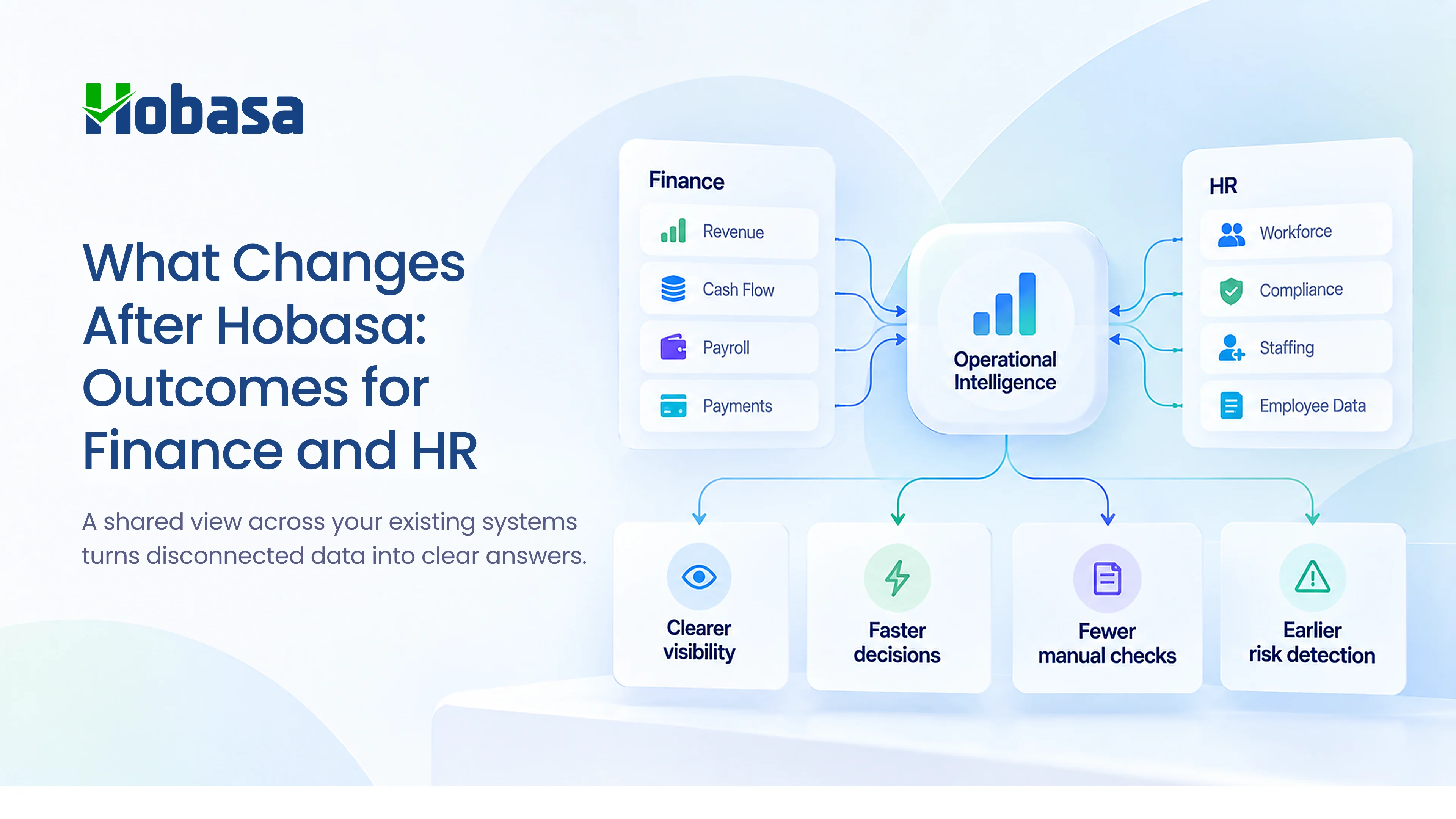
- Hobasa connects Finance, HR, payroll, recruiting and operations systems so the numbers reconcile automatically, cutting days of manual cost reconciliation to minutes.
- Cash position stays visible on an ongoing basis instead of waiting for a once-a-month manual pull, built from the same connected records used across the platform.
- Compliance monitoring catches workforce risk issues, such as wage law, tax threshold and benefit limit changes, as they happen, not months later in an audit.
- Every finding links back to its source record and is reviewed by a person before it reaches you. Hobasa does not replace your existing systems and does not write to your ledger.
The starting problem: Finance and HR see different numbers
Before Hobasa, Finance and HR each work from their own export. A workforce cost analysis that should take an afternoon turns into a week of cleaning spreadsheets and chasing explanations for numbers that do not match. Overtime creep, margin slippage and compliance gaps stay invisible until they already show up in the close.
None of this is a data problem in the way most teams assume. The data exists. It is just scattered across systems that were never designed to talk to each other, and nobody on either team has the time to be the permanent translator between them.
What becomes visible in week one
Hobasa's team connects your accounting, payroll, HR and operational systems and maps them into one comparable model. This is not a migration and it does not touch how your existing systems work day to day. What changes is what you can see once those systems are read side by side.
A workforce cost analysis that used to mean exporting three tools and reconciling them by hand becomes something you can pull up directly, with the source records behind every number. When a Finance and an HR number disagree, Hobasa keeps both and flags the disagreement itself as the finding, instead of quietly picking one side.
Want that first-week clarity on your stack?
See how Hobasa surfaces cross-system issues for Finance and HR without replacing the tools you already run.
Talk to our teamCash flow visibility: what Finance teams can now see
Cash flow visibility is usually the first thing a CFO notices changing. Instead of waiting for a manual close to know where cash actually sits, Finance teams get a continuously updated view built from the same connected records used everywhere else in the platform. A cash conversion ratio that once required a spreadsheet built from scratch each month becomes a number that stays current on its own.
This does not mean Hobasa forecasts your cash position or predicts future performance. It means the current picture, the one Finance already has to answer questions about every week, is available without the manual pull.
Fewer surprises: workforce risk caught earlier
On the HR side, the same connected view changes how workforce risk gets caught. Wage law changes, tax threshold shifts and benefit limit updates are the kind of thing that quietly breaks compliance long before anyone notices in a routine audit. Hobasa's compliance monitoring re-runs the relevant checks as those requirements change, so a workforce risk management issue surfaces when it happens, not months later.
This is not a replacement for your HR system or your compliance process. It is a second layer that watches for the moment those processes disagree with what is actually happening in payroll and scheduling.
Faster answers, sourced
Every finding Hobasa surfaces links back to the records it came from. That includes the workforce cost analysis numbers, the cash flow visibility view, and the workforce risk management checks above. Compliance monitoring and anomaly detection do the actual detecting; a person reviews each finding before it reaches you, and nothing is sent that cannot be traced back to a source record.
This matters because the output is meant to hold up in front of a board, an investor or an auditor, not just in an internal meeting.
Spend less time reconciling, more time advising.
Hobasa turns the same questions that take days of exports into answers your team can defend.
Get in touchHow teams benchmark progress
Once Finance and HR are working from the same connected data, both sides get a consistent way to track progress over time. A CFO can watch revenue leakage and margin trends the same way each month instead of rebuilding the view from scratch. Financial benchmarking against your own prior periods becomes straightforward because the underlying numbers are already reconciled, not because Hobasa is comparing you to a published industry index it has not verified.
What Hobasa does not change
To be direct about scope: Hobasa does not replace your accounting system, your payroll provider or your HRIS. It does not write to your ledger. It does not forecast your financial or workforce performance for you. What it changes is the time and effort between having the data and being able to trust what it says, and how early you find out something is wrong.
See What Changes When Your Systems Connect.
Connect your Finance, HR, payroll, recruiting, and operations data to surface workforce costs, cash flow insights, and risks that are difficult to see across separate systems.
FAQs
In the first month, most teams see the immediate value in workforce cost analysis and cash flow visibility becoming a pull instead of a project. By the first quarter, the ongoing anomaly and workforce risk management checks have usually caught at least one issue that would otherwise have surfaced later, in a close or an audit.
No. Hobasa connects to the systems you already run and reads across them. Your accounting, payroll and HR platforms stay exactly where they are.
Hobasa is an early-stage platform. Rather than point to case studies we do not yet have, this article describes the capabilities themselves: cross-system reconciliation, continuous rule-based checks, and source-linked findings. You are welcome to see these directly on a walkthrough of your own data.