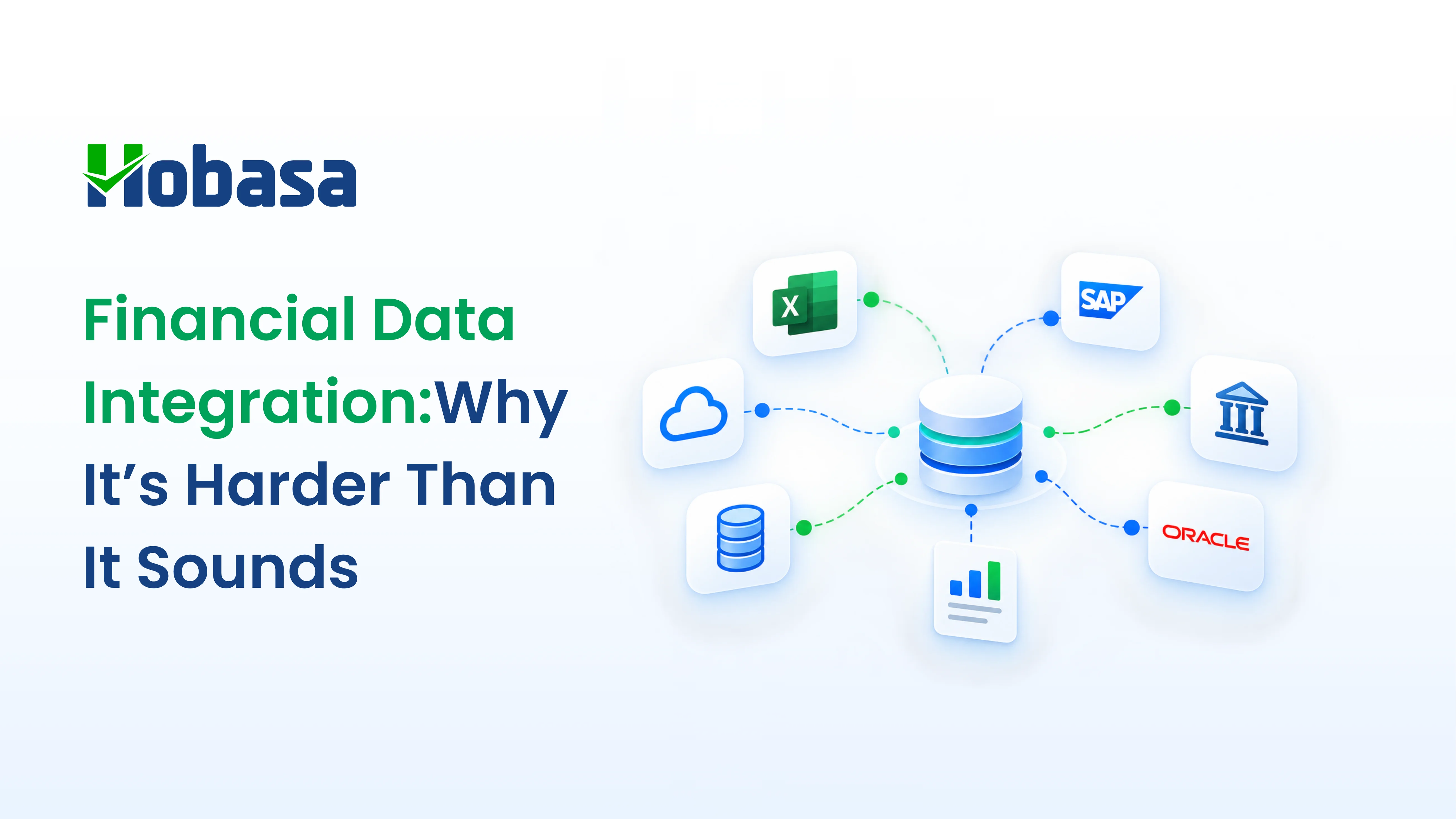
- Financial data integration connects accounting, ERP, banking, and payroll systems so data moves between them automatically, rather than being re-entered by hand.
- Finance teams still spend 30% to 40% of their time on manual reconciliation, according to industry research, largely because legacy systems, inconsistent data formats, and one-off connections make true integration harder than it sounds.
- There are several real approaches, API-based integration, RPA for legacy systems without APIs, and batch or file-based transfer, each suited to a different situation.
- Integration alone is not the same as intelligence. Connecting two systems' data is a prerequisite; someone or something still has to notice when the connected data disagrees.
- Below: what financial data integration actually involves, why it's harder in practice than most vendors let on, the real approaches to it, and how a layer like Hobasa fits without requiring a data engineering project.
What is financial data integration? Financial data integration is the process of connecting an organization's financial systems, accounting software, ERP, banking platforms, payroll, and reporting tools, so data flows between them automatically and consistently, instead of being manually re-entered or reconciled by hand. Done well, it means a transaction recorded once shows up correctly everywhere it needs to. Done poorly, or not at all, it means finance teams spend a meaningful share of every week doing by hand what the systems were supposed to do for them.
What Is Financial Data Integration?
Financial data integration is the process of connecting an organization's financial systems, most commonly accounting software, an ERP, banking platforms, payroll, and reporting tools, so that data recorded in one system flows correctly into the others without manual re-entry.
At a basic level, this means a vendor invoice entered in accounting shows up correctly in the bank reconciliation. At a more advanced level, it means intercompany transactions across multiple entities consolidate correctly, currency conversions apply consistently, and a number pulled into a board report matches the source system it came from, every time, not just when someone happens to check.
Why Financial Data Integration Is Harder Than It Sounds
Vendors describe integration as a checkbox: "connects to your ERP." In practice, several structural problems make it a genuine ongoing challenge, not a one-time setup task.
Legacy systems without modern APIs. Older platforms, still common in finance because switching core systems is disruptive, often have no clean API to connect to, forcing teams toward manual workarounds or robotic process automation that mimics a person clicking through a portal.
Format inconsistencies. ERP, banking, and CRM platforms rarely share the same field names, date formats, or customer and vendor identifiers. A "customer ID" in one system and a "client ID" in another might refer to the same entity, but nothing automatically knows that.
Security and cross-border regulation. Moving financial data across systems, especially across borders, runs into real compliance requirements; US companies handling EU customer data, for instance, have to account for GDPR's rules on data transfers.
Scale during peak volume. Month-end and quarter-end close create transaction volume that many integrations, especially older or lightly-built ones, were never designed to handle smoothly, which is exactly when a slowdown costs the most.
The scale of the underlying problem is bigger than a single company's tech debt. A typical bank runs between 50 and 200 distinct applications, and treasury systems, general ledgers, risk platforms, and CRM tools frequently operate in isolation from each other even inside the same organization. Smaller companies run fewer systems, but the same basic pattern, systems that don't talk to each other by default, shows up at every size.
Types of Financial Data Integration
Not every integration problem calls for the same solution.
| Approach | How it works | Best suited for |
|---|---|---|
| API-based integration | Systems connect directly through documented APIs, exchanging data automatically and in near real time | Modern cloud platforms (QuickBooks Online, NetSuite, most current ERPs) with well-documented APIs |
| RPA-based integration | Software robots mimic manual actions, logging into portals and moving data where no API exists | Legacy systems or platforms with no API access at all |
| Batch or file-based transfer | Data exports on a schedule (nightly, weekly) and loads into the destination system | Lower-frequency needs where real-time sync isn't essential |
| Pre-built connector layer | A platform maintains ready-made connections to common finance and HR systems, so a business doesn't build a custom pipeline for each one | Businesses that want their systems reconciled and monitored without running their own integration project |
The first three are largely IT and data-engineering decisions, and tools built for them, MuleSoft, Boomi, Azure Data Factory, and similar platforms, are aimed at technical teams building custom data pipelines. The fourth is where a business gets the benefit of integration without taking on that build.
The Real Cost of Poor Financial Data Integration
The cost shows up less as a single dramatic failure and more as a permanent tax on finance's time and confidence in its own numbers.
Industry research puts the manual-reconciliation burden at 30% to 40% of finance team time industry-wide, and some large financial institutions report their teams spending nearly half their time on manual reconciliation rather than analysis. Month-end close processes that should take days can stretch into weeks when integration is weak, and real-time liquidity or cash positions become educated guesses rather than precise, current numbers.
There's also a compounding effect: every new system a business adds, a new payroll provider, a new banking relationship, a new subsidiary, adds one more manual connection to maintain if integration was never solved properly the first time. The 67% of CFO teams manually keying data between ERP and banking platforms daily are not doing so by choice. They are doing so because the underlying integration was never built to keep pace with how many systems a modern finance function actually touches.
Financial Data Integration vs Financial Data Intelligence
Connecting two systems' data is necessary. It is not, by itself, sufficient.
Integration alone answers the question "can this data move between systems." It does not answer "does this data agree with what the other system says," or "is this pattern something someone should look at." A well-integrated pipeline can faithfully move a payroll number into the general ledger every single month and still never notice that the number drifted further from budget than it should have. Integration is the plumbing. Someone, or something, still has to notice when the water coming out looks wrong.
This is where modern AI-assisted approaches are starting to add real value on top of integration rather than instead of it: current tools increasingly use AI for transaction matching, data enrichment, and anomaly flagging, while people still own validation and the handling of exceptions. That division, AI doing the matching and flagging, a person confirming what matters, is the same principle behind how Hobasa is built, and it's worth understanding as a distinct layer from the integration question itself.
See what sits on top of your existing integrations.
Explore the Hobasa platform to see how connected finance and HR data gets turned into findings, not just a data feed.
Talk to our teamWhy Choose Hobasa
Hobasa is not an iPaaS or ETL platform, and it does not ask a business to run a custom data-engineering project to connect its systems. It's a cross-system intelligence platform that connects to finance, HR, payroll, and operations systems a business already runs, through pre-built connectors to platforms including QuickBooks Online, NetSuite, Sage Intacct, ADP, BambooHR, and Workday, among others.
What that means in practice for financial data integration specifically:
No custom pipeline to build or maintain. The connectors already exist; a business doesn't need a data engineer to stand up and maintain a MuleSoft-style integration project just to get its own systems talking to each other.
Integration is the starting point, not the finish line. Once connected, Hobasa reads across the data to find where the general ledger, payroll, and HR records disagree, rather than just moving data faithfully from one place to another.
Every finding is source-grounded. Findings cite the exact record they came from, a ledger entry, a payroll line, an HRIS field, rather than presenting a conclusion with no trail back to the data.
A person reviews every finding before it reaches you. Consistent with Hobasa's stated AI-assisted, human-reviewed approach, matching the same principle of AI doing the matching work and a person owning the validation.
For the HR side of this same problem, connecting HR and payroll data with the same discipline, see the companion piece: HR Data Integration: Connecting Your HR Systems Without the Manual Work.
Bring a real reconciliation you currently do by hand.
Talk to the Hobasa team and see what it looks like once your systems are actually reading from each other.
Talk to our teamHow to Approach Financial Data Integration
Map what's actually disconnected today. List every finance and HR system in use, and specifically where data currently moves manually between them.
Match the integration type to the system. Modern, API-friendly platforms are usually straightforward. Legacy systems without APIs may need RPA or a connector layer built to handle them specifically.
Decide if you're solving a plumbing problem or an intelligence problem. If the systems already connect but nobody is checking whether the numbers agree, the gap isn't integration, it's monitoring.
Price the real cost of the status quo first. The hours currently spent on manual reconciliation are the baseline any integration approach has to beat, not an afterthought to calculate later.
Keep a person in the review loop. Whichever approach you choose, automated matching still benefits from a person owning the exceptions and the final call, not full unsupervised automation from day one.
Turn business data into decision-ready insight.
Connect Finance, HR, Payroll, and Operations data to surface the context behind business signals, so your team can understand what is happening and decide what to do next.
FAQs
Financial data integration is the process of connecting an organization's financial systems, accounting software, ERP, banking platforms, and payroll, so that data recorded in one system flows correctly into the others automatically, rather than being manually re-entered or reconciled by hand.
Legacy systems often lack modern APIs, different platforms rarely share the same field names or identifiers, cross-border data transfers raise real compliance questions, and integrations frequently strain under the transaction volume of month-end and quarter-end close.
The main approaches are API-based integration for modern platforms, RPA-based integration for legacy systems without APIs, batch or file-based transfer for lower-frequency needs, and a pre-built connector layer that avoids a custom integration build entirely.
Industry research puts the manual-reconciliation burden at roughly 30% to 40% of finance team time, and one survey found 67% of CFO teams manually key data between their ERP and banking platforms at least daily.
No. Integration moves data between systems reliably; it does not by itself check whether the numbers in two connected systems actually agree with each other. That comparison is a separate, additional step.
No. Those platforms are built for custom, IT-led data-engineering integration projects. Hobasa connects to common finance and HR systems through pre-built connectors and focuses on surfacing findings from the connected data, not building custom pipelines.
It depends on the approach. Custom API or RPA-based integration projects typically do need dedicated technical resources. A pre-built connector layer is built specifically to avoid that requirement for common finance and HR systems.