- Business signals rarely live inside one system. A change in margin, turnover, or throughput is often explained by data sitting in a different function entirely, which is why single-system dashboards can be accurate and still incomplete.
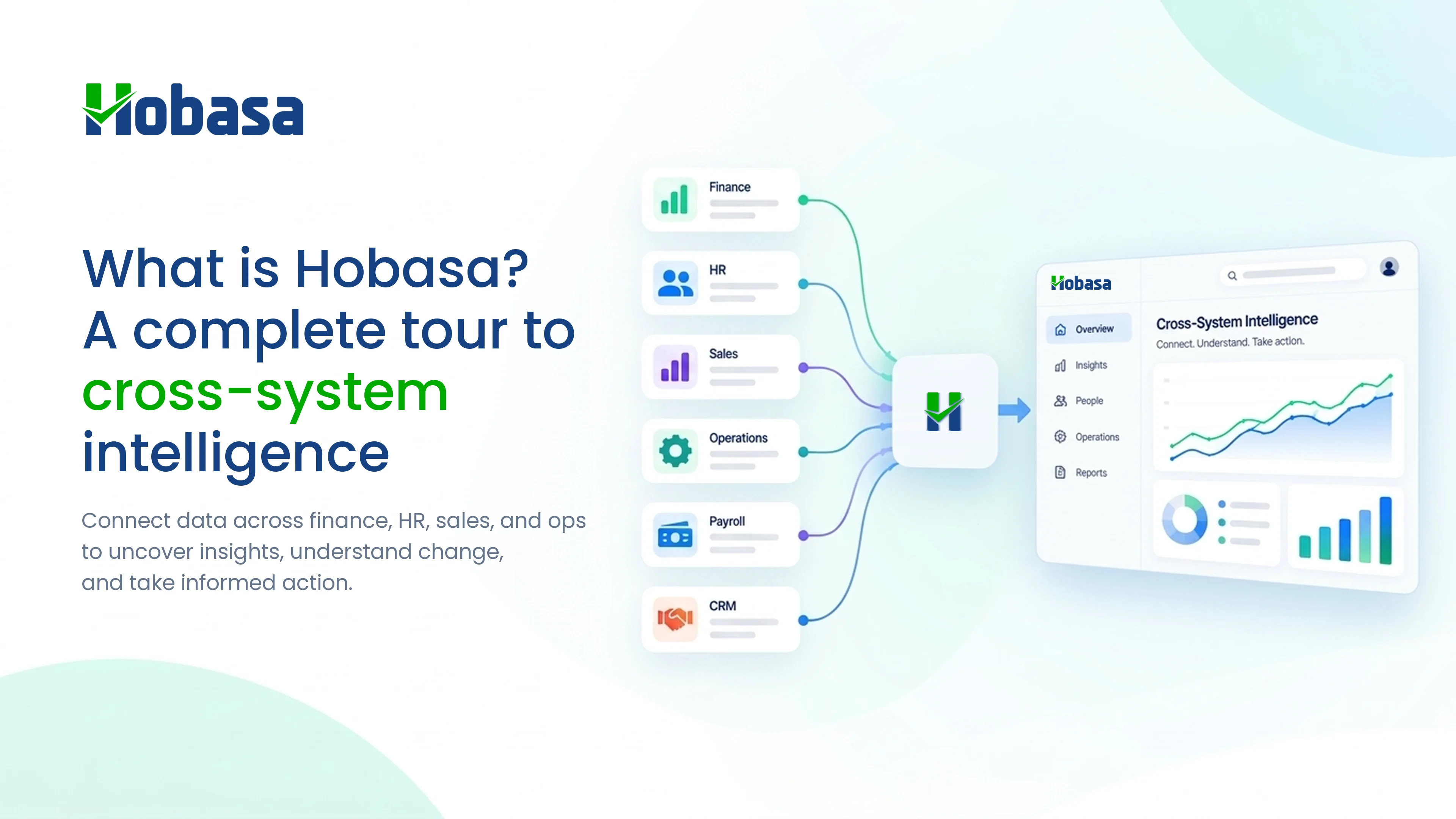
- Cross-system intelligence connects finance, HR, operations, and other business data into one analytical layer, so leaders can see the relationships between systems, not just the metrics inside each one.
- Hobasa's conversational AI lets users ask questions in plain language and get source-grounded answers, with every finding traceable back to the record it came from.
- The platform is built to be industry agnostic: the same intelligence layer adapts to different data structures across sectors like automotive, travel, and financial services.
- Below: why cross-system intelligence matters, how Hobasa's AI assistants and intelligence layer work, how the platform adapts across industries, and why this is designed as an evolving ecosystem rather than a one-time reporting project.
This is where cross-system intelligence comes in. Hobasa connects business information across systems and applies an intelligence layer to identify patterns, investigate anomalies, surface relationships, and turn fragmented information into contextual, decision-ready insights.
At its core, Hobasa is built for the new enterprise environment, one where businesses need continuous intelligence, faster analysis, root-cause investigation, and proactive visibility rather than relying solely on static reports or complex data queries.
In this blog, we will learn everything about Hobasa and how it provides cross-system intelligence.
Why Cross-System Intelligence Matters
Business data is often accurate within individual systems, yet still difficult to interpret at the enterprise level. The reason is simple: the signals that explain business performance are rarely contained in one place.
A change in one metric may be influenced by activity in another function, while important risks can emerge from relationships between datasets rather than from a single number. Cross-system intelligence helps bring these connections into view, giving leaders a more complete understanding of what is happening across the business.
This becomes particularly valuable when organizations need to combine finance and HR data to understand how financial performance and workforce activity influence one another.
Business Signals Rarely Exist in Isolation
A business can have accurate information in every individual system and still lack a complete view of what is happening.
Consider a few examples.
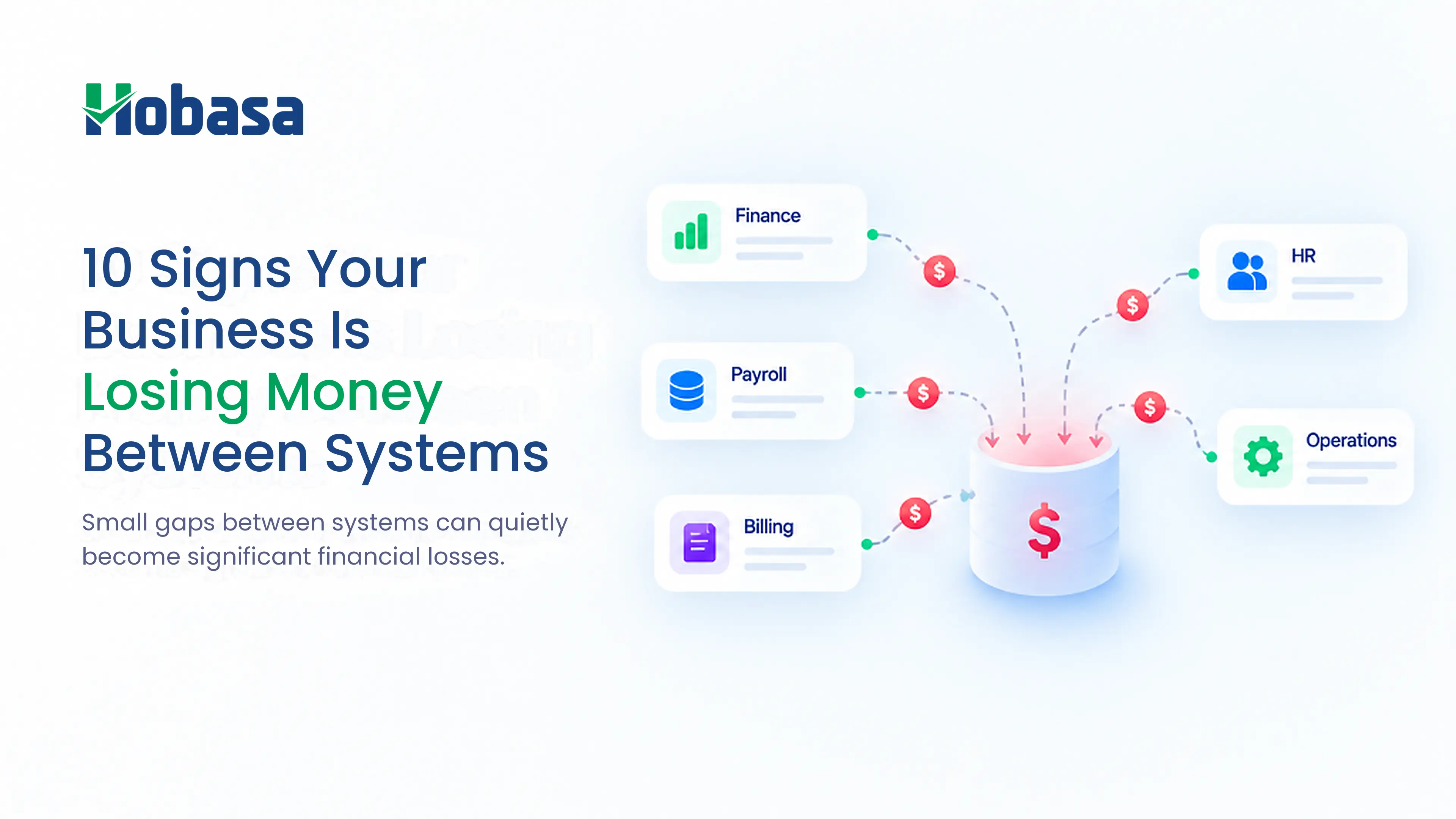
A company sees a decline in gross margin. The finance system shows the change, but the reason may sit elsewhere. Customer data could reveal a shift toward lower-margin accounts. Sales data might reveal rising discount rates. Procurement data could show higher supplier costs. Workforce data could show increased overtime.
The margin number itself is not the problem. The missing context is.
The same principle applies across almost every function.
A rise in employee turnover may become more meaningful when viewed alongside compensation, scheduling, workload, absenteeism, or manager-level patterns.
An operational bottleneck may become visible only when staffing, utilization, and financial performance are considered together.
The most important signal may therefore sit between systems rather than inside one of them.
Still reading each system in isolation?
Hobasa connects Finance, HR, and operations signals so relationships, not just metrics, become visible.
Talk to our teamIsolated Metrics Can Hide Important Relationships
Most business applications are designed around a particular function. They are very good at answering questions within that function.
An accounting system can talk about revenue, expenses, receivables, payables, and margins.
An HR system can show headcount, employee movements, compensation, and other workforce information.
But leadership questions often cross those boundaries.
- Why did profitability decline?
- Why are labor costs increasing?
- Why is cash conversion slowing?
- Which operational changes are affecting customer performance?
- Where is operating capacity being lost?
Answering these questions requires more than retrieving individual metrics. It requires connecting the relevant information and understanding the relationships between them.
For example, reporting across multiple business systems can help leaders examine financial results alongside workforce, operational, customer, and other relevant information rather than reviewing each dataset independently.
Read more: The numbers business owners should be watching every week
See how the relationships get surfaced. Explore the Hobasa platform to see cross-system analysis, live monitoring, and predictive analytics in one place.
Anomalies Without Context Are Only the Beginning
Anomaly detection has become an important part of modern analytics. Identifying an unusual transaction, unexpected cost movement, sudden change in employee activity, or deviation from an established pattern can help organizations focus attention where it really matters.
But an anomaly by itself does not explain the business problem.
A deeper investigation might examine:
- Which locations or teams were most affected?
- Which employees generated the additional hours?
- Did headcount fluctuations play a role?
- Did customer or order volume increase?
- Were there any scheduling gaps?
- Did productivity change?
- Did the increase affect margins?
- Was the additional labor associated with higher revenue or simply higher cost?
This progression, from detecting an unusual event to investigating its relationships and potential causes, is an important distinction between basic monitoring and deeper intelligence.
Turn Your Data Into Actionable Insights With Intelligent AI Assistants
The way leaders interact with business data is changing. Instead of navigating through multiple systems, reports, and dashboard tabs to find an answer, AI assistants allow users to interact with their data directly. Hobasa brings this conversational layer into business analytics, making data easier to explore, investigate, and act on.
Talk to Your Data Instead of Clicking Through Tabs
Hobasa's conversational AI capabilities allow business users to ask questions about their data using natural language rather than navigating through multiple reports or relying on technical queries.
A leader can ask questions such as "What changed in revenue this month?", "Why are operating costs increasing?", or "Which areas of the business need attention?" and use the response as a starting point for deeper analysis.
This makes data interaction more direct. Users do not have to know which system contains the information, which report to read, or how to structure a complex query before they can begin investigating a business challenge.
Contextual Insights, Anomaly Detection, and Proactive Advisory
Finding an unusual number is only useful when there is enough context to understand what it means.
Hobasa's intelligence layer can analyze business information across systems to identify patterns, detect anomalies, and provide context around significant changes. For example, an increase in labor costs can be examined alongside headcount, overtime, workforce activity, and revenue to identify factors that may be contributing to the change.
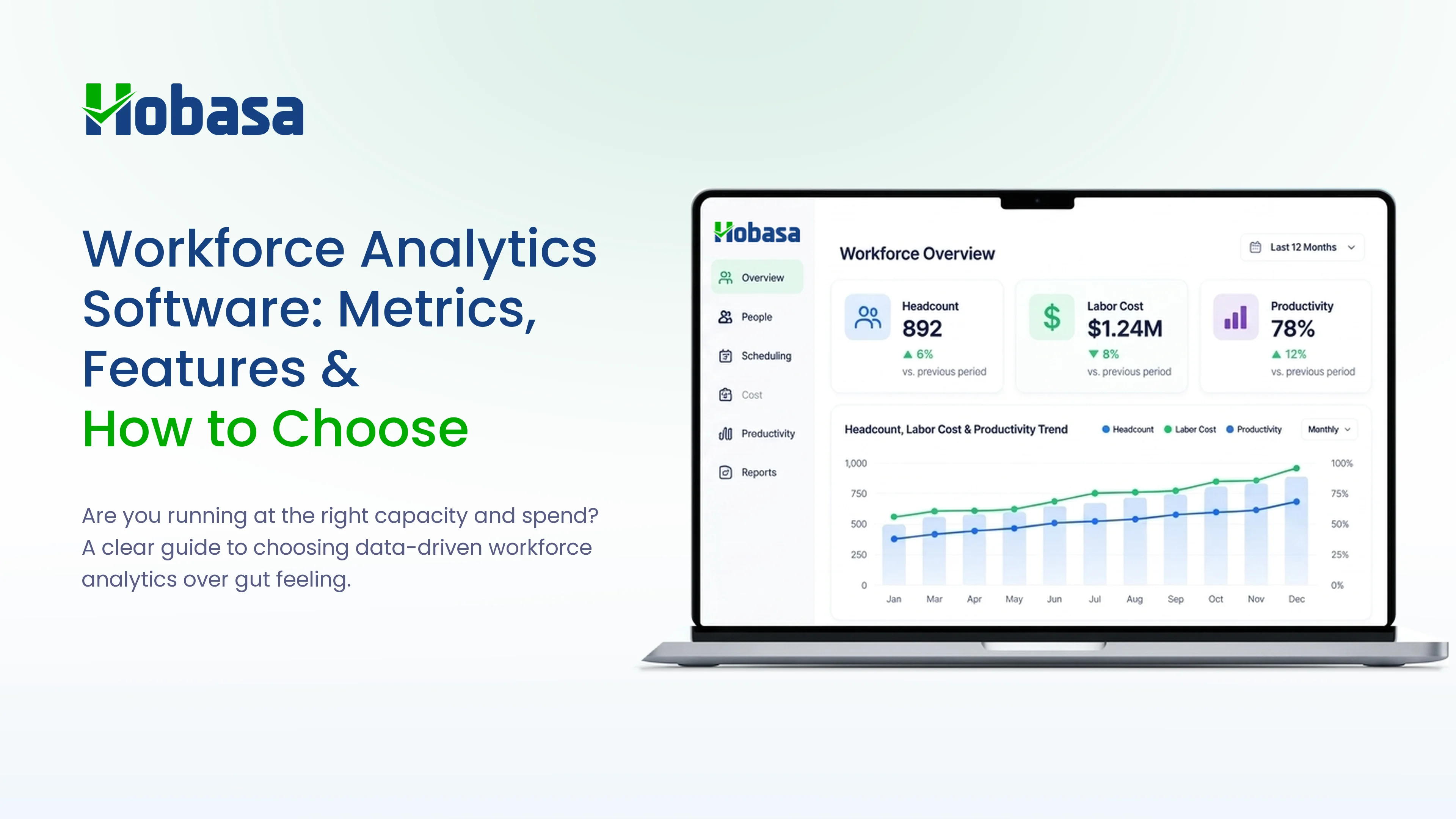
The ability to examine finance and HR data in one dashboard can also give business leaders a more connected view of financial and workforce-related movements, particularly when labor costs, headcount, productivity, and profitability need to be considered together.
The system can also move beyond responding to questions by surfacing important changes and potential risks proactively. Instead of requiring leaders to know exactly what to look for, the intelligence layer can bring relevant signals to their attention and provide a starting point for investigation.
Generate Clean, Executive-Ready Reports
Analytics becomes more useful when insights can be communicated clearly.
Hobasa's AI capabilities can turn underlying analysis into structured, executive-ready reports that summarize important business movements, findings, and areas requiring attention. Rather than requiring leaders to interpret multiple charts or compile information manually, the analysis can be presented in a format that is easier to review and share.
This is particularly useful for management reviews, leadership discussions, board reporting, and other situations where complex business information needs to be communicated clearly and efficiently.
Highly Immersive, Beautifully Designed Dashboards
Dashboards remain an important part of the analytics experience because they provide a visual way to monitor business performance.
Hobasa combines this visual layer with deeper intelligence, allowing dashboards to present important KPIs, trends, changes, and business signals in an interactive environment. The objective is not simply to make dashboards visually appealing, but to make them easier to explore and more useful for understanding what is happening across the business.
This creates a more immersive way to work with business data, where leaders can see the signal, explore the underlying context, and move from observation to investigation without leaving the analytical environment.
Curious what this looks like on your own systems? Book a walkthrough and bring one business question you'd normally need three reports to answer.
From Anomaly to Root Cause: The Intelligence Layer Behind the Data
Identifying an anomaly is only the first step. A business leader needs to know what changed, where it changed, what other factors are connected to it, and whether it represents a risk or an opportunity.
This requires more than placing data on a dashboard. It requires an intelligence layer that can understand the information, establish relationships across systems, investigate meaningful changes, and continuously analyze new data as the business evolves.
Let's explore how Hobasa handles data transformation.
We Don't Simply Put Data Into Your Dashboards
A dashboard can show that revenue declined, expenses increased, or employee turnover changed. But displaying the number does not explain what caused the movement.
Hobasa is designed to go beyond visualization. Data from different business systems is brought into an analytical environment where it can be understood in relation to other relevant information.
This can help organizations consolidate data from multiple systems reporting into a more connected analytical environment rather than relying on isolated reports from individual applications.
The objective is to move from displaying what happened to understanding why it happened.
This distinction is fundamental to cross-system intelligence. The value is not in creating another place to view existing metrics, but in creating a layer that can analyze the relationships between them.
An Intelligence Layer That Understands Business Context
Hobasa provides an intelligence layer that acts as the analytical bridge between an organization's underlying data and the insights presented to its users.
It evaluates information across connected sources, identifies relevant relationships, and uses those relationships to provide context around business signals.
For example, an increase in operating costs should not necessarily be treated as an isolated financial event. The relevant context could include changes in headcount, supplier spending, operational activity, customer demand, or other business factors.
By bringing these relationships into the analysis, the intelligence layer can provide a more complete picture of the factors surrounding a change.
From Anomaly Detection to Deep Investigation
When the system identifies an anomaly, the analysis does not have to stop at the initial alert.
The intelligence layer can investigate the signal across relevant dimensions, such as time periods, business units, locations, customers, employees, transactions, or other available attributes, to determine where the change originated and what other information may be associated with it.
A significant change in labor costs, for example, may lead the analysis toward overtime, staffing levels, employee activity, operational volume, and revenue. A change in customer revenue may require examining purchasing patterns, pricing, order frequency, cancellations, and customer concentration.
The result is a deeper analytical view without requiring every investigation to begin with a manually constructed query.
From anomaly to root cause, without a week of exports.
Hobasa helps teams move from “something changed” to “here is why,” with sources attached.
Get in touchEffortlessly Adapting to Changing Customer Data
Enterprise data is rarely static.
Organizations add new systems, change applications, introduce new fields, modify workflows, and restructure how information is recorded. An analytical environment that depends on a rigid, fixed understanding of the underlying data can quickly become difficult to maintain.
Hobasa is designed to adapt to changing data structures and evolving business environments. Rather than assuming that every organization will provide information in exactly the same format, the intelligence layer works to understand the structure and meaning of incoming information and maintain the relationships required for analysis.
This adaptability is particularly important in organizations with multiple systems, frequent process changes, acquisitions, or expanding data environments.
Offers Continuous, Context-Aware Insights at Scale
A business does not have a fixed set of analytical questions.
The questions that matter today may change as the organization grows, enters a new market, adds a business unit, experiences a new risk, or changes its operating model.
Hobasa's approach is designed around a continuously evolving analytical environment rather than fixed dashboards and reports. It easily adapts to changing business needs and shifts toward more relevant use cases as the analytical priorities of the organization change.
This creates an analytical environment where the available intelligence remains aligned with what matters to the business rather than becoming a static library of reports that gradually loses relevance.
Understanding Structured and Unstructured Data
Important business data does not exist only in spreadsheets and databases.
Structured data may include transactions, employee records, invoices, customer information, operational measurements, and financial figures. Unstructured information can include contracts, policies, documents, reports, and other business materials.
Hobasa's intelligence approach is designed to work across both types of information, allowing structured business data and contextual information to contribute to analysis.
This matters because a number alone may tell you that something happened, while a document, contract, policy, or other source may provide important context for understanding why it happened or what it means.
Built for Large-Scale Data Environments
Enterprise organizations can generate enormous volumes of data across systems and over time. An intelligence layer therefore needs to work beyond small, predefined datasets.
Hobasa is designed to analyze large and diverse business data environments while maintaining the relationships required for meaningful analysis. The objective is not simply to process more records, but to make large volumes of information analytically useful without requiring business users to manually sift through it.
As data volumes grow, this becomes increasingly important. More data should create greater analytical depth, not simply more information for leaders to sort through.
A Continuous Analytics Engine
Traditional analytics often revolves around scheduled reports or specific requests. A continuous analytics approach operates differently.
Instead of waiting for a user to request an analysis, the system can continuously evaluate incoming business information for meaningful changes, anomalies, patterns, and relationships.
This allows the analytical environment to evolve with business. New data can contribute to ongoing analysis, emerging signals can be identified earlier, and relevant insights can be surfaced as business conditions change.
The result is a shift from analytics as a one-off reporting activity to analytics as an ongoing intelligence capability, one that continuously examines the business and helps leaders understand what deserves attention.
One Platform, Infinite Possibilities: Industry Agnostic in Every Way
Hobasa is not built around a single industry, business model, or predefined set of datasets. Its core intelligence layer is designed to understand different types of business information, establish relationships between datasets, and apply that understanding to the specific operating environment of each organization.
This is what makes Hobasa truly industry agnostic. The platform does not require businesses to adopt a fixed analytical structure simply because they belong to a particular industry. Instead, it works with the data and systems already present within the organization and builds intelligence around the relationships that matter to that business.
One Intelligence Layer Across Different Industries
An automotive company and a travel company will naturally generate very different types of data. An automotive business may have information spanning dealerships, sales, inventory, manufacturing, suppliers, service operations, and finance. A travel company may work with booking data, customer behavior, pricing, occupancy, suppliers, and operating costs.
Hobasa can bring these different datasets into a common intelligence environment and analyze them according to the business context in which they exist.
The intelligence layer looks beyond individual metrics to understand how information connects. A change in inventory can be analyzed alongside sales and supplier data. A change in travel demand can be examined against pricing, bookings, and operational capacity. Financial changes can be connected with the operational or workforce activity that may be influencing them.
Hobasa Does Not Assume Every Business Works the Same Way
Many analytics platforms rely on predefined data models, reporting structures, or industry-specific assumptions. This can make it harder to work with organizations that use different systems or structure their data differently.
Hobasa is designed to work with the way each organization actually operates. It can understand different data structures and connect information across the systems within an organization's technology environment. This allows Hobasa to analyze business data in its actual context rather than forcing every organization into the same predefined analytical framework.
This adaptability is central to Hobasa's industry-agnostic approach. Whether the data comes from finance, HR, payroll, CRM, ERP, operations, or other business systems, Hobasa's intelligence layer can examine how those datasets relate and identify signals that may not be visible when each system is analyzed independently.
From Automotive to Travel to Financial Services
The possibilities extend across industries because Hobasa's intelligence is not dependent on a single use case.
For an automotive business, Hobasa could connect operational and financial information to help identify relationships between sales activity, inventory, supplier costs, and margins.
For a travel business, the same intelligence layer could examine relationships between bookings, demand, pricing, occupancy, and operating performance.
For a financial services organization, it could work across financial, customer, transaction, workforce, and compliance data to identify patterns and relationships relevant to that business.
The industries are different. The datasets are different. The business questions are different. What remains consistent is Hobasa's ability to connect the information, understand its context, and turn those relationships into actionable intelligence.
Why Industry Flexibility Matters
Organizations rarely remain static.
They may enter new markets, acquire businesses, launch new products, add locations, change operating models, or adopt new systems.
An intelligence environment that is too tightly tied to one industry or one reporting structure can become restrictive as business evolves.
A domain-agnostic approach provides greater flexibility because the system can adapt its analysis to the data, business context, and questions relevant to each organization.
Hobasa currently positions its platform around finance, workforce, operations, compliance, and related business information rather than a single industry-specific use case. Its integrations span multiple finance, HR, payroll, recruiting, and document systems.
Future-Proofing Business Decision-Making in the Age of AI Analytics
Think Ecosystem, Not One-Time Implementation
The biggest risk with analytics technology is treating it as a one-time reporting project.
Businesses change continuously.
New systems are introduced. Data structures evolve. Business priorities shift. New KPIs become important. Regulations change. Operating models change. AI capabilities advance.
A future-ready intelligence environment therefore needs to evolve with the organization.
The value should compound as the organization connects more information, develops a deeper understanding of its business context, and asks increasingly sophisticated questions.
One Intelligence Layer for Different Business Users
Different leaders look at the same business through different lenses.
A CFO may want to understand margin, cash flow, working capital, and financial risk.
A CHRO may want to understand workforce costs, retention, productivity, and organizational capacity.
An operations leader may focus on throughput, utilization, bottlenecks, and resource allocation.
A CEO may want to understand how all of these factors combine to affect growth and profitability.
The underlying data can be shared while the analytical perspective changes.
Hobasa is designed around multiple user perspectives, including owners, executives, CFOs, CHROs, investors, advisors, and other business stakeholders.
This is important because intelligence becomes more valuable when it can support different decisions without requiring every team to build an entirely separate analytical environment.
From Dashboards to Decision Environments
The evolution of analytics can be viewed as a progression.
Reports tell users what happened.
Dashboards make important metrics easier to monitor.
Analytics help users investigate patterns and relationships.
AI analytics can accelerate analysis and surface patterns at greater scale.
Cross-system intelligence connects these capabilities around the relationships that drive business performance.
The end goal is not to eliminate dashboards, reports, SQL, or existing business systems.
It is to move the analytical process closer to the business question.
Instead of spending significant amounts of time collecting data, reconciling, and preprocessing data before analysis can begin, leaders can focus more on strategy.
Intelligence That Remains Reviewable
As AI becomes more involved in business analysis, trust becomes essential.
A business leader needs full transparency: which source system contributed to the analysis, what variables factored in, and whether the conclusion is fully auditable.
Hobasa emphasizes source-grounded answers, traceability, explainability, and human review. Its platform describes findings that can be linked back to underlying records and reviewed before reaching decision-makers.
This creates an important distinction between AI that generates an answer and AI that supports a defensible business decision.
For business-critical analytics, the latter matters more.
See what a reviewable finding actually looks like. Explore the Hobasa platform to see source-grounded, human-reviewed findings in action, or talk to the team about your own systems.
Building an Environment That Becomes More Useful Over Time
A future-proof analytics environment should not simply deliver value at implementation.
It should become more useful as the organization uses it.
- More connected systems create more context.
- More context creates more opportunities to identify relationships.
- More relationships create deeper analytical possibilities.
- And deeper analysis can support better questions and more informed decisions.
This is the fundamental idea behind treating cross-system intelligence as an ecosystem rather than a single analytics project.
From Data Access to Business Intelligence
The modern enterprise does not have a data shortage.
It has an interpretation challenge.
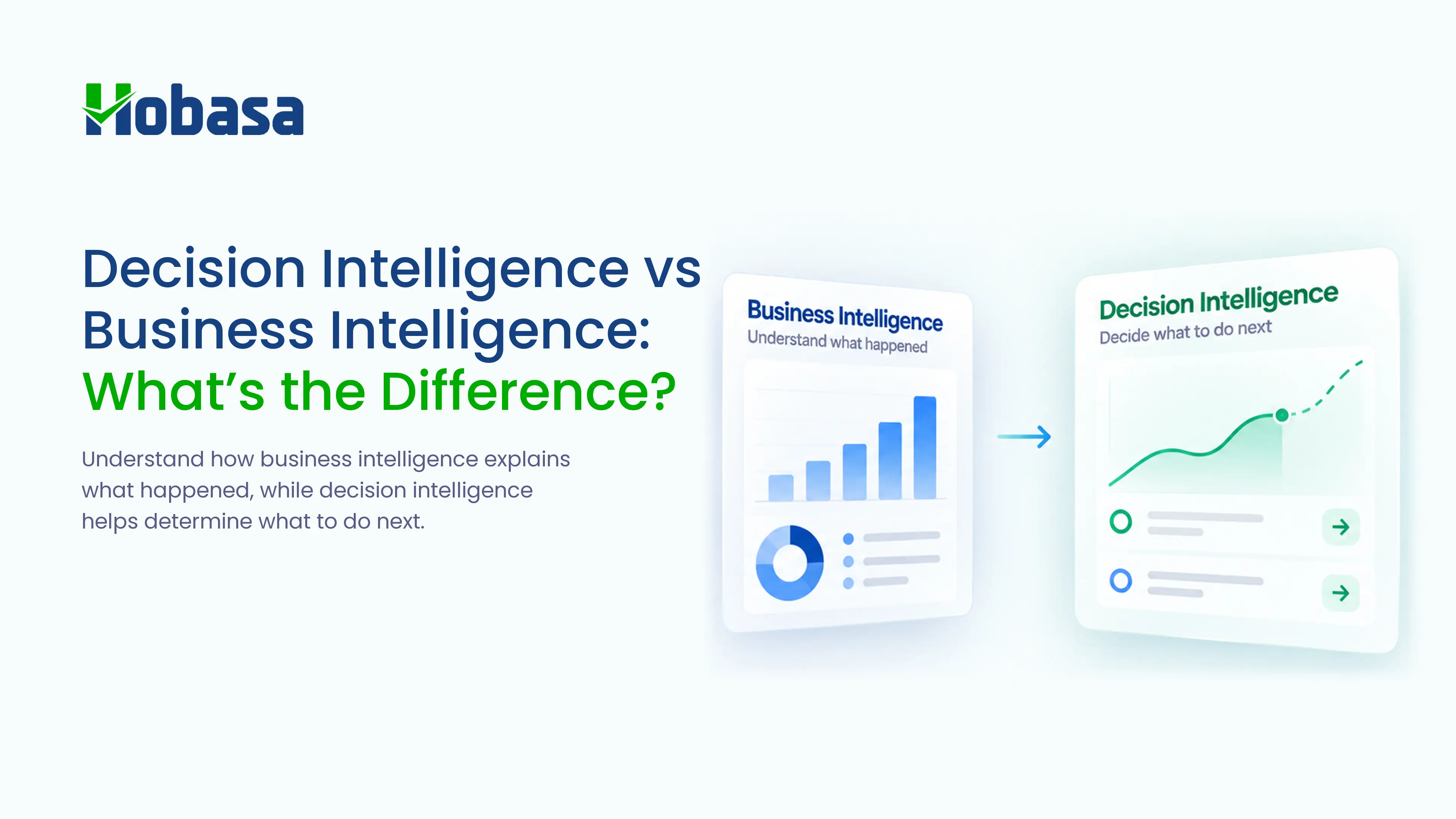
Business information exists across finance systems, HR platforms, CRMs, operational applications, documents, policies, and other sources. Traditional BI and reporting remain valuable, but they are often strongest at showing defined metrics and trends.
The next step is making the relationships between those metrics easier to understand.
Cross-system intelligence adds an intelligence layer that can connect information, continuously evaluate business signals, identify anomalies, investigate potential causes, and provide contextual answers.
For organizations looking to create a single view of finance and workforce data, connect information across business functions, and reduce the effort involved in reporting across multiple business systems, this connected approach can provide a more complete foundation for understanding business performance.
Ready for cross-system intelligence on your stack?
Keep your systems. Let Hobasa read across them and surface what single dashboards miss.
Talk to our teamTurn fragmented business data into connected intelligence.
Connect your finance, HR, payroll, recruiting, and operational data and see the relationships, anomalies, and insights hidden across your systems.
FAQs
Hobasa is a cross-system intelligence platform that connects business information across finance, HR, operations, and other systems, then applies an intelligence layer to identify patterns, investigate anomalies, and turn fragmented data into contextual, decision-ready insights.
Cross-system intelligence means analyzing the relationships between data in different business systems, not just the metrics inside each one. Many important business signals, like why margin declined or why turnover is rising, are explained by activity in a different function than the one showing the change.
Traditional BI is strongest at showing defined metrics and trends within a system. Hobasa is built to explain why something changed and what may need attention next, by connecting data across systems, using conversational AI, and surfacing relationships a single-system dashboard would not show.
No. Hobasa is designed to be industry agnostic. The same intelligence layer adapts to different data structures and business contexts, whether the organization is in automotive, travel, financial services, or another sector.
No. Hobasa connects to the finance, HR, payroll, CRM, ERP, and operational systems a business already runs and adds an analytical layer across them, rather than replacing those systems.
Yes. Hobasa is designed around multiple user perspectives, including owners, executives, CFOs, CHROs, investors, and advisors, so different roles can work from the same underlying data without each team building a separate analytical environment.
Hobasa emphasizes source-grounded answers, traceability, and human review. Findings are designed to be linked back to the underlying records and reviewed before they reach a decision-maker, rather than delivered as an unverified AI conclusion.