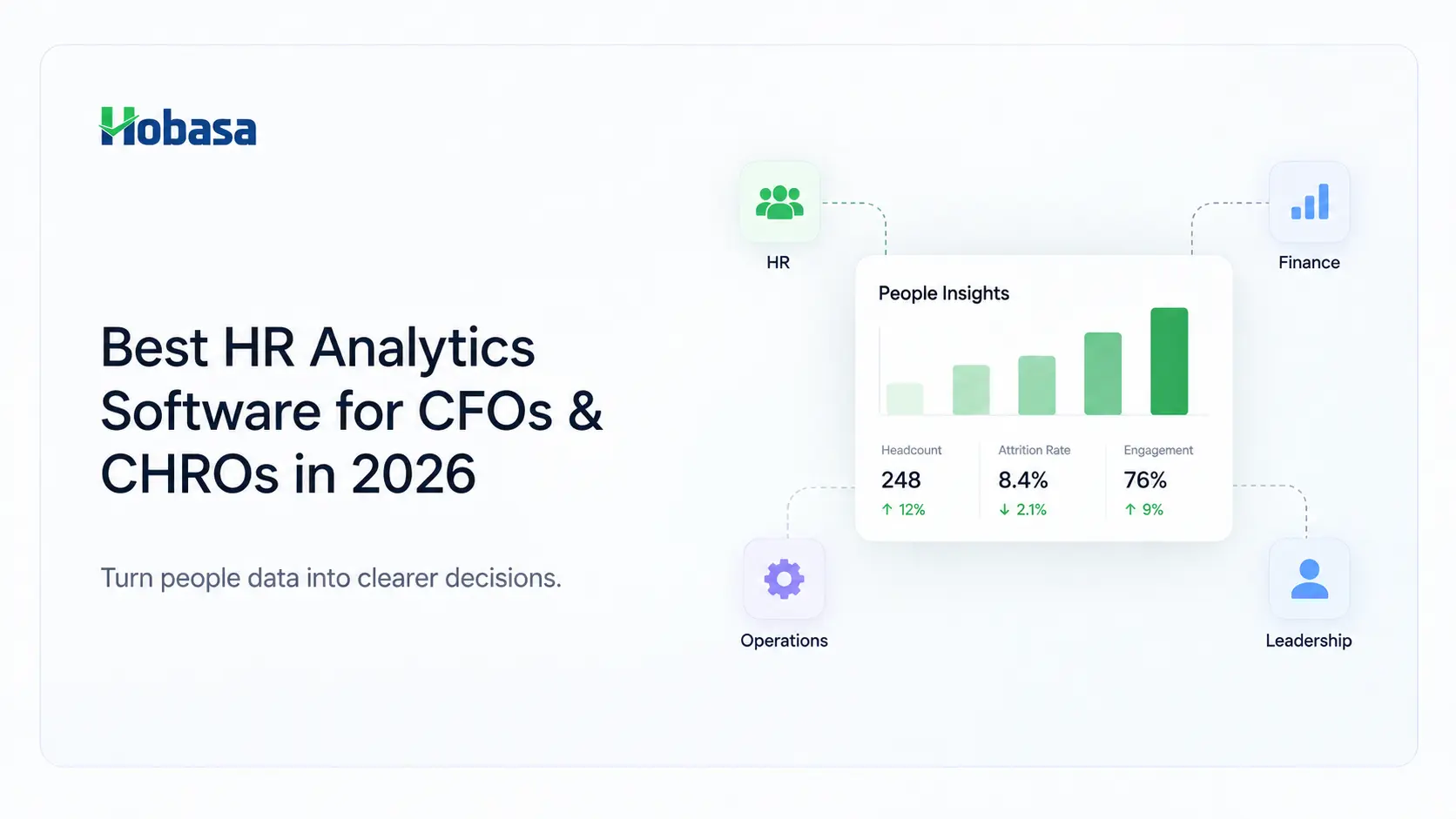
- There is no single best HR analytics software in 2026. The right choice depends on company size, which systems you already run, and whether the real problem is reporting on one system or reconciling several.
- Seven platforms are compared here, Visier, Workday, SAP SuccessFactors, ChartHop, Culture Amp, Tableau, and Hobasa, each strongest for a different situation, not ranked against each other.
- Most HR analytics tools report on one system at a time. CFOs and CHROs increasingly need finance, HR, payroll, and operations data reconciled into one place, which is where cross-system platforms like Hobasa fit.
- HR analytics software is not the same as an HRIS. One stores and administers employee records; the other analyzes data to answer questions the HRIS was never built to answer.
- Below: what HR analytics software should do in 2026, a full platform comparison, CFO- and CHRO-specific priorities, 2026 trends, a buying checklist, and a final verdict.
Workforce data does not live in one place. It sits in the HRIS, in payroll, in the recruiting system, in engagement surveys, and in whatever spreadsheet Finance built to make the numbers reconcile before the board meeting. Every one of those systems is confident. They just do not always agree with each other.
That is the real problem CFOs and CHROs are trying to solve when they search for HR analytics software. Not we need more dashboards. Most companies already have dashboards. The problem is that nobody has one reliable view of the workforce that Finance and HR both trust at the same time.
Which is the best HR analytics software in 2026? There is no single answer that fits every company. Enterprises with a dedicated data team and 5,000 or more employees tend to land on Visier. Companies already standardized on Workday or SAP get the most value from the analytics built into those suites. Fast-growing companies planning org structure lean on ChartHop. Teams whose most urgent problem is engagement use Culture Amp. Organizations with an existing BI practice extend Tableau into HR. And companies that need finance, HR, payroll, and operations data reconciled into one place, without ripping out what they already run, are increasingly evaluating cross-system platforms like Hobasa. The right choice depends on your company's size, which systems you already run, and whether your real problem is reporting on one system or reconciling several.
What Is HR Analytics Software?
HR analytics software collects, organizes, and analyzes workforce data, things like headcount, turnover, performance, compensation, and engagement, to help leaders understand what is happening across the workforce and why. Unlike an HRIS, which exists to store and administer employee records, HR analytics software is built to answer questions: which teams are at the highest risk of losing people, where is hiring taking too long, and how does workforce cost compare to budget.
Modern HR analytics platforms combine data from multiple systems, apply predictive models to forecast outcomes like attrition, and increasingly use AI to summarize what the data means in plain language, with a human still reviewing the output before it reaches a decision.
What Should HR Analytics Software Do in 2026?
The bar for what counts as real HR analytics has moved. A tool that only counts headcount and plots a turnover chart is not doing the job a CFO or CHRO needs in 2026. At minimum, it should cover:
HR data integration: pulling data from HRIS, payroll, recruiting, and engagement tools into one consistent model, not a separate export from each.
Workforce reporting: standard metrics such as headcount, turnover, time-to-fill, and cost per hire available without a manual pull every month.
Workforce analytics: explaining patterns, such as which manager's teams have the highest regretted attrition, not just counting.
Predictive analytics and workforce forecasting: modeling likely attrition, hiring needs, and cost trends before they show up in the numbers.
Risk detection: flagging compliance gaps and data mismatches automatically, not only when someone happens to look.
Employee retention analytics: identifying which teams or roles are at elevated flight risk, early enough to act.
Workforce planning: connecting headcount and hiring plans to actual budget, not treating the two as separate exercises.
Financial and workforce cost visibility: showing CFOs how workforce spend compares to budget, by department and over time.
Cross-system analysis: comparing what HR, payroll, and finance each report for the same thing, and showing where they diverge.
Data accuracy and reconciliation: catching where two systems disagree, rather than presenting one number as undisputed.
AI-assisted insights: summarizing patterns and surfacing anomalies faster than a person manually reviewing spreadsheets.
Governance and human oversight: a person reviews and approves AI-generated findings before they reach an executive decision.
CFOs and CHROs still reconciling three headcount numbers?
Hobasa aligns HR and finance views so analytics starts from one defensible workforce picture.
Talk to our teamBest HR Analytics Software for CFOs and CHROs in 2026
The table below compares seven platforms CFOs and CHROs commonly evaluate. It is not a ranking. Each platform is strongest for a different situation, and the honest answer for most companies is that the right pick depends on scale, existing systems, and which problem is most urgent right now.
| Platform | Best for | Key strengths | CFO relevance | CHRO relevance | Limitations |
|---|---|---|---|---|---|
| Visier | Large enterprises (5,000+ employees) with a dedicated data team | Prebuilt workforce models, strong benchmarking, unifies data across major HRIS and ATS platforms | Connects workforce metrics to financial planning and business outcomes | Purpose-built for retention, succession, and workforce planning at scale | Enterprise pricing; 4 to 8 month implementation; needs dedicated staff to run |
| Workday (Prism Analytics) | Companies already running Workday HCM | Blends HR and financial data inside one unified data model; AI-generated narrative insights | Strong finance-HR integration since HCM and Financials share one model | Native reporting across the employee lifecycle, no separate tool | Value depends on already being on Workday |
| SAP SuccessFactors | Global enterprises standardized on SAP with complex compliance needs | Deep localization across countries; tight S/4HANA and ERP integration | Ties workforce data to SAP's financial systems for existing customers | Strong global HR compliance and reporting in one suite | Most valuable inside SAP; a more fixed analytics model |
| ChartHop | Scaling companies focused on org design and headcount planning | Interactive, data-linked org charts; headcount and scenario planning | Scenario modeling connects org design to budget impact | Strong for planning and visualizing structure changes | Uneven integration depth reported with some ATS/HRIS tools; planning-focused, not predictive-focused |
| Culture Amp | Organizations whose most urgent need is engagement and culture data | Deep survey data, mature benchmark library, strong feedback theme detection | Limited; not a financial or cross-system layer | Strong for morale, belonging, engagement-driven retention risk | Survey-first, not a full people analytics platform; no native payroll/finance data |
| Tableau | Organizations with an existing BI practice and a dedicated data team | Best-in-class visualization; connects to almost any structured data source | Can span finance and HR if a data team builds the models | Useful for fully custom workforce dashboards | No out-of-the-box HR content; everything built and maintained in-house |
| Hobasa | CFOs, CHROs, and advisory teams who need finance, HR, payroll, and operations data to agree | Cross-system intelligence layer connecting existing systems; surfaces discrepancies between them; AI-assisted, source-grounded findings reviewed by a person | Reconciles workforce cost across payroll, HR, and finance, flagging disagreement | Surfaces workforce risk such as attrition, burnout, compliance, and quality of hire using HR, payroll, and recruiting data together | Not an HRIS, payroll system, or standalone visualization suite; a guided engagement, not pure self-serve; earlier-stage than the vendors above |
A short word on each, beyond the table.
Visier built the enterprise people analytics category and remains its reference point, unifying disparate HRIS and operational data into predictive models for retention, compensation, and planning. The tradeoff is scale: most reviewers place realistic implementation at four to eight months, and it is priced for large enterprises with a data team to run it.
Workday (Prism Analytics) extends Workday's unified HCM data model into deeper analysis, blending HR and financial data without leaving the ecosystem. The value is highest for companies already committed to Workday, and lower where HR, payroll, and finance sit on different vendors.
SAP SuccessFactors is the natural choice for multinational enterprises already standardized on SAP, with deep localization and tight S/4HANA integration. Outside that ecosystem, it is a heavier, more rigid analytics model than dedicated analytics platforms.
ChartHop's strength is visual: interactive org charts tied to live people data, with headcount and scenario planning built in. It fits a scaling company modeling what happens to budget and coverage if we add ten people here, more than deep predictive attrition modeling.
Culture Amp is survey-first: continuous engagement measurement feeding sentiment into manager-level retention-risk reports, backed by a mature benchmark library. It is not built to bring in payroll or finance data, so CHROs often still need a separate layer for cross-system cost and risk questions.
Tableau is not an HR analytics platform. It is a general-purpose visualization tool HR teams use to build custom dashboards on HRIS exports, genuinely strong if you already run Tableau elsewhere with a data team to build and maintain the models.
Why Hobasa Is a Strong Choice for CFOs and CHROs in 2026
Here is a scenario most CFOs and CHROs will recognize: the HRIS says headcount is 142. Payroll's most recent run reflects 138. Finance's workforce cost model, built off last quarter's budget, assumes a different number again. Nobody is lying. Each system is accurately reporting what it was told, at a different moment, using a slightly different definition.
This is the actual problem, and it is not solved by another dashboard. A dashboard built inside the HRIS will confidently show the HRIS's number. A dashboard built inside payroll will show payroll's number. Neither will tell you the two disagree, because neither system has visibility into the other.
Hobasa is built for this gap. It is a cross-system intelligence layer, not an HRIS, payroll system, or accounting system, that connects to the finance, HR, payroll, recruiting, and operations systems a company already runs and reads across all of them at once. Rather than replacing any of those systems, it sits on top of them and surfaces what none of them can see alone.
In practice, that shows up as a set of named signals drawn from more than one system at a time: a Workforce Health Score built from HR, payroll, and engagement-adjacent data rather than headcount alone; a Burnout Risk Score drawn from patterns across HR and operational data, not a single survey; Forecasted Attrition, a forward-looking view of likely departures rather than a historical rate; a Quality of Hire Score connecting recruiting data to downstream performance and retention; a Payroll Anomaly Score flagging payroll entries that do not reconcile against the general ledger or HR records; and a Regulatory Compliance Risk view surfacing workforce compliance exposure across HR and payroll data together.
Every finding like this is source-grounded: it cites the specific record it came from, a payroll line, an HRIS field, a recruiting record, rather than presenting a conclusion with no trail back to the data. Hobasa's own stated approach is AI-assisted and human-reviewed, meaning a person checks a finding before it reaches a CFO, CHRO, or board.
To be direct about positioning: Hobasa is not the platform to choose if your primary need is a full people analytics visualization suite, an HRIS replacement, or a payroll system. It is the platform to consider when your existing systems already hold the answer, but nobody has connected them to see it.
See how Hobasa connects HR, payroll, and finance data. Explore the Hobasa platform to see how cross-system findings like these get built, cited, and reviewed.
HR Analytics Software vs HRIS
These two categories get confused constantly, and the confusion has a cost: buying one when you need the other.
An HRIS (Human Resource Information System) is a system of record. It stores employee data, administers benefits, tracks time off, and runs core HR processes. Its job is accuracy and administration, not analysis. BambooHR, Rippling, and Workday's core HCM modules are HRIS examples.
HR analytics software takes data, often from an HRIS, but also from payroll, recruiting, and engagement tools, and analyzes it to answer questions the HRIS itself was never built to answer: which teams are losing people, whether hiring is improving, and how workforce cost tracks against budget.
Most companies need both. An HRIS with no analytics layer is always accurate and always reactive. Analytics software with no reliable HRIS underneath has nothing solid to analyze. Cross-system platforms like Hobasa sit a level above both, reading from the HRIS, payroll, and other systems at once, without replacing the HRIS itself.
HR Analytics Software for CFOs
For a CFO, HR analytics software earns its budget line by answering a narrower, more financial set of questions than the ones HR asks day to day:
Workforce costs: what is actually spent on people, by department, role, and location, versus plan.
Payroll accuracy: whether payroll data matches HR records and the general ledger, since a mismatch here is a direct financial exposure.
Headcount: one trusted figure, not three different ones from three different systems.
Budget vs. actual workforce costs: tracked continuously, not reconstructed manually at quarter-end.
Forecasting: projecting workforce cost forward based on planned hiring, attrition, and compensation changes.
Attrition cost: the real cost of turnover, including recruiting, onboarding, and productivity loss, not just the fact someone left.
Financial impact of workforce decisions: connecting a hiring or restructuring decision to its actual cost.
Cross-system data: reconciling what finance, payroll, and HR each report for the same workforce cost, and flagging where they diverge.
This is where Hobasa's work with fractional CFOs focuses directly: not another workforce dashboard, but a reconciliation layer, including a Payroll Anomaly Score and a Regulatory Compliance Risk view, between what payroll, HR, and finance each separately believe to be true.
Talk to the Hobasa team about connecting your finance and payroll data. Book a walkthrough and bring a real headcount or cost discrepancy you are trying to explain.
Need HR analytics your CFO will actually trust?
Hobasa ties workforce metrics to cost and ledger context, not HRIS-only charts.
Get in touchHR Analytics Software for CHROs
For a CHRO, the priorities shift toward the workforce itself, though the underlying need for cross-system accuracy is the same:
Workforce health: an overall read on stability and risk, not just a single engagement score.
Retention: which teams, roles, or managers show elevated flight risk, and why.
Burnout: early signals of overload before they show up as resignations.
Attrition: both historical turnover and a forward-looking forecast of likely departures.
Recruiting: whether new hires actually perform and stay, not just how fast requisitions close.
Performance: patterns connected to retention and engagement, not viewed in isolation.
Compliance: workforce-related compliance exposure, drawn from HR and payroll data together.
Workforce planning: aligning headcount plans with what the business can actually afford and needs.
Employee data: one consistent view of the workforce, not a different number depending on which system someone opens.
A CHRO working with Hobasa's fractional CHRO offering gets Forecasted Attrition, Burnout Risk Score, and Quality of Hire Score built from HR, payroll, and recruiting data together, the specific gap a survey-only or HRIS-only tool cannot close alone.
2026 HR Analytics Trends
A few things are genuinely different about HR analytics in 2026 compared to a few years ago.
AI adoption in HR has moved from pilot to expectation. Gartner's 2026 CHRO research, based on 426 CHROs across 23 industries, places harness AI to revolutionize HR as a top priority, with a clearly defined AI strategy now expected rather than optional.
HR still has less say in AI strategy than its stake in it would suggest. AIHR research found 92% of HR leaders report at least some involvement in AI implementation, but only 21% are closely involved in AI strategy decisions, a gap pushing CHROs toward cross-functional alliances with the CFO and CTO rather than running AI adoption inside HR alone.
Agentic AI is arriving in workforce operations, not just assisting them. Industry research cited in 2026 coverage suggests more than half of talent leaders plan to add autonomous AI agents to HR operations this year, a shift from AI that helps a person to AI with an active role in workflows, which raises the question of where human judgment has to stay central.
Analytics is shifting from reporting to prediction. Multiple 2026 buyer's guides describe the same shift: counting headcount and plotting turnover are baseline capability now, not a differentiator. The real question platforms are judged on is predictive: which managers are likely to lose people next, and which signals actually predict it.
Governance and human oversight are becoming a stated requirement. Analyst commentary on workforce data governance in 2026 notes that a majority of senior HR executives say they need clearer guidance on privacy and fairness as algorithmic tools spread, with algorithmic HR tools increasingly assessed with the same rigor as a formal HR policy.
Cross-functional, cross-system thinking is the throughline. Whether the source is Gartner's CHRO priorities or the buyer's guides comparing analytics platforms, the same idea recurs: workforce decisions increasingly need finance, HR, and operational data together, not HR data considered on its own.
How to Choose the Right HR Analytics Software in 2026
There is no universal winner, but there is a reliable process. Work through this checklist with both Finance and HR in the room, not just one function evaluating alone.
Integrations: does it connect to your HRIS, payroll, recruiting, and finance systems, or only some of them?
Data quality: does it reconcile conflicting numbers between systems, or just display what one system reports?
Analytics depth: does it explain patterns and causes, or only display counts and charts?
Predictive capabilities: can it forecast attrition, cost, or risk, or only report what already happened?
Reporting: are the reports board- or auditor-ready as is, or do they need manual rework first?
Forecasting: does workforce planning connect to actual budget numbers, or live in a separate spreadsheet?
Security: what certifications and data-handling commitments does the vendor make, in writing?
Auditability: can every number be traced back to its source record?
Ease of use: can HR and Finance both use it without a dedicated analyst for every question?
Implementation: is it weeks or months, and does it require your own data team to run?
CFO/CHRO collaboration: one shared source of truth, or does each side need a separate tool?
Total cost/value: the realistic all-in cost, including internal time to run it, not just the license fee.
Not sure where your systems disagree today? Talk to the Hobasa team and walk through one real headcount, cost, or attrition question your HRIS, payroll, and finance systems currently answer differently.
Shortlisting HR analytics for 2026?
See how Hobasa complements Visier, Workday, and the rest, when cross-system truth is the real requirement.
Talk to our teamFinal Verdict
There is no single best HR analytics software for every CFO and CHRO in 2026, and any roundup that claims otherwise is selling something. The honest answer depends on your scale and your actual bottleneck.
If you run a large global enterprise with a dedicated analytics team, Visier remains the deepest, most proven option, and Workday or SAP SuccessFactors make sense if you are already standardized on one of those ecosystems. If your most urgent need is visualizing org design and planning headcount scenarios, ChartHop is a strong, focused choice. If engagement and culture measurement is the priority, Culture Amp is purpose-built for that. If you already have a BI practice and want full control, Tableau can be extended into HR with the right internal resources.
Hobasa fits a more specific situation: CFOs, CHROs, fractional finance and HR leaders, and advisory teams who are not primarily missing a dashboard, but are missing agreement between the systems they already run. If your HRIS, payroll, and finance systems each show a different number for the same workforce question, and you need that discrepancy surfaced, explained, and reviewed by a person before it reaches a decision, that is the problem Hobasa is built to solve.
It is not the right fit if what you actually need is a new HRIS, a payroll system, or a fully self-serve visualization suite; several platforms above are the better starting point for those needs.
See where your workforce systems disagree.
Connect your HR, payroll, finance, and recruiting data into one reviewed view and surface the discrepancies that matter.
FAQs
There is no single best option for every company. Large enterprises with dedicated data teams often choose Visier; companies standardized on Workday or SAP use the analytics built into those suites; ChartHop suits org design and planning; Culture Amp suits engagement measurement; and companies needing finance, HR, payroll, and operations data reconciled in one place are increasingly evaluating cross-system platforms like Hobasa.
HR analytics software collects and analyzes workforce data, such as headcount, turnover, performance, and compensation, to help leaders understand what is happening across the workforce and why. It goes beyond storing employee records, which is an HRIS's job, to explain patterns, forecast outcomes, and flag risks.
The terms are largely used interchangeably in 2026. Where they differ, "HR analytics" often refers narrowly to HR-department metrics like turnover and time-to-fill, while "workforce analytics" more often implies a broader view that includes cost, planning, and cross-functional business impact.
Yes, and increasingly they need to. Workforce cost is typically one of the largest line items on a company's income statement, so CFOs use HR analytics software to track budget versus actual workforce spend, headcount accuracy, payroll reconciliation, and the financial impact of hiring and attrition.
Most modern platforms connect to at least an HRIS, and stronger cross-system platforms also connect to payroll, recruiting, and finance systems. The depth of that integration varies significantly by vendor, which is why checking integration coverage against your actual systems matters more than a feature list.
No. An HRIS is a system of record for employee data and core HR administration. HR analytics software analyzes data, often pulled from the HRIS and other systems, to answer questions the HRIS was never built to answer. Most companies need both, and cross-system platforms like Hobasa are explicitly designed to work alongside an HRIS, not replace it.
Because workforce decisions sit at the intersection of both roles. A hiring plan is an HR decision with a direct financial cost. A payroll discrepancy is a finance issue with an HR root cause. When CFOs and CHROs work from the same reconciled workforce data instead of two separate sets of numbers, decisions get made faster and with fewer disagreements about whose number is right.