- AI in accounting is no longer optional. Most firms already use it somewhere, but adoption has outpaced trust.
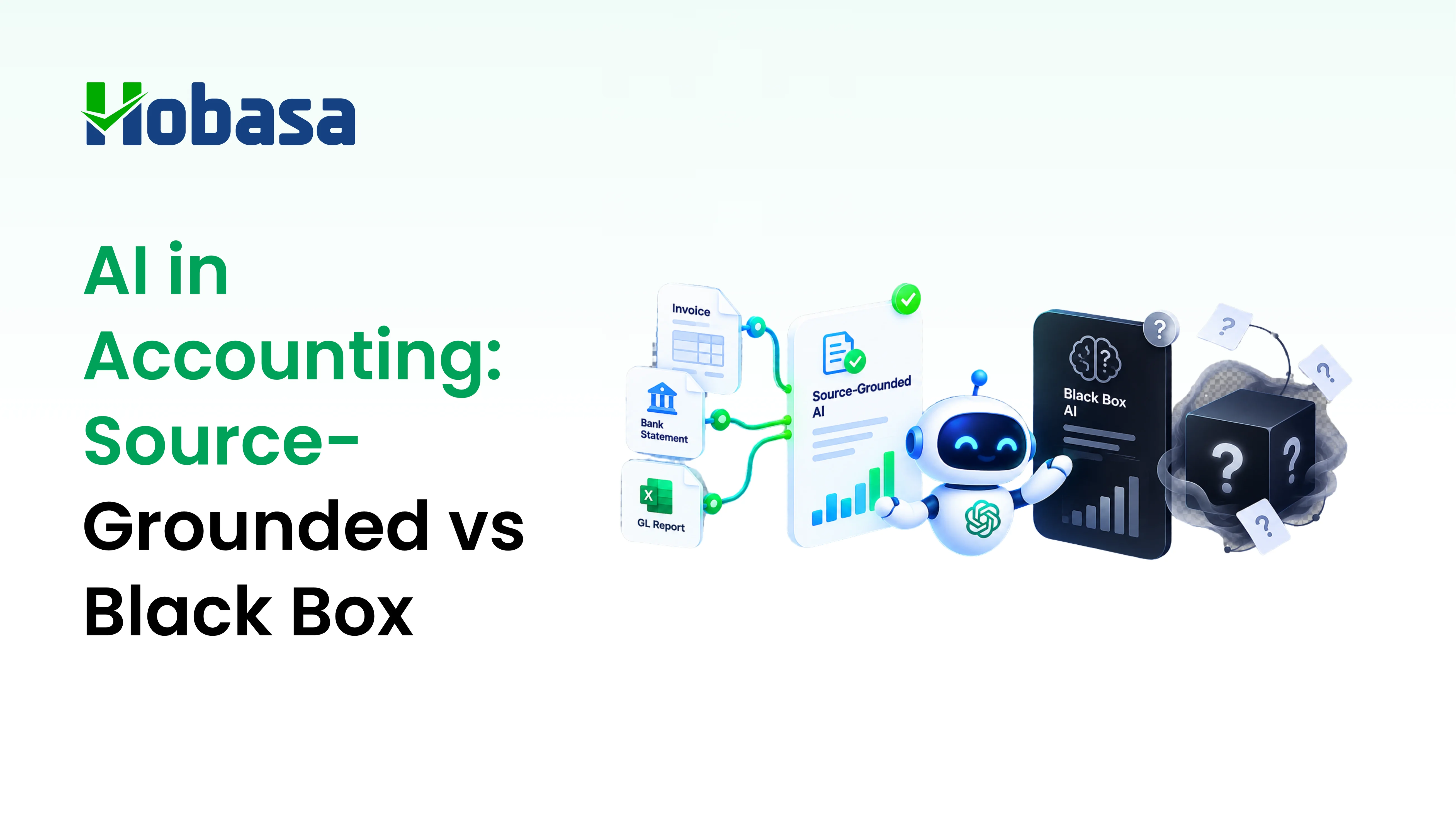
- "Black box" AI gives you an answer with no way to check how it got there. In a profession built on evidence, that is a liability, not a convenience.
- "Source-grounded" AI cites the exact record behind every answer, so a person can verify it before it reaches a client, a partner, or an auditor.
- The legal profession is already living through what happens when unverified AI output reaches a filing. Accounting does not need to repeat that lesson.
- Hobasa is built source-grounded from the ground up: every finding cites the record it came from and is reviewed by a person before it reaches you.
- Below: what black box AI actually risks, what source-grounded AI looks like in practice, and how to evaluate any AI tool before you bring it into your firm.
Ask ten accountants whether they use AI and most will say yes. Ask them to explain exactly how their AI tool reached its last answer, and the room gets quiet. That gap, between using AI and being able to stand behind what it produced, is the real story of AI in accounting right now.
It is not a hypothetical concern. Accounting runs on evidence. Every number in a client's books traces back to a document, a policy, or a rule. When an AI tool hands you a conclusion with no trail back to a source, it is asking your firm to trust it the way you would never let a junior staffer's unchecked work reach a client. That is the difference between a black box and a source-grounded system, and for a CPA firm, it is the difference that actually matters.
This distinction is not academic, and it is not new to other high-stakes professions either. It is simply arriving in accounting now, at the exact moment adoption is accelerating fastest. Firms that get this right early will spend the next few years compounding trust with clients and regulators. Firms that treat it as a detail to sort out later are the ones most likely to be explaining an error after the fact, instead of catching it before it ever left the building.
What "Black Box" AI Actually Means for a CPA Firm
A black box AI tool produces an answer without showing its reasoning. You ask a question, you get a response, and the trail ends there. No citation to the ledger entry, the tax code section, or the client document behind it. No way to see what the model weighed, what it may have gotten wrong, or what it quietly assumed.
This is not a criticism of any specific product. It is a structural feature of how many general-purpose AI tools work. A large language model, used on its own, generates the most statistically likely next words based on its training. It does not inherently check its answer against your client's actual general ledger, actual tax filing, or actual payroll record. When it sounds confident, that confidence is not evidence.
This shows up in ordinary, everyday accounting work more than firms realize. A general AI chatbot asked to research a tax position can produce a citation to a code section or a ruling that no longer applies, or never existed at all. A tool asked to code a transaction can classify it plausibly without ever checking it against the client's actual chart of accounts. A tool summarizing a client's financials can generate a clean, readable narrative that quietly smooths over a discrepancy a human reviewer would have caught in seconds. None of these failures look like failures. They look like normal, confident output.
In everyday use, that is a minor annoyance. In a CPA firm, it is a professional risk, for a few specific reasons:
Every answer is a decision that compounds
Coding a bill, classifying a transaction, or answering a client's tax question all become inputs into the next decision. An unverified error early in the chain does not stay contained.
Someone has to sign it
Whatever the AI produces, a partner or preparer is the one whose name and license are on the output, not the AI vendor's.
Clients and regulators expect an answer, not a guess
"The AI said so" satisfies no auditor, no state board, and no client who later asks why a number was wrong.
Why Black Box AI Is a Bigger Risk in Accounting Than Almost Anywhere Else
Every profession that deals in high-stakes decisions is running into this same problem right now, and accounting is not an exception.
Xero has described this directly in its own AI governance work, calling accounting records "decisioned data": a chain of high-stakes decisions, from coding an incoming bill to closing the books and filing taxes, where each step builds on the last. The company has said accounting has effectively zero tolerance for hallucination, because an AI system needs a genuine, contextual understanding of the ledger to get any single step right.
The clearest warning sign is coming from an adjacent profession. Legal work runs on the same kind of evidence-based standard accounting does, and it is already living through a wave of AI-related professional discipline. A public tracking database has logged AI hallucinations appearing in court filings 495 times since April 2023, with 222 of those in 2026 alone. Ninety-six lawyers have been sanctioned for AI misuse since the start of 2025, compared with just two in the two years before that. Legal commentators tracking these cases have been explicit that this is not only a legal-industry problem: professional malpractice exposure applies just as much to accountants and financial advisors who let unverified AI output reach a client.
Inside accounting specifically, the pattern is already showing up in less formal ways. One widely discussed account described a partner at a mid-sized firm who asked a general AI chatbot whether a client's research and development activity qualified for a specific tax credit under new safe-harbor rules. The tool answered confidently and clearly, and it was wrong. It had not made a small mistake. It had invented a rule that sounded plausible enough to pass a quick read. The partner only caught it because she had researched the same question herself two weeks earlier. Without that coincidence, the error would have reached the client unchecked.
Professional responsibility rules do not carve out an exception for AI. A practitioner is expected to supervise and verify AI-generated work with the same rigor applied to a junior staffer's draft, and failing to catch an error before it reaches a client can be treated as a supervision failure, not a technology one. State boards of accountancy and firm malpractice carriers are watching this closely for the same reason insurers are already tightening language around AI use in legal malpractice policies: the tool that produced the error rarely carries the liability. The firm that signed off on it does.
None of this means AI should stay out of accounting. It means the type of AI matters more than the fact of using AI at all.
Using AI your firm cannot defend under review?
Hobasa is built for source-grounded answers, so accounting teams can show where every claim came from.
Talk to our teamAI Adoption Is Accelerating, Trust Is Not Keeping Pace
The numbers make the gap clear. Firms are moving fast on adoption and much slower on the verification habits that should come with it.
A 2026 survey from Blue J and CPA.com, covering more than 1,000 tax professionals, found that 60% now use AI for tax research at least weekly, up from 33% in 2025.
Thomson Reuters research shows organizational AI adoption in tax and accounting jumped from 22% to 40% between its 2025 and 2026 surveys.
A BILL and NewtonX survey of 207 accounting firm leaders found that 92% say they are familiar with AI in accounting, but only 14% call themselves extremely familiar. Firms cluster into four adoption stages: 10% still just aware, 34% in early adoption, 38% actively adopting, and only 18% at mature adoption.
The AICPA's 2026 Top Issues Survey found that technology and AI adoption ranked among the top two concerns for firms across almost every size category.
Separately, CPA Practice Advisor reported that 64% of accounting firms plan to invest in or upgrade AI systems this year, up from 57% in 2024.
Put together, this describes a profession moving into AI faster than it is building the discipline to check it. Adoption curves like these are usually read as a success story. They are also, quietly, a risk curve: every firm added to the "actively adopting" column without a verification habit in place is one more firm one confident wrong answer away from a client conversation nobody wants to have. That gap is exactly where black box tools do the most damage, quietly, until an error surfaces somewhere a firm cannot control.
See how a cross-system, source-grounded platform looks in practice. Explore what Hobasa built for CPA firms.
What "Source-Grounded" AI Actually Means
Source-grounded AI is built around one simple discipline: every answer has to point back to where it came from.
In practice, that means a few concrete things are true of the tool, not just claimed in its marketing:
Every finding cites its source
Not "the data suggests," but the specific ledger entry, invoice number, payroll record, or client document the answer is based on.
Disagreements are surfaced, not resolved silently
When two systems show different numbers for the same thing, a source-grounded tool flags the conflict instead of quietly picking one and moving on.
A person reviews the output before it reaches a decision-maker
Grounding reduces the rate of fabricated answers, but it does not replace judgment. The review step is what makes the output defensible.
The reasoning is documented, not just the answer
What rule was applied, what records were involved, and why the finding matters are all part of the output, not something you have to reconstruct after the fact.
This is the same idea behind what the broader AI industry calls "grounding": research on enterprise AI adoption has found that grounded systems reduce hallucinations because every claim anchors to a retrievable source instead of a fabricated pattern, and that this is what makes audit trails and compliance documentation actually manageable in regulated work.
For a CPA firm, the payoff is not just fewer errors. It changes what a firm can actually offer a client. Compliance work, tax filings, audits, has always demanded this level of rigor by definition. Advisory work is where source-grounding matters just as much but gets overlooked, because a plausible-sounding recommendation about cash flow, pricing, or hiring feels lower-stakes than a filed return, right up until a client acts on it and it turns out to be wrong.
Source-Grounded vs. Black Box: Side-by-Side
| Black box AI | Source-grounded AI | |
|---|---|---|
| How you get an answer | A conclusion, with no visible reasoning | A finding, with the source record attached |
| When two systems disagree | Usually resolved silently, one number wins | Flagged as the finding itself |
| Who catches an error | Whoever happens to double-check by luck | Built into the review step, every time |
| What you can show an auditor or board | The output, and your word that it is right | The output, the source, and a documented review |
| Where the risk sits | With whoever signs off on unverified output | Reduced, because nothing ships unverified |
Source-grounded AI for CPA workflows.
See how Hobasa keeps AI outputs tied to your clients’ systems and documents.
Get in touchWhat This Looks Like Inside a CPA Firm
The difference is easiest to see in a single example.
Illustrative example. A CPA firm is preparing quarterly reporting for a mid-sized client. A black box AI tool, asked to summarize the client's vendor spend, reports a clean 12% increase quarter over quarter, phrased confidently, with no supporting detail. It is a plausible number. It is also wrong, because two duplicate invoices from the same vendor were double-counted, something the tool had no way to flag since it was never asked to check for that pattern, and never showed its work either way.
A source-grounded tool handling the same task does not just report the number. It shows that vendor spend rose $42,180, or 18%, and it cites the two specific bills from the same vendor, ten days apart, that appear to be duplicates. It flags the discrepancy as the finding, not a footnote. An analyst reviews it, confirms the duplicate, and only then does it reach the partner with a documented explanation, ready to bring into the client conversation.
Same task. Very different thing to sign your name to.
A second example, on the advisory side. A firm's client asks whether a group of contractors should really be classified as 1099 workers. A black box tool, asked to summarize the client's workforce setup, returns a general answer about contractor classification rules, phrased helpfully, with no reference to the client's actual contracts, hours, or payment patterns. It reads as sound advice. It is also not actually checked against this client's facts.
A source-grounded tool handling the same question pulls the client's actual payroll and contract data, flags that three of the contractors have fixed weekly hours and use company equipment, both classic misclassification risk factors, and cites the specific records behind that flag. It does not tell the firm what to conclude. It gives the reviewing accountant exactly what they need to make the call themselves, and to document why.
Bring a real client question to a walkthrough. Book 30 minutes with Hobasa and see how a finding like this gets built, cited, and reviewed before it ever reaches you.
Why CPA Firms Choose Hobasa's Source-Grounded Approach
This is not an incidental feature for Hobasa. It is the design starting point. Hobasa states it as an operating principle, not a slogan: no black boxes, no surprise deliverables, no scope drift hidden in invoices.
Every finding cites the exact record behind it
Whether it is a general ledger entry, an AP bill, or a payroll record, the source is attached, not summarized away.
AI surfaces the pattern; a person confirms it
Hobasa's own stated principle is AI-assisted, human-reviewed: AI speeds up analysis and pattern detection, but judgment and quality review are what make the output something a firm can actually stand behind.
It reads across every client system, not one at a time
Accounting, payroll, HR, and operations data connect into one model, so a finding can reflect the full picture instead of one system's isolated view.
Built for how a firm actually reviews work
A multi-client dashboard with drill-down into any single client, and exception-based review, so partner and senior time goes to judgment calls, not scanning every line for something that might be wrong.
The trust posture is documented, not assumed
ISO 27001 Certified, SOC 2 Type II Certified, and a stated commitment that client data is never used to train external models.
It is built to help a firm serve more clients without losing depth
The same review discipline that makes a finding defensible is what lets a firm expand its client base without expanding headcount at the same rate, because exception-based review means partner and senior time only goes where the data actually flagged something.
For a firm evaluating AI tools right now, the practical question is simple: can this tool show you exactly why it reached its answer, in a form you could hand to a partner, a client, or an auditor without editing it first. That is the bar Hobasa is built to clear.
How to Evaluate Any AI Tool Before You Bring It Into Your Firm
You do not need to take a vendor's word for whether a tool is source-grounded. Most vendor pitches use the same handful of words: transparent, explainable, trustworthy. Those words cost nothing to say. Ask these questions instead, and judge the tool by whether it can actually answer them, not by how confidently the sales deck uses the right vocabulary.
Can it show the exact source behind any answer it gives you?
Not a category of data, the specific record.
What happens when two connected systems disagree?
A tool that silently resolves conflicts is hiding information you need to see.
Is there a human review step before output reaches a client or decision-maker?
If the answer is no, ask who is accountable when it is wrong.
Does it work across your actual client systems, or just one?
A tool that only reads your accounting software cannot catch what only shows up when payroll, HR, or operations data disagrees with it.
What does the vendor say about your data?
Is client data ever used to train external models, and can you get that in writing.
Can you produce documentation from it that would satisfy a partner review or an audit request?
If you would still need to redo the work manually to document it properly, the tool has not actually saved you the risk, only the typing.
Evaluating AI for your firm this year?
Talk to Hobasa about what “source-grounded” should mean before you commit to a black box.
Talk to our teamAI in Accounting Needs to Show Its Work
AI in accounting is not slowing down, and it should not have to. The question every firm has to answer is not whether to use it, but whether they can explain, defend, and document every answer it gives them.
A black box tool cannot help with that, no matter how confident its answers sound. A source-grounded platform like Hobasa is built specifically so the answer, the source, and the review are never separated from each other.
Talk to the Hobasa team about what that looks like for your firm.
Give your accounting AI a source you can stand behind.
See how source-grounded, human-reviewed AI can help your CPA firm surface findings with the evidence behind every answer.
FAQs
Black box AI describes any tool that produces an answer without showing how it got there, no citation to the source record, no visible reasoning, and no way for a person to verify the conclusion before acting on it.
Accounting decisions compound. A coding error, a misclassified transaction, or an unverified tax conclusion becomes an input into the next decision, and the professional who signs off, not the AI vendor, carries the liability if it is wrong.
Source-grounded AI ties every answer to the specific record it came from, such as a ledger entry, invoice, or payroll record, and surfaces disagreements between systems instead of resolving them silently, so a person can verify the finding before it is used.
Ask it to show the exact source behind a specific answer. A source-grounded tool can point to the record immediately. A black box tool can only restate or rephrase its original answer.
Not meaningfully. The citation and review step adds a small amount of structure to the output, but it removes the much larger cost of catching an error after it has already reached a client or a filing.
Hobasa connects directly to a firm's accounting, payroll, HR, and operations systems, builds one connected model across them, and attaches the source record to every finding. An analyst reviews each finding before it reaches a decision-maker, following Hobasa's stated principle of AI-assisted, human-reviewed delivery.
Not necessarily in subscription cost, but the comparison that matters is total cost, not sticker price. A black box tool that produces one unverified error a client acts on can cost far more in remediation, reputation, and lost trust than the price difference between tools ever would.
Nothing, until it does. The risk with black box tools is not that they are wrong constantly, it is that they are wrong occasionally, confidently, and without warning, which is exactly the pattern that has already produced sanctions and malpractice claims in the legal profession. The fix is not to stop using AI. It is to only use AI that can show its work.