What Is Compliance Monitoring?
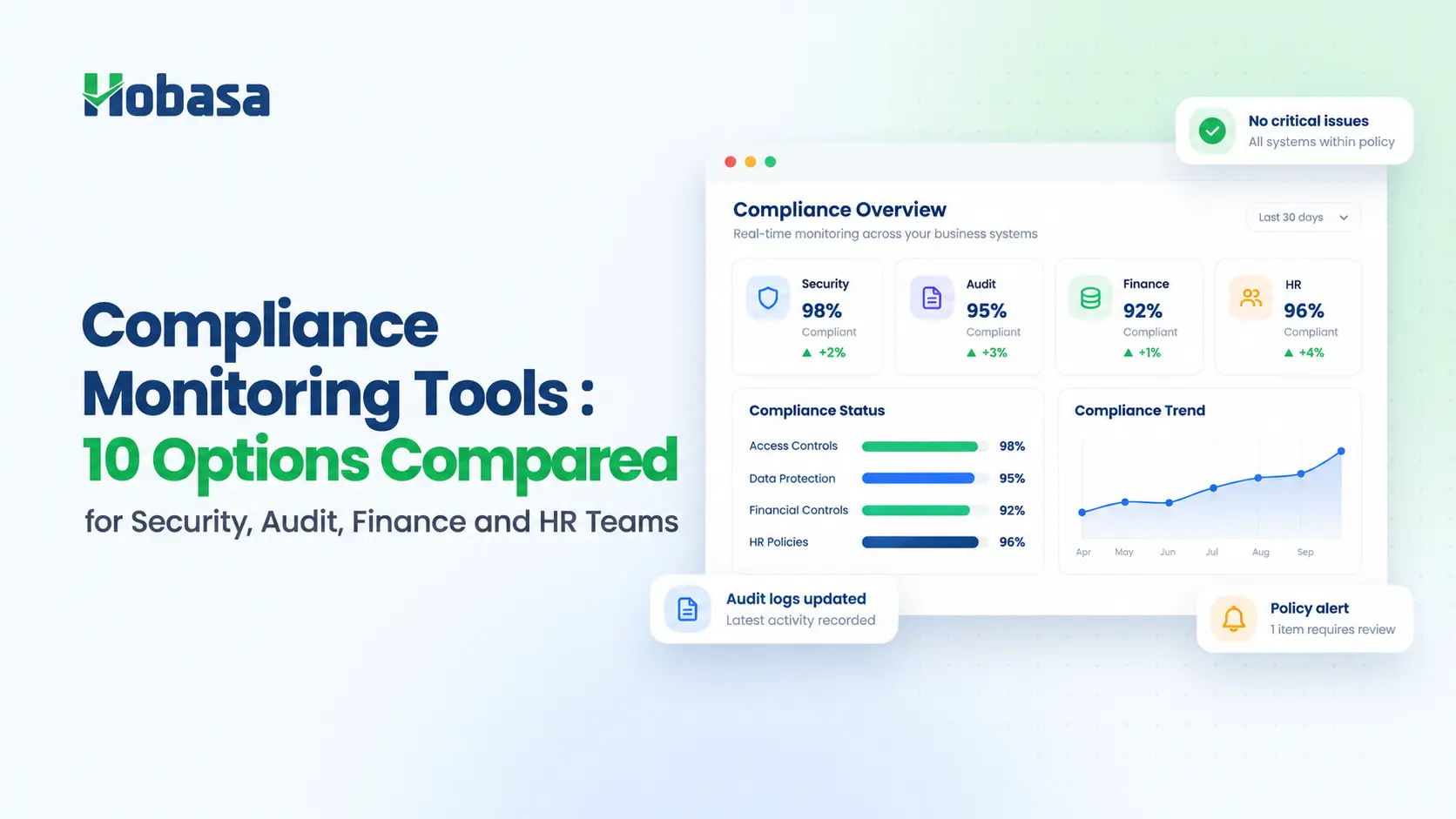
Compliance monitoring is the ongoing process of checking that a business is following the laws, regulations, standards and internal policies that apply to it, and producing evidence that it is.
The key word is ongoing. A traditional audit looks at a sample of activity after the fact, once a year or once a quarter. Monitoring checks controls continuously or on a frequent schedule, so a problem is caught when it happens instead of months later during fieldwork.
Compliance monitoring vs. compliance management: Monitoring is the detection layer. It tests controls and flags exceptions. Compliance management is broader. It includes policies, risk registers, training, remediation workflows and reporting to the board. Many platforms do both, but it helps to know which one you are actually buying.
What Are Compliance Monitoring Tools?
Compliance monitoring tools are software that connects to your business systems, tests data and settings against a defined set of rules or controls, and alerts the right person when something falls outside policy. Most also store evidence so you can show an auditor what was checked and when.
A typical compliance monitoring tool does five things:
1. Connects to source systems through APIs, connectors or file imports.
2. Maps data to controls, such as "every vendor payment over a set amount has a second approver."
3. Tests those controls automatically on a schedule or in real time.
4. Alerts owners when a control fails, with enough detail to investigate.
5. Records results and evidence for auditors, regulators or the board.
Where tools differ is what they connect to and which rules they test. That is where the four categories come in.
The Four Types of Compliance Monitoring Software
Before you compare features, decide which of these jobs you are hiring a tool to do. Gartner's Peer Insights market for compliance monitoring solutions illustrates the problem well: it lists security automation tools like Vanta next to ERP transaction tools like Datricks and MindBridge and HR platforms like Rippling, all under one heading.
| Type | What it proves | Typical systems watched | Example tools |
|---|---|---|---|
| 1. Security and privacy compliance | You meet frameworks like SOC 2, ISO 27001, HIPAA, PCI DSS or GDPR | Cloud infrastructure, identity, devices, code repositories | Vanta, Drata, OneTrust |
| 2. Enterprise GRC and audit | Your controls, risks and audit program are documented, tested and reported | Control libraries, audit workpapers, risk registers | Optro (AuditBoard), MetricStream, Workiva |
| 3. Financial controls monitoring | Transactions and access in finance systems follow policy | ERP, general ledger, user access | Pathlock, MindBridge, Datricks |
| 4. Payroll and HR compliance | Pay, tax filings and employment records follow the rules | Payroll, HRIS, time tracking | Rippling (and other payroll platforms) |
Most mid-sized companies end up with tools in two or three of these boxes. The mistake is assuming one box covers the others.
Compliance Monitoring Tools Compared: The 10 at a Glance
| # | Tool | Type | Best for | Core strength |
|---|---|---|---|---|
| 1 | Vanta | Security and privacy | Cloud companies pursuing SOC 2 or ISO 27001 | Automated evidence collection for security frameworks |
| 2 | Drata | Security and privacy | SaaS teams with a dedicated compliance owner | Continuous control testing across multiple frameworks |
| 3 | OneTrust | Security and privacy | Multinationals with heavy privacy obligations | Privacy, consent and third-party risk in one suite |
| 4 | Optro (formerly AuditBoard) | Enterprise GRC and audit | Internal audit and risk teams | Connected audit, risk, infosec and compliance workflows |
| 5 | MetricStream | Enterprise GRC and audit | Large firms in heavily regulated industries | Regulatory content libraries and enterprise GRC depth |
| 6 | Workiva | Enterprise GRC and audit | Public companies managing SOX and reporting | Controls management linked to financial reporting |
| 7 | Pathlock | Financial controls | ERP-heavy finance teams (SAP, Oracle, Workday) | Segregation of duties and access risk monitoring |
| 8 | MindBridge | Financial controls | Audit and finance teams reviewing the ledger | Risk-scoring every general ledger entry |
| 9 | Datricks | Financial controls | SAP environments needing transaction-level monitoring | Process mining for anomalies and fraud indicators |
| 10 | Rippling | Payroll and HR | Growing companies running payroll in many states | Automated payroll tax filings and rule updates |
How we chose these tools: We reviewed the compliance monitoring guides ranking in the US for this topic, Gartner Peer Insights' compliance monitoring solutions market, and each vendor's own published product information as of October 2026. We picked tools that are widely shortlisted within each of the four categories. This is not a paid ranking, and the order follows the categories above, not a score. We did not include pricing because most of these vendors quote it privately, and third-party estimates go out of date quickly.
The 10 Best Compliance Monitoring Tools in 2026
Security and privacy compliance monitoring
1. Vanta
Best for: Cloud-native companies preparing for their first SOC 2 or ISO 27001 audit, or adding frameworks as they grow.
Vanta connects to cloud infrastructure, identity providers, HR systems and developer tools, then tests security controls automatically and gathers the evidence auditors ask for. It supports common frameworks including SOC 2, ISO 27001, HIPAA, PCI DSS and GDPR.
Strengths
- Large integration library, which cuts manual evidence gathering
- Widely recognized by audit firms, which can make the audit itself smoother
- Fast path to a first security certification
Consider
- Built around information security frameworks, not financial transactions or payroll rules
- Pricing is quote-based
Ask in the demo: "Which of our controls will still need manual evidence after setup?"
2. Drata
Best for: SaaS teams with a compliance owner who want continuous testing across several frameworks.
Drata runs automated control tests and collects evidence for frameworks such as SOC 2, ISO 27001, HIPAA, PCI DSS and GDPR. Controls can be mapped once and reused across frameworks, which matters when you add a second or third certification.
Strengths
- Continuous control monitoring with clear pass/fail status
- Cross-framework control mapping reduces duplicate work
- Strong fit for companies selling to security-conscious buyers
Consider
- Focused on security and privacy frameworks
- Works best when someone internally owns the program day to day
Ask in the demo: "How do you handle a control that depends on a system you don't integrate with?"
3. OneTrust
Best for: Mid-size and large organizations with privacy obligations across many countries.
OneTrust is a broad suite covering privacy (including GDPR and CCPA), consent and cookie management, third-party risk and data governance. Its compliance monitoring strength is on the privacy side, where obligations change often by jurisdiction.
Strengths
- Deep privacy and consent coverage across jurisdictions
- Third-party and vendor risk modules in the same platform
- Suited to multinational programs
Consider
- Breadth comes with a steeper setup and learning curve
- More than a small team usually needs
Ask in the demo: "Which modules do we need for our use case, and which can we skip?"
Enterprise GRC and audit platforms
4. Optro (formerly AuditBoard)
Best for: Internal audit, risk and compliance teams in mid-size and large companies.
AuditBoard rebranded as Optro in March 2026. The platform brings audit, risk, infosec and compliance into a single view, with products for controls management, autonomous testing, operational audits, risk oversight and regulatory compliance.
Strengths
- Connects audit workpapers, controls and risk in one place
- Strong fit for teams running a formal internal audit function
- Automated control testing reduces manual sampling work
Consider
- An enterprise platform, with implementation effort to match
- The name change means some reviews and resources still use "AuditBoard"
Ask in the demo: "Which control tests run automatically against our live systems, and which rely on uploaded evidence?"
5. MetricStream
Best for: Large enterprises in heavily regulated sectors like banking, healthcare and energy.
MetricStream is an enterprise governance, risk and compliance (GRC) platform with regulatory content libraries, control mapping, automated testing and dashboards. It is built for organizations managing many regulations across many jurisdictions.
Strengths
- Depth for complex, multi-jurisdiction regulatory programs
- Prebuilt regulatory libraries and control mapping
- Enterprise-grade reporting for boards and regulators
Consider
- Longer deployments than lighter tools
- Likely more platform than a mid-market company needs
Ask in the demo: "What does a realistic first-phase rollout look like for a team our size?"
6. Workiva
Best for: Public companies and pre-IPO finance teams managing SOX controls alongside financial and regulatory reporting.
Workiva is best known for financial and regulatory reporting, and it also offers internal controls and SOX compliance solutions. Its advantage is linking control documentation and testing to the reports those controls support.
Strengths
- Controls and reporting in the same environment
- Strong fit for SEC reporting and SOX programs
- Familiar to many audit and finance teams
Consider
- Centered on documenting and testing controls, not scanning every transaction
- Best value when you also use it for reporting
Ask in the demo: "How do control test results connect to the numbers in our filings?"
Financial controls monitoring
7. Pathlock
Best for: Finance and IT teams running SAP, Oracle, Workday or other large ERPs.
Pathlock focuses on access risk and continuous controls monitoring. It analyzes segregation of duties (SoD) and sensitive access across applications like SAP, Oracle, Workday and PeopleSoft, automates access reviews, and tests controls across transactions.
Strengths
- Strong segregation of duties monitoring across multiple ERPs
- Access governance and controls testing in one platform
- Can quantify the financial impact of access violations
Consider
- Most valuable in larger, ERP-heavy environments
- Access-focused, so it won't check whether pay or headcount data agrees across systems
Ask in the demo: "Can you show a real SoD conflict and the transactions it affected?"
8. MindBridge
Best for: Audit firms and finance teams that want to review the whole general ledger, not a sample.
MindBridge applies risk scoring to every ledger entry using a set of algorithms across dimensions like cost center, region and legal entity. Its findings are explainable, so teams can see why an entry was flagged.
Strengths
- Reviews 100% of ledger entries instead of a sample
- Explainable risk scores that support audit documentation
- Useful for SOX programs and financial risk assessments
Consider
- Focused on ledger data, not HR, payroll or operational systems
- Works on the data it receives, so upstream errors in other systems may arrive already "booked"
Ask in the demo: "How do we act on a high-risk entry, and who reviews it?"
9. Datricks
Best for: Companies on SAP that want transaction-level monitoring of end-to-end business processes.
Datricks connects to the ERP, maps each step of business processes, and analyzes complete datasets on an ongoing basis. It flags financial anomalies with real-time alerts and root-cause detail, and highlights non-compliance, errors and possible fraud indicators in a single dashboard.
Strengths
- Process-level view of where controls break down
- Continuous analysis of full datasets
- Root-cause detail helps teams fix the process, not just the entry
Consider
- Strongest in SAP environments
- ERP-centered, so data held in HR or payroll systems sits outside its main view
Ask in the demo: "Which processes do you map out of the box for our ERP version?"
Payroll and HR compliance
10. Rippling
Best for: Growing companies running payroll across several states that want compliance handled inside the payroll system.
Rippling is an HR and payroll platform rather than a standalone monitoring tool, but it is listed in Gartner's compliance monitoring market and handles a large share of payroll compliance work. It automatically files federal and state payroll tax forms, tracks tax rules at federal, state and local levels, and offers alerts when laws change.
Strengths
- Payroll tax filing and new hire reporting handled automatically
- Multi-state and local tax rule tracking
- Compliance built into the system that runs payroll
Consider
- Monitors compliance within its own platform
Won't tell you if your general ledger, HRIS or billing records disagree with what payroll paid
Ask in the demo: "How do we spot a pay rate in payroll that doesn't match the rate in the HR record?"
Look Beyond Individual Compliance Tools
Discover how cross-system monitoring can help identify discrepancies between finance, HR and payroll data.
Explore HobasaKey Features to Look For in a Compliance Monitoring Solution
Whatever category you are buying in, these features separate useful tools from expensive dashboards.
Continuous or scheduled control testing. Controls should be tested automatically, not only when someone remembers.
Integrations with the systems that hold the risk. A tool can only monitor what it connects to. List your systems first, then check coverage.
Read-only access by default. Monitoring rarely needs write access. Limiting access reduces risk and speeds up IT and security approval.
Clear exception workflows. Every alert needs an owner, a due date and a record of how it was resolved.
Source-linked evidence. Each finding should link to the exact record behind it, so an auditor or manager can verify it quickly.
Configurable rules. Your policies are not generic. You should be able to set thresholds, approval limits and exceptions.
Alert quality, not alert volume. Ask how the tool reduces false positives and groups related events.
Audit-ready reporting. Reports should show what was tested, when, by whom, and what changed.
Human review where it matters. For AI-assisted tools, ask who validates a finding before it reaches a decision-maker.
How to Choose the Right Compliance Monitoring Tool
Use this table to build a starting shortlist based on your situation.
| Your situation | Start with |
|---|---|
| Customers are asking for your SOC 2 report | Security and privacy tools (Vanta, Drata) |
| You operate in many countries with privacy rules | OneTrust |
| You run a formal internal audit function | Optro, MetricStream |
| You are public or preparing for an IPO | Workiva, plus a financial controls tool |
| You run SAP or Oracle and worry about access risk | Pathlock |
| Your auditors want more than sampled testing of the ledger | MindBridge, Datricks |
| You run payroll in multiple states | Your payroll platform's compliance features (for example, Rippling) |
| Your problems show up when finance, HR and payroll numbers don't match | A cross-system monitoring layer (see below) |
Then work through four questions:
1. What exactly do we need to prove, and to whom? A customer, an auditor, a regulator and your own board each want different evidence.
2. Where does the risk actually live? Map which systems hold the data behind each control.
3. Who will own alerts? A tool without an owner becomes shelfware within a quarter.
4. What will we still check manually? Every tool leaves gaps. Name them before you sign.
Questions to Ask Every Vendor
Bring these into every demo:
- Which of our systems do you connect to natively, and which need file uploads?
- What access do you need, and can it be read-only?
- Show us a failed control from detection to resolution.
- How do you reduce false positives?
- Can every finding be traced to the source record?
- Who reviews AI-generated findings before they reach us?
- What does implementation require from our team, week by week?
- What will this tool not monitor in our environment?
That last question is the most useful one, and vendors rarely volunteer the answer.
What Most Compliance Monitoring Tools Don't Check
Every tool on this list does its job well within its own boundary. A security tool watches your cloud. A GRC platform watches your control library. An ERP tool watches your ledger. A payroll platform watches payroll.
The trouble is that a lot of real compliance exposure sits between those boundaries, in records that each look fine on their own but disagree with each other.
Some illustrative examples of issues that fall through the gaps:
A terminated employee is still paid. The HRIS shows the termination. Payroll didn't get the update. Neither system flags it, because each is internally consistent.
A pay rate doesn't match. The HR record says one hourly rate, payroll uses another. Wage and hour compliance depends on which one is right.
Labor cost in the ledger doesn't match payroll. The general ledger and the payroll register drift apart by a few entries each period. Small differences build up into reconciliation problems at close or audit.
Billable hours don't reach the invoice. Time tracking shows hours worked, but billing doesn't include them. That's revenue leakage, and often a contract compliance issue too.
An approval is missing across systems. A payment is approved in one tool, but the approver doesn't hold that authority in the HR system of record.
None of these is unusual, and none of them is caught by a tool that only looks at one system. Catching them requires connecting finance, HR, payroll and operations data, lining the records up, and checking where they disagree.
Find the Gaps Between Your Business Systems
See how Hobasa connects finance, HR, payroll and operations data to identify discrepancies that individual systems may miss.
Talk to Our TeamWhere Hobasa Fits
Hobasa is not a SOC 2 automation tool, a GRC suite or a payroll provider, and it is not ranked in the list above for that reason. It is a cross-system intelligence layer designed for the gap described in the previous section.
Here is how Hobasa describes its approach on its platform page:
Connect: It links to the systems you already use, such as QuickBooks, NetSuite, Sage Intacct, Workday, ADP, Gusto, and Excel or Google Sheets. Access is read-only by default.
Reconcile: It maps records from each system into one comparable model. When two systems disagree, both figures stay visible, and the disagreement itself becomes the finding.
Monitor: Compliance checks re-run as data and rules change, covering areas such as approvals, segregation of duties and audit trails, along with HR measures like a payroll anomaly score and regulatory compliance risk.
Review: Rules do the detecting, AI explains the result, and a qualified reviewer validates each finding against the source records before it is released.
It works alongside the tools above, not instead of them. A company might use Drata for SOC 2, its payroll platform for tax filings, and Hobasa to check that payroll, HR and the general ledger agree with each other.
Conclusion
The best compliance monitoring tool in 2026 is the one that matches what you need to prove. Start by naming the category: security and privacy, enterprise GRC and audit, financial controls, or payroll and HR. Shortlist two or three tools in that category, and ask each vendor what they will not monitor.
Then look at the space between your systems. That is where many compliance problems start, and where single-system tools have the least visibility.
See How Hobasa Approaches Cross-System Monitoring
Connect finance, HR, payroll and operations data to identify discrepancies and compliance risks between systems.
FAQs
Compliance monitoring software connects to business systems, tests activity and settings against rules or controls, alerts owners when something falls outside policy, and stores evidence for audits. It replaces periodic manual checks with continuous or scheduled automated testing.
It depends on the type of compliance. Vanta and Drata are common choices for security frameworks like SOC 2. Optro (formerly AuditBoard), MetricStream and Workiva serve enterprise audit and GRC programs. Pathlock, MindBridge and Datricks focus on financial controls. Payroll platforms such as Rippling handle payroll tax compliance.
Continuous compliance monitoring means controls are tested automatically and repeatedly, often in near real time, instead of once a year during an audit. Issues are caught when they happen, which shortens the time between a control failure and its fix.
Compliance monitoring detects and records whether controls are working. Compliance management is wider. It includes policies, risk assessments, training, remediation and reporting. Many GRC platforms cover both.
Continuous controls monitoring is the automated testing of business controls, usually in finance and ERP systems. Examples include checking segregation of duties, approval limits and unusual transactions across all records rather than a sample.
AI can help score risk, explain anomalies and reduce manual review. Rules still define what compliant means, and a person should review important findings before acting on them. Ask any vendor where AI is used and who checks its output.
Start with your payroll platform's built-in tax and filing compliance. Then compare payroll data against the HRIS and general ledger on a regular schedule: employee status, pay rates, hours and labor cost totals. Disagreements between those systems are often the earliest sign of a compliance issue.
No. They make audits faster and less disruptive by keeping evidence ready and catching issues early. Auditors still form their own opinion, and most frameworks still require an independent assessment.