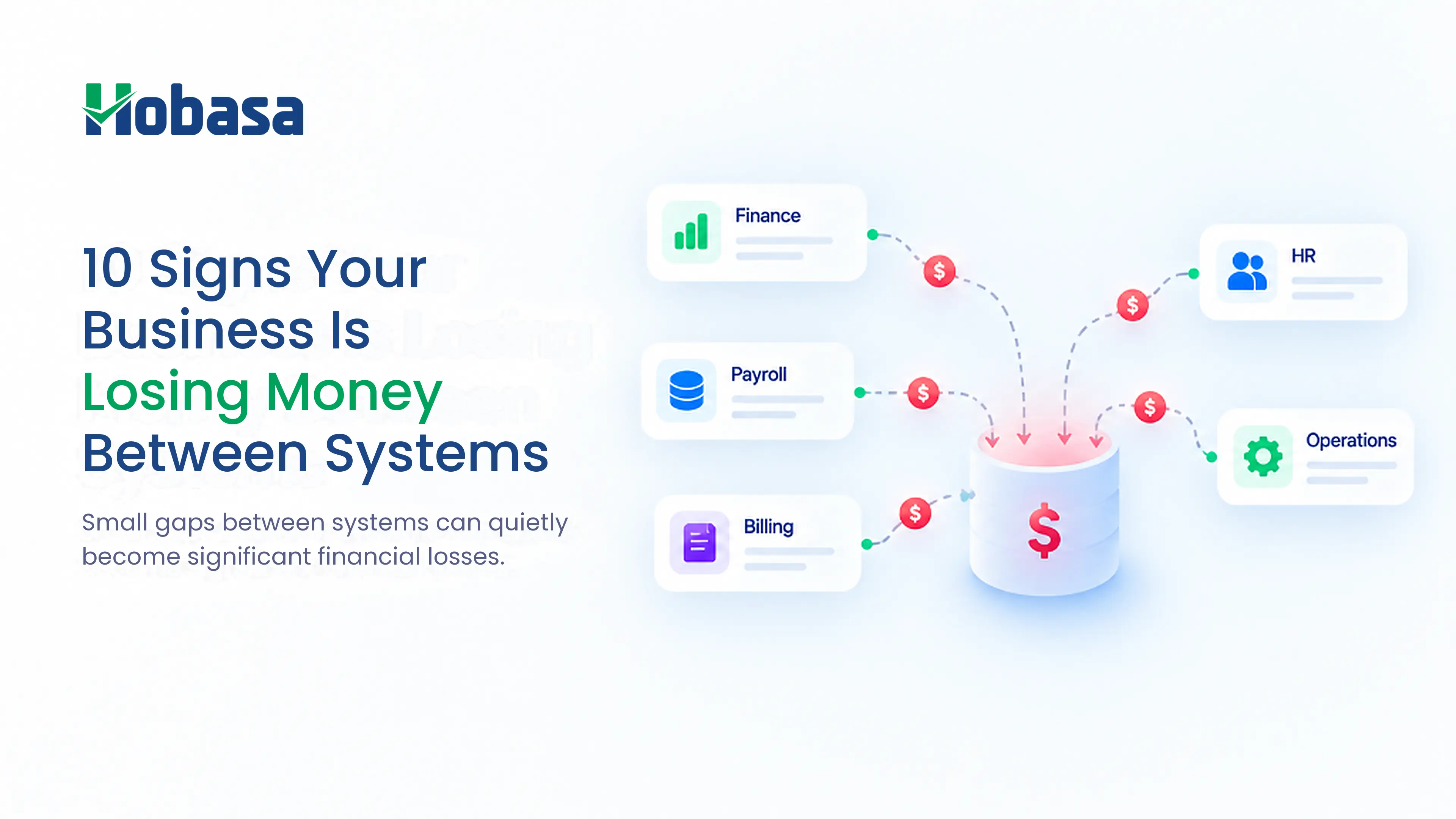
- Finance and HR data usually lives in separate systems (accounting, ERP, billing, banking, HRIS, payroll, recruiting), which is why "data overload" is really a connection problem, not a volume problem.
- Hobasa adds an analytical layer across those systems rather than replacing them, reconciling information and surfacing anomalies, risks, and opportunities that no single system can see alone.
- Its conversational AI lets finance and HR users ask questions in plain language and get answers grounded in the underlying data, with findings traceable to source records.
- Investigation is iterative: one answer can lead to a follow-up question, letting a user go from an initial anomaly to the context behind it without manually stitching systems together.
- Below: how Hobasa's agentic AI and conversational AI work, how cross-system analysis surfaces relationships a single system would miss, and how continuous monitoring supports proactive financial and workforce planning.
The challenge is not simply having too much data. It is being able to connect that data, investigate what it means, and identify what deserves attention without spending hours pulling information from different systems.
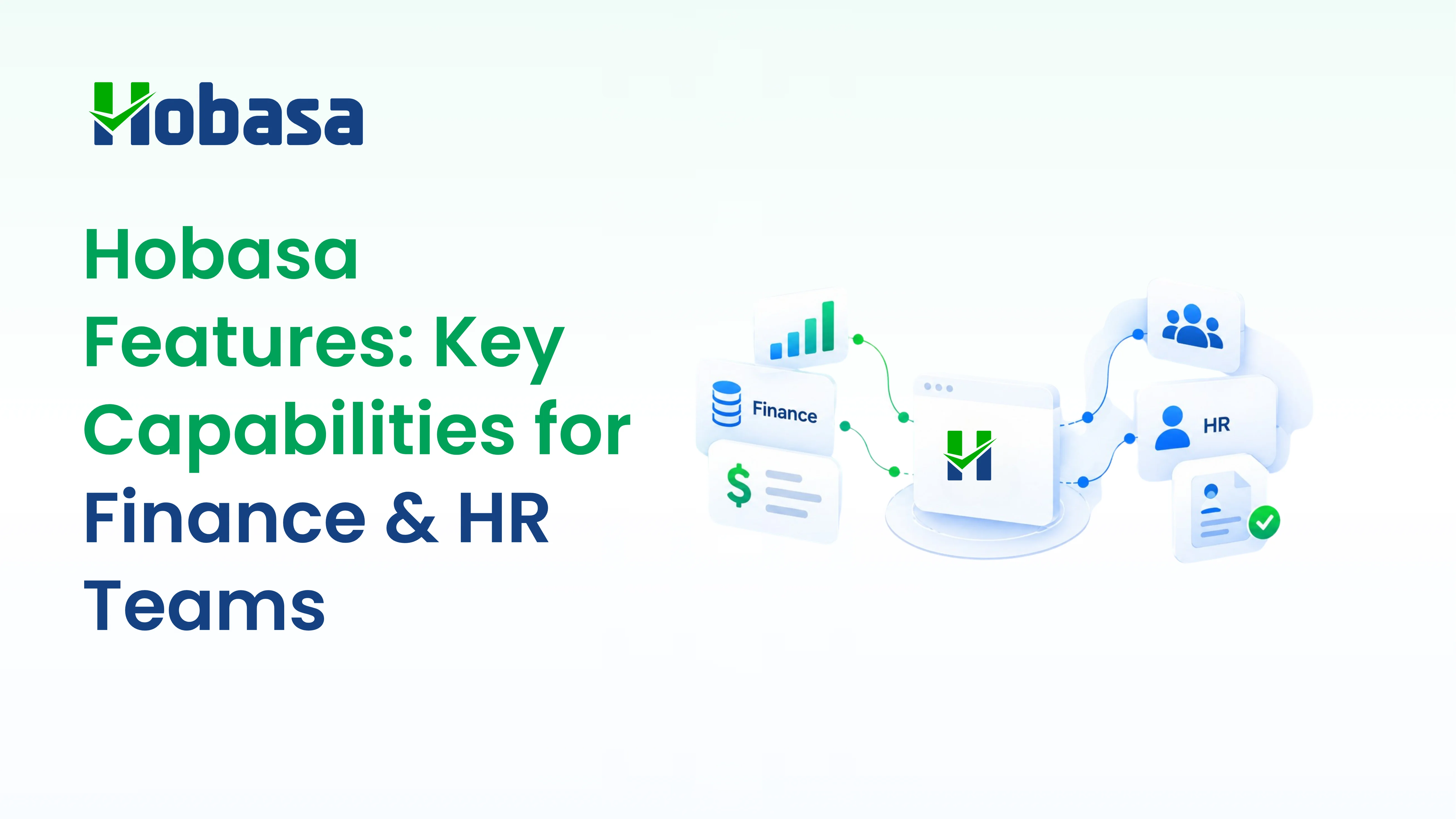
Hobasa is built as a cross-system intelligence platform for Finance and HR. It connects information across business systems, uses AI to analyze relationships and surface meaningful signals, and provides contextual insights that teams can investigate and act on. Rather than replacing the systems teams already use, Hobasa adds an analytical layer across them.
From data overload to data relief: How Hobasa agentic AI empowers finance and HR teams
For Finance and HR teams, data overload often comes from having multiple sources of information rather than a single source of truth.
A finance team may need to look across the general ledger, accounts payable, accounts receivable, revenue, payroll, and operational data to understand a change in financial performance. HR teams may need to connect employee records, compensation, attendance, performance, retention, and recruiting data to understand workforce trends.
Hobasa brings these connected sources into one analytical view. Its platform is designed to reconcile information across systems, identify relationships between datasets, and surface anomalies, risks, and opportunities that may not be visible within an individual system.
This can reduce the manual effort involved in gathering information before analysis can even begin.
Instead of starting with several reports and manually comparing them, teams can start with the business question they need to answer and use Hobasa to investigate the relevant information.
For example, Finance could investigate a margin decline by looking beyond the income statement and examining related revenue, cost, payroll, and operational signals. HR could investigate a retention issue by looking at workforce patterns alongside factors such as workload, hours, tenure, or other relevant data.
The objective is simple: less time assembling information and more time understanding it.
See the connected view for yourself. Explore the Hobasa platform to see how finance, HR, payroll, and operations data come together in one analytical layer.
Ask questions, gain insights: How Hobasa conversational AI empowers finance and HR teams
One of Hobasa's key capabilities is its conversational AI layer.
Instead of navigating through multiple dashboards or learning where a particular metric is stored, users can ask questions about connected business data in plain language.
For example, a finance user could ask:
- Why did operating expenses increase this month?
- What is driving the change in gross margin?
- Which customers are contributing most to the increase in receivables?
- Are there unusual transactions I should review?
An HR user could ask:
- What is driving the change in employee turnover?
- Which teams show the strongest retention risk?
- Are there unusual payroll patterns that need investigation?
- How have workforce costs changed relative to business performance?
Hobasa's conversational AI layer works across connected Finance, HR, payroll, and operational data, allowing users to investigate questions without treating each system as a separate analytical environment. Its responses are designed to remain grounded in the underlying business data, with findings traceable to their source records.
This changes the interaction from finding a report to finding an answer.
Deep-dive into your data without the complexity
Getting an answer is often only the beginning of an analysis.
A Finance team may notice that vendor spending increased. The next question is what caused the increase. Was it a legitimate change in purchasing volume? A price increase? A new supplier? A duplicate transaction?
Hobasa allows teams to move from an initial observation into deeper investigation.
Its cross-system analysis can connect information from accounting, payroll, HR, and operational systems to help explain relationships between different business events.
The value is not simply that Hobasa can surface an anomaly. It helps users move from the anomaly to the context behind it.
Read more: The cost of delayed data in a world that's constantly changing
Talk to the Hobasa team about a real question your finance or HR data can't currently answer on its own. Book a walkthrough and see the investigation happen live.
Want these capabilities on your Finance and HR data?
Hobasa turns cross-system signals into decisions your team can explain and defend.
Talk to our teamInteract with Hobasa AI in simple language
Complex business questions do not always need complex queries.
Hobasa's conversational interface allows Finance and HR users to interact with connected data using straightforward language. Users can ask follow-up questions, investigate a finding, request explanations, and explore specific areas of the business without having to formulate technical queries.
This is particularly useful when the question changes during an investigation.
A Finance user might start with: "Why did cash conversion decline?"
Then continue with: "Which part of accounts receivable changed?"
And: "Which customers account for most of the increase?"
An HR user could start with: "Where is employee turnover increasing?"
The interaction becomes iterative. Each answer can lead to another question, allowing users to dive deep into the issue until they have enough context to determine what requires attention.
Hobasa also supports source-grounded answers, with findings linked back to the underlying records rather than presenting unsupported AI-generated conclusions.
Ask your data the questions leadership actually asks.
See Hobasa AI work across Finance and HR systems, grounded in your own records.
Get in touchExplore complex data with little or no effort
The complexity of business analysis often comes from connecting information rather than from the individual datasets themselves.
A finance team may already know how to analyze a P&L. An HR team may already know how to review workforce metrics. The harder questions often sit between those datasets.
For example:
1. Is rising labor cost being driven by headcount, overtime, or changes in workforce composition?
2. Is a decline in profitability concentrated in specific customers, products, or locations?
3. Is an increase in payroll expense accompanied by changes in revenue or operational activity?
4. Are workforce changes affecting financial performance?
Hobasa is designed to analyze these relationships across connected systems. It studies data closely and surfaces discrepancies between systems rather than simply choosing one figure and ignoring the other.
This means finance and HR teams can investigate business questions that span multiple functions without manually stitching together every dataset first.
The result is a more practical analytical experience: ask the question, explore the relevant relationships, and focus on the finding rather than the mechanics of assembling the data.
Continuous insights for proactive financial and workforce planning
Business conditions do not wait for the next reporting cycle.
Revenue changes, costs fluctuate, employees join or leave, workforce patterns shift, and operational issues develop continuously. A dashboard reviewed once a month may show what happened, but it can miss the early signals that appear between reviews.
Hobasa continuously evaluates fragmented business data and identifies changes, anomalies, and emerging patterns in real time. Its platform includes real-time anomaly detection, continuous monitoring, predictive analytics, and alerts designed to surface issues as they develop.
For finance, this can support prompt visibility into areas such as:
1. Revenue leakage
2. Cash conversion
3. Expense changes
4. Margin pressure
5. Unusual transactions
6. Accounts receivable and payable patterns
7. Emerging financial risks
For HR, continuous intelligence can support areas such as:
1. Workforce health
2. Payroll anomalies
3. Burnout risk
4. Attrition
5. Hiring and retention patterns
6. Workforce compliance risks
7. Changes in productivity or workforce costs
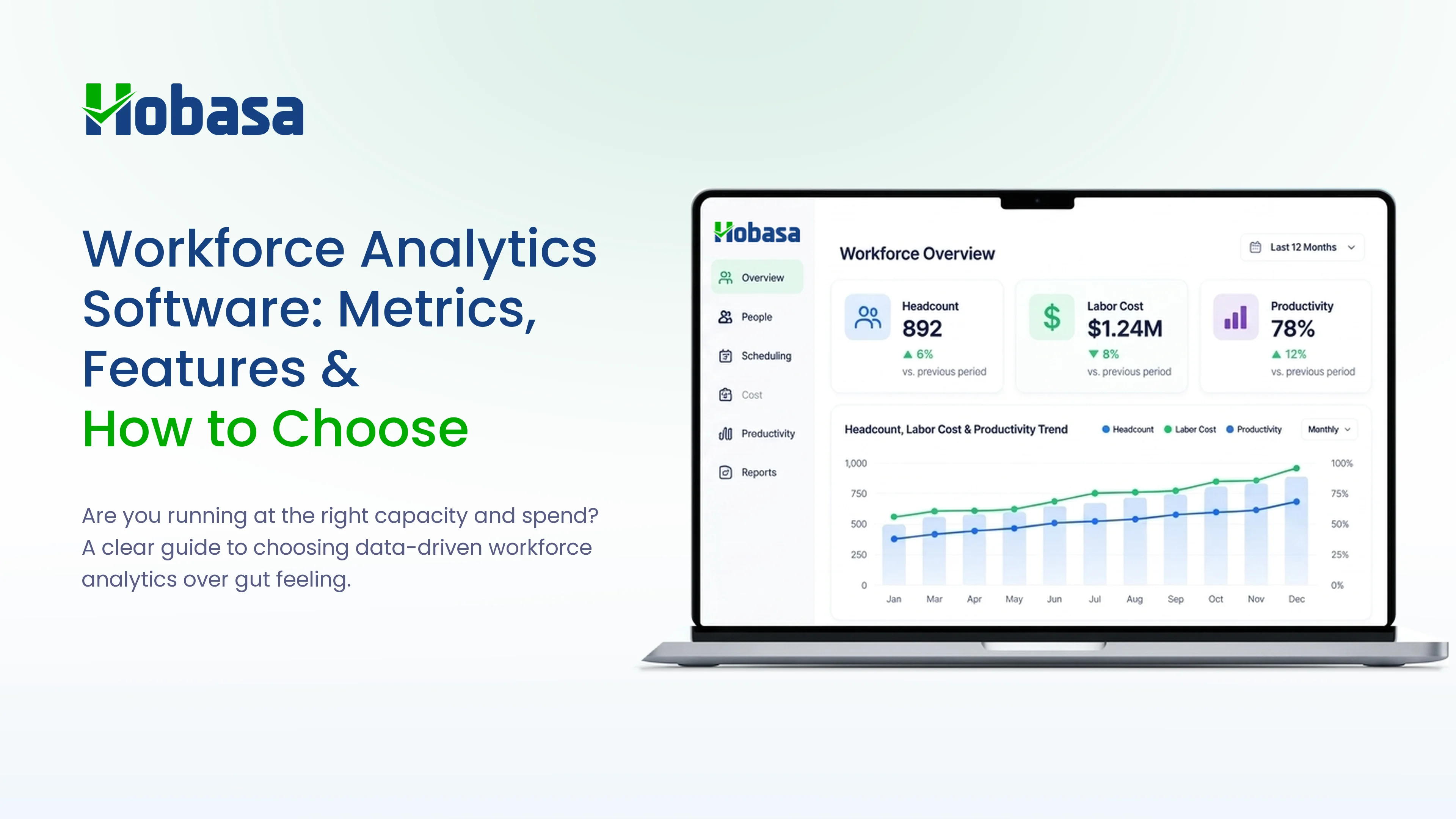
Hobasa's current platform includes the most relevant finance and HR KPIs that really matter. These KPIs are paired with AI summaries, observations, risks, and recommended next actions rather than being presented as standalone numbers.
This gives finance and HR teams a way to move from reporting performance to monitoring the signals that may shape future performance.
Read more: Detecting and preventing financial leakage: how to plug the gaps
Turn finance and HR data into connected intelligence.
Talk to the Hobasa team about a real business question your finance or HR data cannot currently answer on its own.
FAQs
Hobasa connects finance, HR, payroll, and operational systems into one analytical layer, then uses conversational AI, cross-system anomaly detection, and continuous monitoring to surface risks and opportunities that a single system cannot see on its own.
No. Hobasa is designed to add an analytical layer across the systems a team already uses, rather than replacing accounting, ERP, HRIS, or payroll platforms.
Users ask questions about connected business data in plain language, such as "why did operating expenses increase this month?" Hobasa's conversational AI responds using the underlying connected data, with findings traceable back to their source records rather than presented as unsupported conclusions.
Yes. The interaction is designed to be iterative: a user can start with a broad question and continue with follow-up questions to narrow in on the specific systems, customers, or teams behind a change.
Areas like revenue leakage, cash conversion, expense changes, and margin pressure on the finance side, and workforce health, payroll anomalies, burnout risk, and attrition on the HR side, are monitored continuously rather than only reviewed at the next scheduled report.
Hobasa's conversational AI and analysis are designed to stay grounded in the underlying business data, with findings traceable to their source records, rather than presenting unsupported AI-generated conclusions.