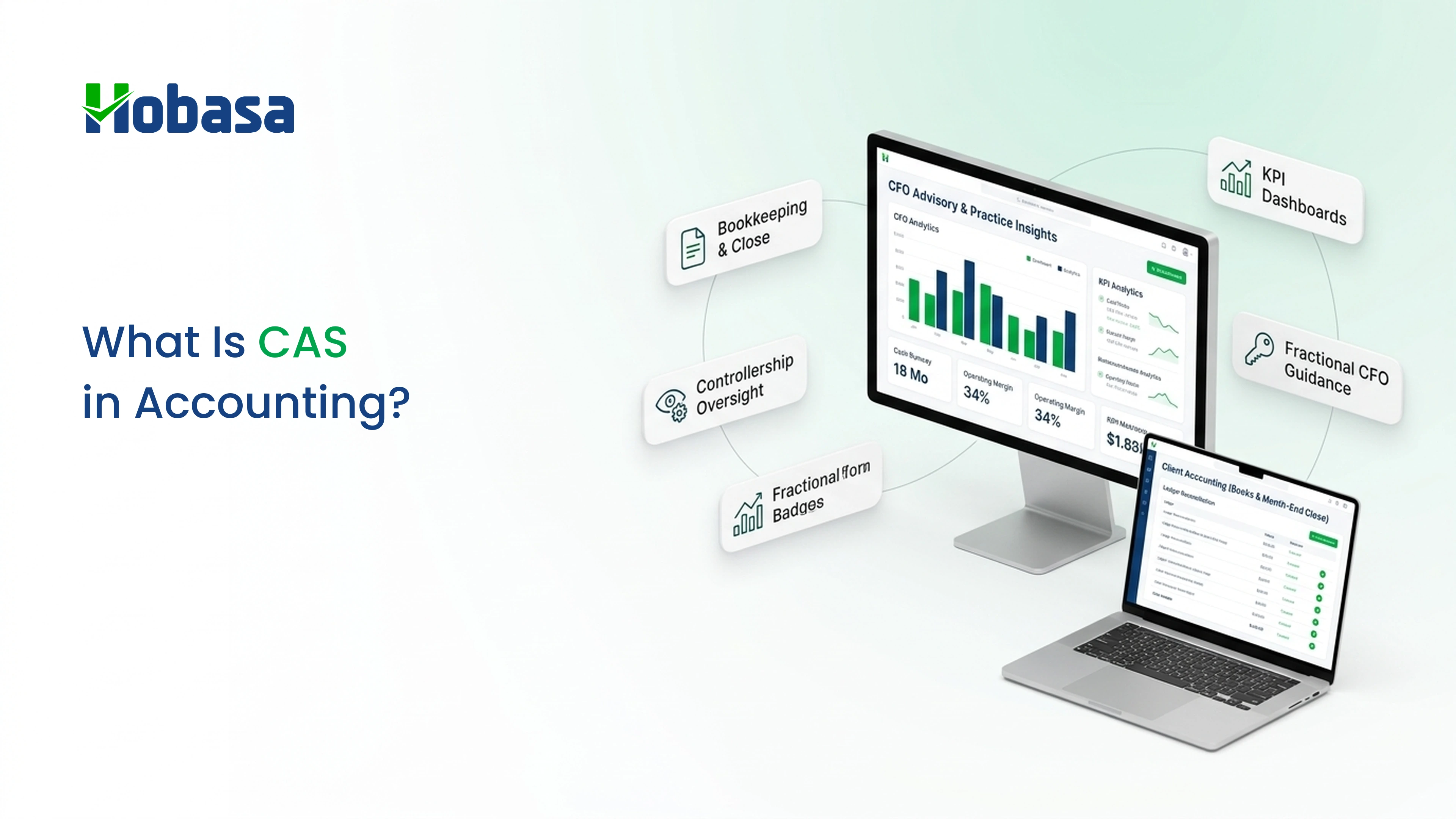
- CAS stands for client advisory services in the AICPA and CPA.com's formal usage. Many firms use it for client accounting services, and CAAS (client accounting and advisory services) spells out both halves.
- CAS is a continuing relationship, not a project: transactional accounting, controllership, analysis, and CFO-level advice on a monthly or quarterly rhythm.
- It is growing fast. The 2024 CPA.com and AICPA benchmark survey reported 17% median CAS growth and median CAS revenue up 61% since the 2022 survey.
- CAS is not bookkeeping, and it is not cost accounting standards, which is an unrelated set of rules for government contractors.
- The definition is the easy part. The hard part is the data: good advice depends on consistent records across each client's systems.
If you searched "what is CAS in accounting," you probably found three different answers. That is not your imagination. The same three letters stand for client advisory services, client accounting services, and, in a separate corner of accounting, cost accounting standards.
CAS in accounting usually means client advisory services, the formal term used by the AICPA and CPA.com, or client accounting services, the label many CPA firms use for the same ongoing work. Either way, it describes recurring accounting and advisory support that a firm delivers to a client every month, not a one-time tax or audit engagement.
This guide sorts out the names, explains what CAS includes, compares it with bookkeeping and traditional accounting, and covers what a CAS practice needs to run well.
What Does CAS Stand for in Accounting?
CAS stands for client advisory services in the AICPA and CPA.com's formal usage, and for client accounting services in the way many firms and software vendors use it.
Several sources note that there is no industry-wide agreement. That is why you see a third term, CAAS, which spells out both halves.
| Term | Who uses it | What it usually means |
|---|---|---|
| Client advisory services | AICPA and CPA.com (formal designation) | Ongoing financial and business guidance built on the firm's accounting work |
| Client accounting services | Many CPA firms and software vendors | Outsourced accounting such as bookkeeping, close, and reporting, often with advice on top |
| CAAS (client accounting and advisory services) | Firms that want both halves explicit | The full package: accounting plus advisory |
In practice the terms overlap. Two firms can use the same word for different service menus.
When you compare providers or read research, check which definition is being used. A survey of "client advisory services" and a brochure for "client accounting services" may not be describing the same thing.
Not to be confused with Cost Accounting Standards
Cost Accounting Standards, also abbreviated CAS, are a separate set of federal rules that apply to certain government contractors. They have nothing to do with a CPA firm's client services. If you see CAS next to defense contracting or federal procurement, this is the meaning.
What Does CAS Include?
There is no single CAS menu. Most firms build it as a ladder, starting with the accounting and adding layers of advice.
| Layer | What it covers | What the client gets |
|---|---|---|
| Transactional accounting | Bookkeeping, reconciliations, payables and receivables, payroll processing, month-end close | Accurate books |
| Controllership | Review of the close, accounting policies, internal controls, financial statements | Reliable statements and a controller's oversight |
| Analysis and reporting | KPI dashboards, management reports, variance review, benchmarking | A clear picture of performance |
| CFO-level advisory | Cash planning, budgeting, pricing and margin guidance, support for lenders and boards | Decisions backed by the numbers |
Not every firm offers every layer. Many start at the bottom and build upward as clients ask for more.
Some firms describe the top two layers as virtual controller and fractional CFO services.
What a Month of CAS Looks Like
A typical monthly cycle looks like this. The exact steps vary by firm and by tier.
Close the books. Transactions are recorded and reconciled, and the month is closed.
Review. A controller or senior accountant checks the numbers and asks about anything unusual.
Report. The client receives a package: financial statements, key metrics, and a short commentary.
Advise. A call walks through what changed, why, and what to consider next.
Follow up. Open items carry into next month's review.
The advice in step 4 is only as good as the checking in step 2.
CAS vs CAAS: Is There a Real Difference?
It depends on who you ask. There are three common views.
The formal view. The AICPA and CPA.com use "client advisory services," so CAS already means the advisory work.
The split view. Some firms use CAS for the accounting layer (bookkeeping, close, reporting) and CAAS for accounting plus advisory.
The interchangeable view. Many practitioners treat the two as the same thing, and say CAAS simply spells out the advisory part.
Where firms do separate the terms, the difference looks like this.
| CAS (accounting-focused) | CAAS (accounting plus advisory) | |
|---|---|---|
| Scope | Transactional and compliance work | Adds forecasting, planning, and strategic guidance |
| Typical question | Are the books right? | What should we do next? |
| Delivery | Standardized, repeatable | Tailored to the client's decisions |
The practical advice is simple. Pick the term your clients recognize, then define what is included in your proposal. A label is only useful if the scope behind it is written down.
CAS vs Bookkeeping and Traditional Accounting
CAS accounting builds on bookkeeping and tax work. It does not replace them.
| Bookkeeping | Traditional accounting (tax, audit, compliance) | CAS | |
|---|---|---|---|
| Timing | Recording transactions as they occur | Periodic, often annual or quarterly | Ongoing, usually monthly |
| Main output | Accurate records | Tax returns, audited or reviewed statements | Reports plus advice |
| Orientation | Looks at what happened | Mostly backward-looking | Looks at what happened and what to do next |
| Relationship | Task-based | Engagement-based | A continuing partnership |
The key difference is timing and purpose. Bookkeeping records. Compliance work reports once a period. CAS reviews every month and explains what the numbers mean.
Why CPA Firms Offer CAS
The opportunity is well documented. The CPA.com and AICPA PCPS 2024 CAS Benchmark Survey covered 206 firms, using 2023 data.
Median CAS revenue growth was 17%.
Median CAS revenue was up 61% since the 2022 survey.
Firms expected CAS revenue to nearly double over three years.
Firms with significant revenue from CFO-level or business insights services earned more than 30% higher monthly recurring revenue.
The survey also named the main obstacles: staffing first, then clients' understanding of what CAS is worth.
In April 2025, the AICPA's Accounting and Review Services Committee clarified how the financial statement preparation standard applies within CAS engagements. CPA.com said that modern CAS, including dashboards and business insights, falls under consulting and advisory services.
These figures come from the 2024 survey. CPA.com has said a 2026 edition is due in December 2026.
Who Uses CAS?
CAS accounting fits owners who have outgrown a bookkeeper and want finance-level guidance without hiring a full-time CFO.
Common signs a business may need it:
- Reports arrive late or cannot be explained.
- Leadership cannot say why margin or cash moved.
- Finance, payroll, and operations each keep their own numbers.
- Hiring, pricing, or borrowing decisions are made without clean data behind them.
For the firm, CAS turns seasonal work into recurring work, and puts the firm closer to the client's decisions.
What a CAS Practice Runs On
A CAS practice usually layers its tools like this.
| Layer | What it does |
|---|---|
| Cloud accounting platform | Holds each client's books |
| Reporting and insights | Turns books into KPI packs and dashboards |
| Forecasting and planning | Models the future where clients need it |
| Practice management | Runs the recurring monthly workflow |
| Proposals and billing | Scopes and bills recurring work |
| Data preparation and review | Checks data across client systems before advice |
Tools exist for every layer, and we compare them in our guide to CAS software. Books alone are rarely enough, which is why QuickBooks reports leave gaps.
The Hidden Constraint: Client Data
The last layer is the one most CAS guides skip. Advice is only as good as the data behind it, and across a book of clients that data lives in many systems.
A client's ledger, payroll provider, and operational tools each tell part of the story. Reporting tools usually read only one of them.
Illustrative example. A CAS team prepares a monthly KPI pack for a client. The pack looks healthy. Behind it, one payroll run was never posted, so labor cost in the ledger is understated and margin looks better than it is. The reporting tool shows the number accurately. It cannot know the payroll record disagrees.
The example is fictional.
Catching this takes a comparison across systems, before the advice goes out. Our guides to financial data integration and payroll data errors explain why connected systems still drift and which checks find it.
Where Hobasa Fits in a CAS Practice
Hobasa is not CAS software, accounting software, or a practice management tool. It does not plan, budget, or forecast.
It reads across a client's accounting, payroll, and operational systems and surfaces where they disagree. It is built for firms that serve many clients.
On its CPA page, Hobasa describes these capabilities:
Multi-client dashboard with individual client views. One connected view across the book, with drill-down into any client.
Exception-based review. Time goes to the items flagged as worth a look, not a line-by-line scan.
Anomaly detection across accounting, payroll, and operations. Unusual transactions and misclassifications surface before review.
Advisory opportunity identification. Moments where a client may need cash, margin, hiring, or planning guidance, with the data behind them.
Compliance gap detection with alerts. Continuous monitoring instead of period-end surprises.
Every finding cites the exact record it came from, and an analyst reviews it before it reaches you. Hobasa is a managed layer with real people supporting your firm, and it sits on top of your existing tools. Access is read-only by default.
It connects to systems including QuickBooks Online, NetSuite, Sage Intacct, Zoho Books, ADP Workforce Now, Workday, and Rippling. See the full list under integrations. If a client's system is not listed, the team can confirm how quickly it can be connected.
Learn more about Hobasa for CPA firms and advisory firms.
See the layer between your clients' systems and your advice
Explore the platform to see how records from separate systems are compared, with the source behind every finding.
Explore the platformHow a Firm Can Start Building CAS
You do not need every layer on day one. A sensible order:
1. Define the services. Write down what each tier includes and what it does not.
2. Standardize deliverables. Clients should receive the same monthly package every time.
3. Set the data foundation. Put clients on a cloud accounting platform and agree on how records are kept.
4. Price it as recurring. Move from per-task fees to a monthly engagement.
5. Add tools as volume grows. Reporting first, then planning, workflow, and billing.
6. Check the data before you advise. A review step prevents confident advice built on a bad number.
Read also: How AI Is Reshaping Finance and Accounting Operations
Read also: AI in Accounting: Why Source-Grounded Beats Black Box for CPA Firms
Conclusion
CAS in accounting is best understood as a relationship, not a service line: accurate books, a monthly review, and advice built on both. The names vary, and the scope matters more than the label.
The firms that do it well treat data quality as part of the service. Advice is only as good as the records behind it.
For more guides for firms like yours, browse our CPA firm guides.
Talk to the Hobasa team about the client data you reconcile by hand
Tell us which systems your clients run.
FAQs
CAS stands for client advisory services in the AICPA and CPA.com's formal usage. Many firms and vendors use it for client accounting services, and CAAS (client accounting and advisory services) combines both. Check which definition a source is using before comparing.
Some firms use CAS for the accounting layer and CAAS for accounting plus advisory. Others treat the terms as interchangeable, and the AICPA's formal term already means advisory work. Define the scope in writing, whichever label you use.
No. Bookkeeping records transactions. CAS includes bookkeeping and adds close, review, reporting, and advice on a continuing basis. It is built on bookkeeping, not a replacement for it.
Most firms organize CAS in layers: transactional accounting, controllership, analysis and reporting, and CFO-level advisory. Not every firm offers every layer, and many start with the accounting and add advice over time.
Traditional accounting such as tax and audit work is periodic and mostly backward-looking. CAS is ongoing, usually monthly, and pairs reporting with advice on what to do next. It complements tax and audit work rather than replacing it.
The 2024 CPA.com and AICPA benchmark survey found 17% median CAS growth and median CAS revenue up 61% since 2022. Firms also see recurring revenue and closer client relationships. Staffing is the main obstacle they report.
Typically a cloud accounting platform, a reporting tool, a forecasting tool where needed, practice management, and a proposal and billing tool. A data review layer helps when clients run several systems.
No. Cost Accounting Standards are a separate set of federal rules that apply to certain government contractors. They are unrelated to a CPA firm's client advisory or client accounting services.