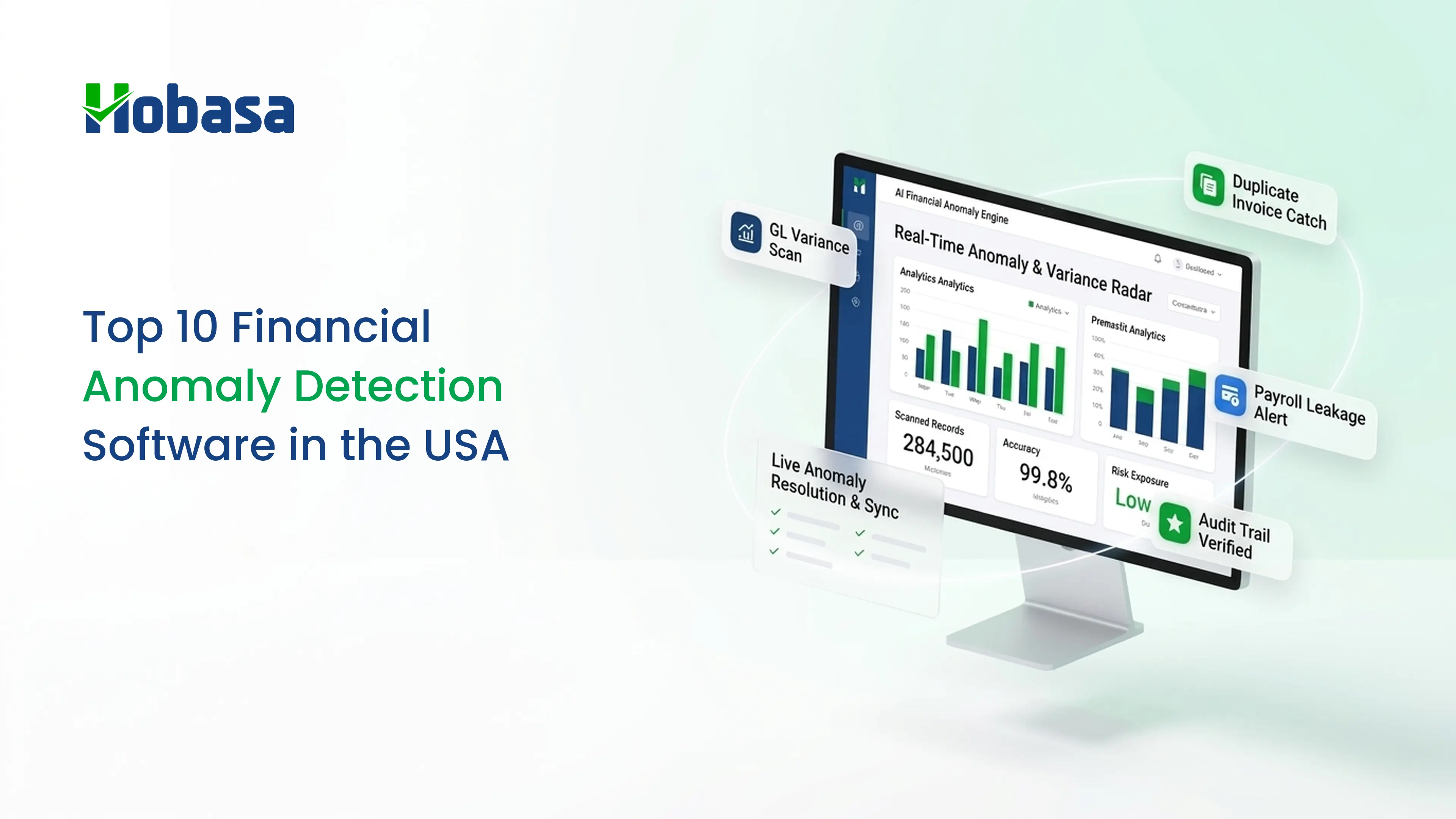
- Financial anomaly detection software falls into three working categories: ledger and journal entry analytics, spend and accounts payable monitoring, and FP&A variance detection. Bank fraud and anti-money laundering tools are a different market.
- The ACFE's 2024 study found a typical organization loses about 5% of revenue to fraud, and the median scheme ran 12 months before detection. Organizations with proactive data monitoring had a median loss of $100,000, versus $200,000 without it.
- US auditing standards (PCAOB AS 2401 and AICPA AU-C 240) call for journal entry testing, which is why full-population ledger tools are common.
- Every tool watches its own data. None of the ten compares payroll, HR, and ledger records across systems.
- Below: the quick answer, the three categories, ten tool profiles with what each can't see, how to choose, and where a cross-system layer fits.
What Is the Best Financial Anomaly Detection Software?
There is no single best financial anomaly detection software. The right choice depends on what you need to watch.
Ledger and journal entries (audit and controllership teams): MindBridge or CaseWare IDEA.
The close process: BlackLine or HighRadius.
Expenses and accounts payable at enterprise scale: AppZen or Oversight.
US mid-market spend control: Ramp.
High invoice volume: Vic.ai.
Plan-versus-actual review: Planful or Datarails.
Problems that appear when payroll, HR, and the ledger disagree: a cross-system layer such as Hobasa, which sits beside these tools.
What is Financial Anomaly Detection?
Financial anomaly detection is the use of rules, statistics, and machine learning to find transactions, entries, or patterns in financial data that deviate from what is expected.
An anomaly is not automatically a mistake or fraud. It is something unusual that deserves a look. Most turn out to be timing differences, one-off events, or data entry slips. A few are errors or fraud.
Three techniques do the work, and good tools combine them:
Rules. Flag known patterns, such as a payment above an approval limit or a vendor with the same bank account as an employee.
Statistics. Flag values far outside the normal range for an account, user, or period.
Machine learning. Learn what normal looks like and score departures from it. Because labeled fraud examples are scarce in finance, many tools use unsupervised or ensemble models, with rules layered on top.
Anomaly detection in accounting applies these techniques to ledgers, sub-ledgers, payments, and plan data. Accounting anomaly detection software packages them for audit, finance operations, and FP&A teams.
Anomalies come in different shapes, and a simple threshold misses some of them.
| Anomaly type | Example | Why simple rules miss it |
|---|---|---|
| Single unusual entry | One large manual journal entry on the last day of the quarter | Caught by a threshold, but only if the threshold is set well |
| Contextual | A normal amount posted by an unusual user, or at an unusual time | The amount looks fine on its own |
| Pattern | Many small payments split to stay under an approval limit | Each payment is below every threshold |
| Missing | A recurring entry that never posted | Nothing unusual exists to flag |
Why It Matters for US Finance Teams
The data on fraud is blunt. The ACFE's Occupational Fraud 2024: A Report to the Nations analyzed 1,921 cases across 138 countries. It is a global study, not US-only, but it is the standard reference US finance and audit teams use.
A typical organization loses about 5% of revenue each year to fraud.
The median loss per case was $145,000, and the median scheme took 12 months to detect.
Tips detected 43% of cases. Automated transaction and data monitoring detected 3%.
Organizations with proactive data monitoring and analysis had a median loss of $100,000, compared with $200,000 for those without it. About 45% of organizations had it in place.
Read that last pair carefully. Monitoring rarely catches the fraud itself, but where it exists, losses are lower.
US auditing standards add a second reason. PCAOB AS 2401 (public company audits) and AICPA AU-C 240 (other audits) call for journal entry testing as a response to the risk of management override of controls. That is why full-population ledger analysis, rather than sampling, has become a standard part of the audit toolkit.
Not every anomaly is fraud. Most are errors, and errors are expensive too. For the wider pattern, see financial leakage.
The Three Types of Financial Anomaly Detection Software
Before comparing features, decide which job you are hiring a tool to do.
| Type | What it watches | Typical buyer | Example tools |
|---|---|---|---|
| Ledger and journal entry analytics | Every general ledger entry, scored for risk | Audit, controllership, internal audit | MindBridge, CaseWare IDEA, BlackLine, HighRadius |
| Spend and accounts payable monitoring | Expenses, cards, invoices, and payments before they are paid | AP, procurement, finance operations | AppZen, Oversight, Ramp, Vic.ai |
| FP&A variance detection | Plan-versus-actual and trend data | FP&A and finance leaders | Planful, Datarails |
Duplicate invoice detection and duplicate payment detection are typical jobs for the spend category.
A fourth market we left out
Bank fraud and anti-money laundering platforms, such as FICO Falcon, SAS, NICE Actimize, NetGuardians, and ThetaRay, monitor customer transactions at financial institutions. They solve a different problem, so they are not in this list.
Security and framework tools like Vanta and Drata are also separate. For those, see our guide to compliance monitoring tools.
Financial Anomaly Detection Software: The 10 at a Glance
The tools are grouped by category, not ranked.
| # | Tool | Category | Best for | Core strength |
|---|---|---|---|---|
| 1 | MindBridge | Ledger | Audit and controllership teams | Full-population risk scoring of ledger entries |
| 2 | CaseWare IDEA | Ledger | Audit firms and internal audit | Flexible audit data analytics |
| 3 | BlackLine | Ledger and close | Enterprise close teams | Anomaly checks inside reconciliation and journals |
| 4 | HighRadius | Ledger and close | Large record-to-report teams | Anomaly detection tied to financial impact |
| 5 | AppZen | Spend and AP | Enterprise expense and invoice audit | Pre-payment audit of every report and invoice |
| 6 | Oversight | Spend and AP | Large enterprises | Cross-channel spend exceptions |
| 7 | Ramp | Spend | US mid-market spend control | Controls at the point of spend |
| 8 | Vic.ai | AP | High invoice volume | Autonomous invoice processing with anomaly checks |
| 9 | Planful | FP&A | Mid-market FP&A teams | Variance and exception flags in plan-versus-actual |
| 10 | Datarails | FP&A | Excel-first finance teams | Exception-first review in Excel |
Not Sure Which Anomaly Detection Tool Fits Your Finance Team?
The right tool depends on your systems, data quality, and the types of financial risks you need to catch. Before comparing options, understand what your team actually needs.
Find the Right Approach1. MindBridge
Best for: audit, controllership, and internal audit teams that want every ledger entry risk-scored.
MindBridge analyzes full populations of general ledger transactions instead of samples. It combines machine learning, statistical methods, and business rules, and explains the risk indicators behind each score. It also supports journal entry testing aligned with audit standards.
Strengths
- Full-population coverage instead of sampling.
- Explainable risk scores that support documentation.
- Built around audit and assurance workflows.
Consider
- Enterprise-oriented and quote-based.
- Returns shrink when transaction complexity is low.
What it won't see: records outside the ledger. If an error starts in payroll or HR, it may arrive in the ledger already booked and look normal.
Ask in the demo: show how a high-risk entry moves from flag to resolution, and who reviews it.
2. CaseWare IDEA
Best for: audit firms and internal audit teams that run journal testing and forensic analysis.
CaseWare IDEA is audit data analytics software. It imports ledgers, spreadsheets, and database extracts, then runs journal entry tests, sampling, and fraud tests. It is available on desktop and in the cloud.
Strengths
- Depth and flexibility for auditors.
- Works with Excel, CSV, and database imports.
Consider
- One 2026 comparison describes its AI capabilities as still developing rather than mature.
- More analyst-driven than automated, and it needs training.
What it won't see: live activity between runs. It analyzes the data you load.
Ask in the demo: how much of this runs on a schedule, versus an analyst running tests per engagement?
3. BlackLine
Best for: enterprise close teams that want anomaly checks inside reconciliation and journals.
BlackLine is a financial close platform covering reconciliation, matching, and journal entry automation. Third-party sources describe an AI-driven journal risk analysis that flags unusual entries before they post.
Strengths
- Anomalies are caught inside the close workflow.
- Controls and audit trail in the same place.
- Enterprise scale.
Consider
- Enterprise scope and price. Anomaly detection is one capability of a larger suite.
- A competitor's comparison notes long implementations.
What it won't see: data that never enters the close process, such as HR and payroll records.
Ask in the demo: which anomaly checks run before posting, and which run after?
4. HighRadius
Best for: large finance teams running record-to-report that want ledger, receivables, and payables anomalies tied to dollar impact.
HighRadius offers automated anomaly detection that assesses severity and financial impact, with workflows to resolve what it finds. Comparisons describe deep SAP and Oracle support and NetSuite support.
Strengths
- Anomalies are prioritized by financial impact.
- Resolution workflow, not just alerts.
- ERP depth.
Consider
- Enterprise implementation effort.
- Best value inside its broader record-to-report suite.
What it won't see: systems outside the finance stack it integrates with, such as HR and payroll.
Ask in the demo: how are anomalies ranked by dollar impact, and who closes them?
5. AppZen
Best for: enterprises that want every expense report and invoice audited before payment.
AppZen audits expense reports, card transactions, and invoices before they are paid. It looks for duplicates across expense reports, cards, and invoices, policy violations, and fraud indicators such as manipulated receipts. In April 2026 it launched an AI-agent-based accounts payable inbox.
Strengths
- Pre-payment audit, so problems are caught before money leaves.
- Duplicate detection across channels.
- Policy-level explanations for flagged items.
Consider
- Enterprise-oriented, with a vendor-led, multi-week rollout.
- Focused on spend and AP.
What it won't see: payroll, headcount, and ledger patterns outside spend.
Ask in the demo: show duplicate detection across an expense report and an invoice.
6. Oversight
Best for: large enterprises that want exceptions correlated across travel, card, expense, and AP.
Oversight is built around cross-channel monitoring. It correlates spend signals across channels into prioritized exceptions for analyst review.
Strengths
- Correlation across spend channels.
- Prioritized exceptions with an analyst workflow.
Consider
- Enterprise scale and setup.
- Strongest where spend data is already structured.
What it won't see: payroll and HR data.
Ask in the demo: how do you prioritize exceptions, and how is false-positive feedback handled?
7. Ramp
Best for: US mid-market finance teams that want policy enforcement and duplicate checks inside cards, bills, and expenses.
Ramp is a spend management platform. Its published material describes AI agents that detect duplicate invoices and fraud attempts, assemble approval summaries, and match transactions during close.
Strengths
- Controls apply at the point of spend.
- One platform for cards, bills, and expenses.
- Reconciliation built into close.
Consider
- Anomaly checks apply to spend that runs through the platform.
- Capabilities above are vendor-described.
What it won't see: spend and records outside the platform, plus payroll and HR.
Ask in the demo: what share of our spend would actually flow through the platform?
8. Vic.ai
Best for: teams processing high invoice volumes who want autonomous processing with anomaly checks.
Vic.ai automates invoice processing, general ledger coding, purchase order matching, and anomaly detection.
Strengths
- Automation with exceptions routed for review.
- Suited to volume.
Consider
- One 2026 comparison says it is built for volume, with a thin case at low invoice counts.
What it won't see: anything that is not an invoice.
Ask in the demo: at what invoice volume does this pay off for a company our size?
9. Planful
Best for: mid-market FP&A teams that want anomalies flagged inside plan-versus-actual review.
Planful combines planning, close, and reporting. Its AI features, including Planful Predict, are described as covering anomaly detection and automated variance analysis with exception reporting.
Strengths
- Anomalies surface where finance already works.
- Variance analysis and exception reporting.
Consider
- It finds unusual numbers in plan and actual data, not transaction-level fraud.
- One comparison notes less depth for complex global consolidations.
What it won't see: the underlying transactions, and records in other systems.
Ask in the demo: does a flagged variance trace down to the transaction, or stop at the account?
10. Datarails
Best for: Excel-first finance teams that want exception-first review.
Datarails is an Excel-native FP&A platform. It relaunched as FinanceOS in March 2026, and its AI features include anomaly detection, automated variance analysis, and exception reporting.
Strengths
- Works where Excel-based teams already work.
- Exception-first review.
Consider
- Depends on consolidated financial data and spreadsheet discipline.
- It does not replace your accounting system or an audit tool.
What it won't see: transaction-level audit risk, and HR and payroll data.
Ask in the demo: which exceptions come from source transactions, and which from summary data?
Also Worth Knowing
Datricks (process mining for SAP environments), Supervizor (continuous audit analytics across ERPs), DataSnipper (audit evidence tie-out in Excel), Workday Adaptive Planning and Limelight (FP&A with anomaly features), and Numeric and FloQast (close workflows with variance commentary).
Features to Look For in Financial Anomaly Detection Software
Feature lists look alike. These criteria separate useful tools from noisy ones.
Coverage. Does it analyze full populations or samples?
Explainability. Every flag should say why it was raised.
False positive control. Ask how thresholds are tuned and how feedback improves the model.
Data requirements. Which ERP and accounting systems connect natively, and how clean must the data be?
Resolution workflow. An alert needs an owner, a status, and a record of the outcome.
Audit trail. You should be able to show what was flagged, when, and what happened.
Read-only access. Monitoring rarely needs write access.
Human review. For AI-assisted tools, who checks the output before it reaches a decision-maker?
Cross-system view. Can it compare records from more than one system? Most cannot.
Finding Anomalies Is Only Half the Job
Most tools focus on specific financial workflows. If you need to identify mismatches across finance, HR, and payroll systems, look beyond individual transactions to understand the complete picture.
Explore Cross-System Financial InsightsWhat Anomaly Detection Software Doesn't Check
Every tool above watches its own slice of the business. That is the right design. It also creates three blind spots.
1. Records in other systems. A ledger tool sees the ledger. A spend tool sees spend. Neither compares them with payroll or HR.
2. Missing items. Anomaly detection flags unusual entries that exist. A recurring entry that never posted creates nothing to flag.
3. Root cause. One 2026 comparison notes that audit and anomaly tools surface problems, not root causes. A flag tells you where to look. It rarely tells you why.
Illustrative example. A person is paid through accounts payable as a contractor. The HRIS and payroll show the same person as an employee. Each system is internally consistent, and no single tool sees anything unusual. The problem only exists in the comparison.
The example is fictional.
Finding it takes a comparison across accounts payable, payroll, and HR records. For the wider pattern, see disconnected finance systems, financial data integration, and payroll data errors.
Read also: 10 Signs Your Business Is Losing Money Between Systems in 2026.
Where Hobasa Fits
Hobasa is not on the list above, and it is not an audit tool, an AP automation platform, or a bank fraud system. It does not plan, budget, or forecast.
It is a cross-system intelligence layer. It reads across finance, HR, and payroll systems and surfaces where they disagree.
Cross-system reconciliation. Payroll versus accounting, HR versus finance, and operations versus the general ledger, surfaced automatically instead of at month-end.
Anomaly detection across financial and operational data. Unusual transactions and pattern breaks, flagged continuously. See the platform's anomaly detection.
HR and payroll signals. For example a Payroll Anomaly Score that flags unusual pay, hours, or classification patterns for review.
Both numbers kept. When two systems disagree, Hobasa keeps both and treats the disagreement as the finding.
Rules detect, AI explains, a person validates. Findings cite the exact source record, and a qualified reviewer checks each one before release.
Read-only by default. Access is scoped to what the checks need.
It works alongside the tools in this guide. A company might use MindBridge for audit-grade ledger analysis, a spend platform for payments, and Hobasa to check that payroll, HR, and the ledger agree with each other.
Hobasa connects to systems including QuickBooks Online, NetSuite, Sage Intacct, ADP Workforce Now, Workday, and Rippling. See integrations. If a system is not listed, the team can confirm how quickly it can be connected.
It is built for advisors and teams that run reviews across many systems, including fractional CFOs and CPA firms.
Check what your anomaly tools can't see
Explore the platform to see how finance, HR, and payroll records are compared, with the source behind every finding.
Explore the platformHow to Choose Financial Anomaly Detection Software
Start with what you need to watch and who will own the alerts.
| If your situation is... | Start your shortlist with |
|---|---|
| You run audits or internal audit and need full-population ledger testing | MindBridge, CaseWare IDEA |
| You want anomaly checks inside the close | BlackLine, HighRadius |
| Enterprise expense and AP leakage is the concern | AppZen, Oversight |
| You are a US mid-market team that wants spend controls | Ramp |
| Invoice volume is high | Vic.ai |
| Your finance team reviews plan-versus-actual in Excel or an FP&A tool | Planful, Datarails |
| Problems appear when payroll, HR, and the ledger disagree | A cross-system layer beside your other tools |
Questions to ask every vendor
1. What data do you analyze, and what is outside your view?
2. Which ERP and accounting systems do you connect to natively?
3. Do you analyze full populations or samples?
4. How do you explain each flag?
5. How do you reduce false positives, and how does feedback improve results?
6. What happens when an alert is raised: who owns it, and how is it closed?
7. Is access read-only?
8. What does implementation require from our team, and how clean must our data be?
A 30-day evaluation plan
Week 1: define the anomalies you most want to catch, and who will review them.
Week 2: shortlist two tools from different categories.
Week 3: run each on the same period of real data, including a known past error.
Week 4: compare flags, false positives, and time to resolve. Check references of similar size.
Common mistakes to avoid
Buying a tool to "find fraud" without deciding who reviews the flags.
- Feeding it messy data and expecting clean results.
- Ignoring false positives until the team stops reading alerts.
- Assuming one tool covers every system.
- Forgetting that missing records and cross-system mismatches do not look like anomalies.
For how AI fits this work responsibly, read our guide to AI in accounting.
Conclusion
The right financial anomaly detection software depends on what you need to watch: the ledger, spending, or the plan. Name the job first, then shortlist two tools in that category and ask each what it will not see.
Then look at the space between your systems. That is where many costly problems start, and where single-system tools have the least visibility.
For more guides like this one, browse our CFO guides.
Talk to the Hobasa team about the mismatches your tools can't see
Get in touch and bring one number your systems disagree on.
FAQs
Financial anomaly detection software uses rules, statistics, and machine learning to find transactions, entries, or patterns that deviate from what is expected. It gives finance, audit, and controller teams a short list to review instead of the whole ledger.
Tools combine rules for known patterns, statistical checks for values outside the normal range, and machine learning that learns what normal looks like. Because labeled fraud examples are scarce, many use unsupervised or ensemble models, with a person reviewing the flags.
An anomaly is anything unusual, and most are errors, timing differences, or one-off events. Fraud detection looks specifically for deliberate misconduct. Anomaly detection feeds fraud detection, but a flagged item is not proof of fraud.
Yes, in audits. PCAOB AS 2401 for public company audits and AICPA AU-C 240 for other audits call for journal entry testing to address the risk of management override of controls. Tools such as MindBridge analyze full ledgers to support this work.
Many specialist tools are enterprise-oriented and quote-based. Smaller teams often start with the controls built into their spend and accounts payable platform, or the anomaly features in their FP&A tool, and add a specialist tool as volume and risk grow.
No. It narrows where to look and explains why. Auditors still design procedures, exercise judgment, and form their own opinion, and most standards still require independent assessment.
Unusual does not mean wrong, and models do not know your business context. Reduce false positives by cleaning source data, tuning thresholds, feeding review outcomes back into the tool, and asking vendors how they explain and rank each flag.
Generally no. Each tool analyzes its own data, so a mismatch that only appears when two systems are compared often goes unseen. Catching it requires comparing records across systems.
No. Hobasa is not an audit, AP automation, or bank fraud tool. It reads across finance, HR, and payroll systems and flags where they disagree, working alongside the tools in this guide. Access is read-only by default.